Musée Romain de Lausanne – Vidy

Overall Impact:                **** 4 stars – small Museum but some stunning finds well set out

Access                                ***** 5 stars – easy access by all modes – it’s Switzerland after all!

Atmosphere                      **** 4 star – works admirably hard to relate finds to excavations

Other                                  *** 3 stars – great to find so much so well done for what is, when all said and done, a quite minor site!

IMG_4455
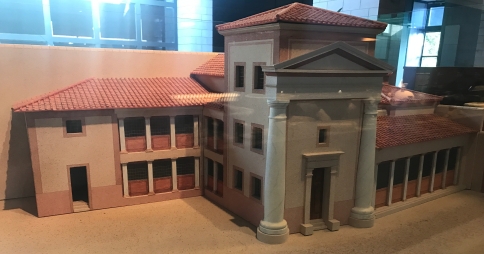
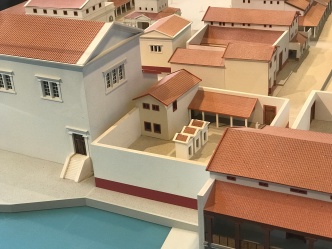
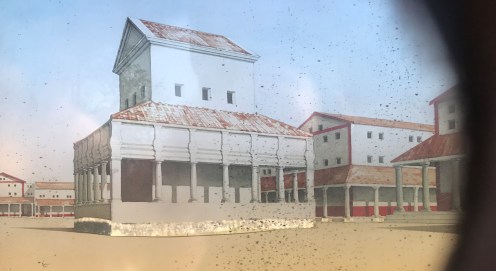
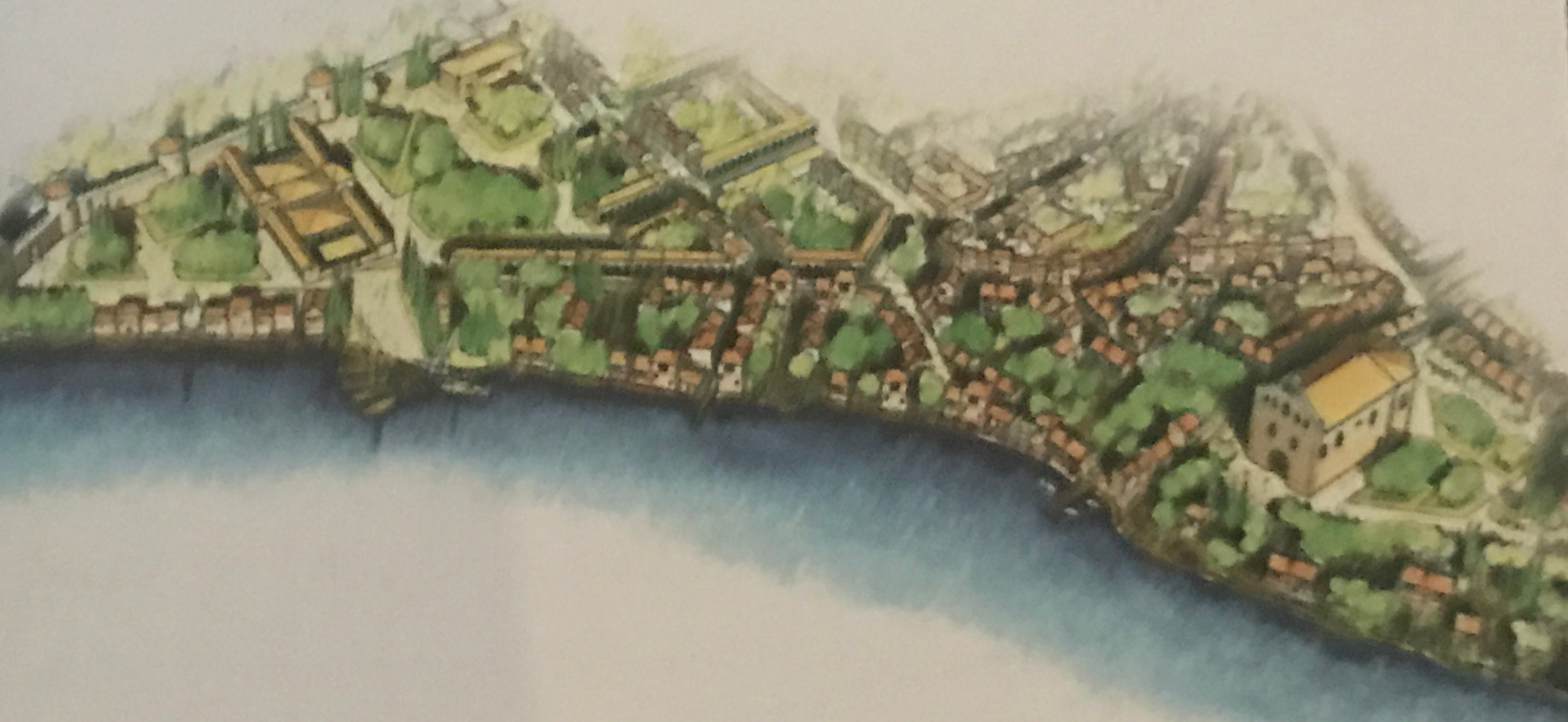
A reconstruction of the Roman house where the Museum is situated – note its suggested grand entrance pillars

The best finds from Roman Lousonna are displayed in a modern building situated within the surviving foundations of a very grand Roman merchant’s house with warehouses attached (or that is what it appears to have been).   You enter pay your CHF8 (concessions CHF5 and children free) then climb upstairs above walls with preserved painted wall plaster.

The quality of the finds from this small Gallo-Roman town of the Helvetii rather put the finds from small Roman towns in Britannia to shame – or at least it felt that way to us.  Here are just a few examples:

IMG_4468
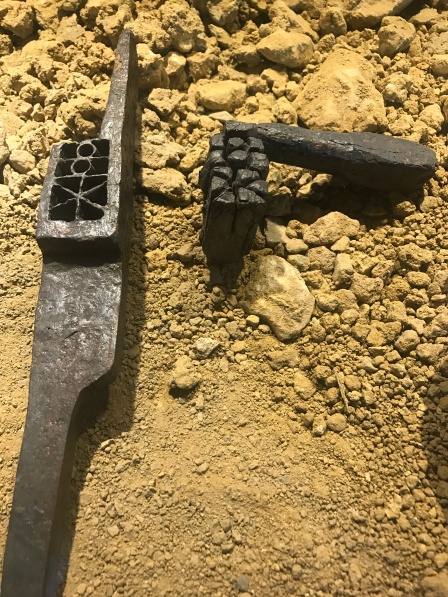
A complex locking bar and key
IMG_4469
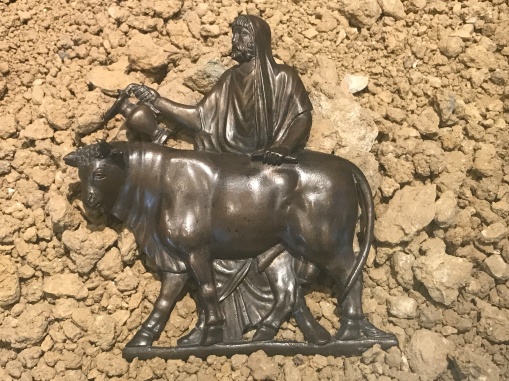
A bronze votive showing a libation being poured over a bull prior to sacrifice
IMG_4429
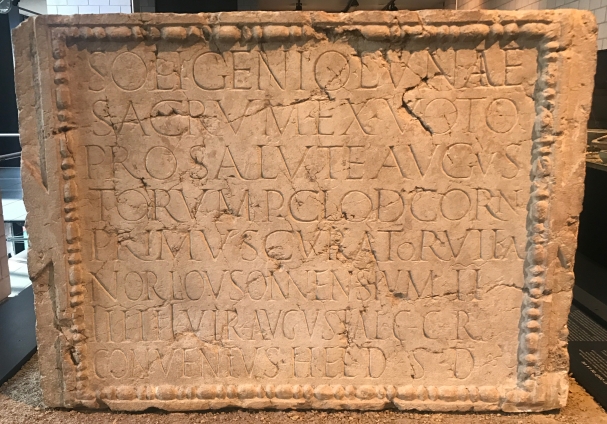
The standard of carving is very fine – note the reference to Lousonna
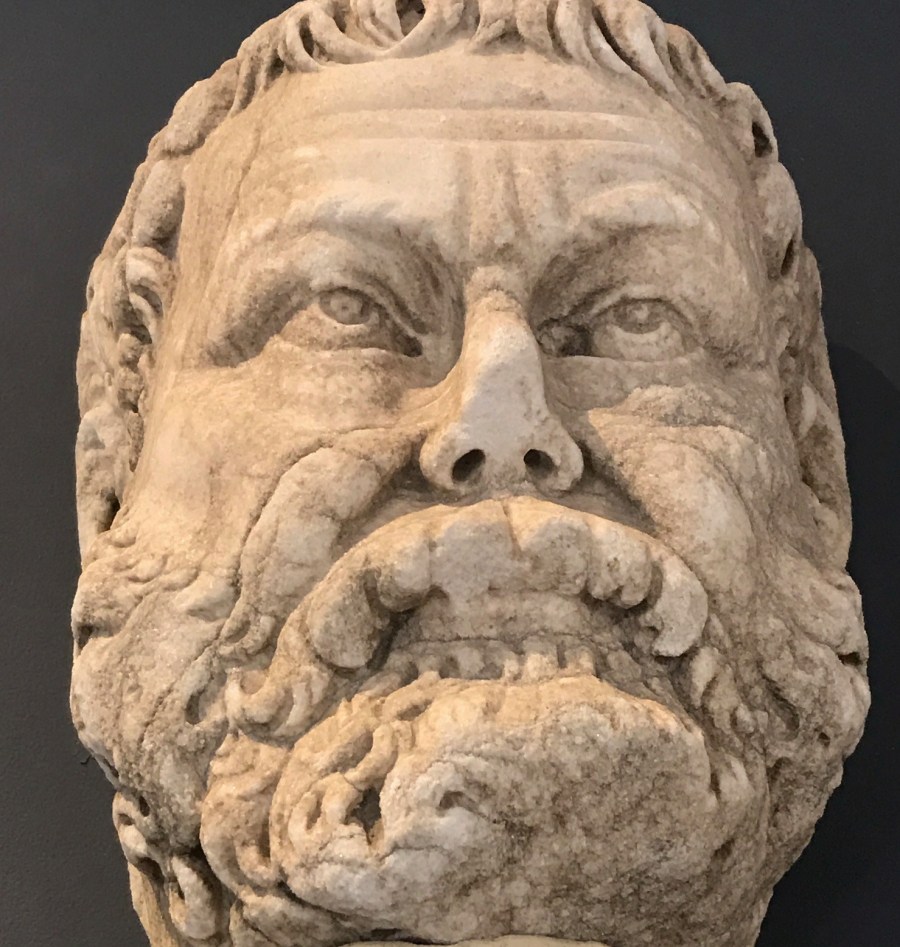
img_4470.jpg
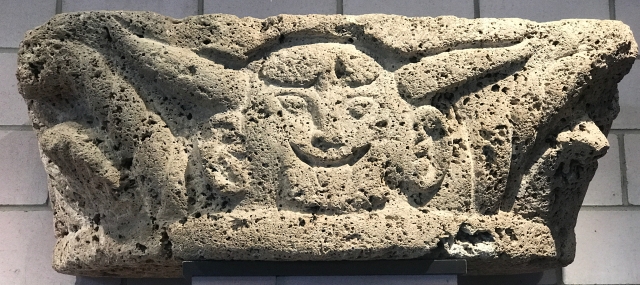
The extraordinary horned head – maybe the god Cernunnos who appears on the Pillar of the Boatmen from Lutetia (Paris) now in Musée de Cluny?

The quality of carving on the various inscriptions is very fine. We thought the finest single artefact was the small but very detailed bronze relief of a priest pouring a libation over the unfortunate bull prior to sacrifice, thought to be a decoration from an altar.

The models of Lousonna are of the highest standard, comparable to the wonderful building models in the Museum of London’s Roman Galleries.   There is an English catalogue you can borrow to carry round with you, although sadly not available to purchase.

IMG_4437IMG_4446

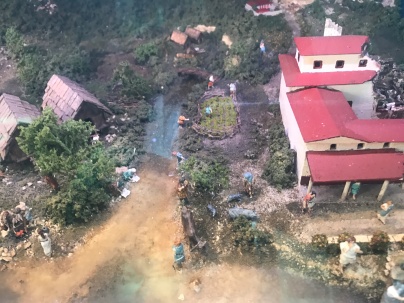
Finally, the Museum goes to some effort with a re-construction of a sizeable cross-section of the excavation in a mock-up of a site hut, together with finds records etc on the wall to show how the dig had taken place.

So if you are in the area, don’t miss Lousonna!

Lousonna (Lausanne – Vidy)

Overall Impact:               *** 3 stars – a nicely presented and well-maintained small town

Access                                ***** 5 stars – carpark next door, cycle, walking and Swiss buses

Atmosphere                      ** 2 stars – perfunctory pond for former lake-edge helps, as do the inventive Swiss visualisations

Other                                  ** 2 stars – you can get a feel for what it would have been like

IMG_4415
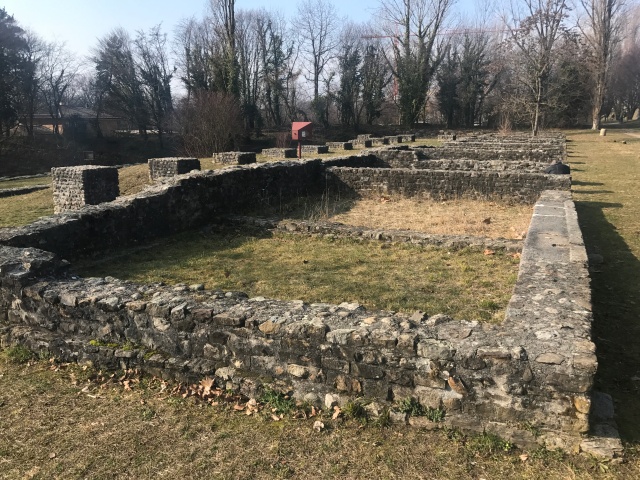
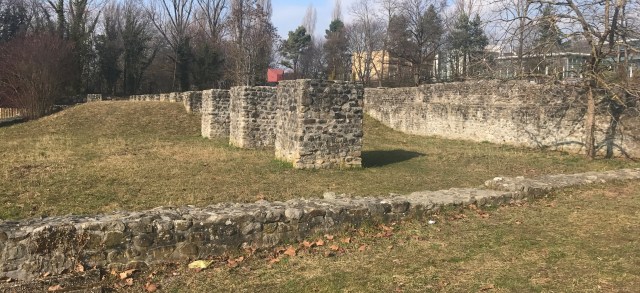
View over the offices along the north side of the Basilica.  One of the curious Swiss reconstruction viewing boxes can be seen.

As excellent as it was unexpected, we stumbled across the Roman small town of Lousonna on a visit to Lausanne, Switzerland, last week.

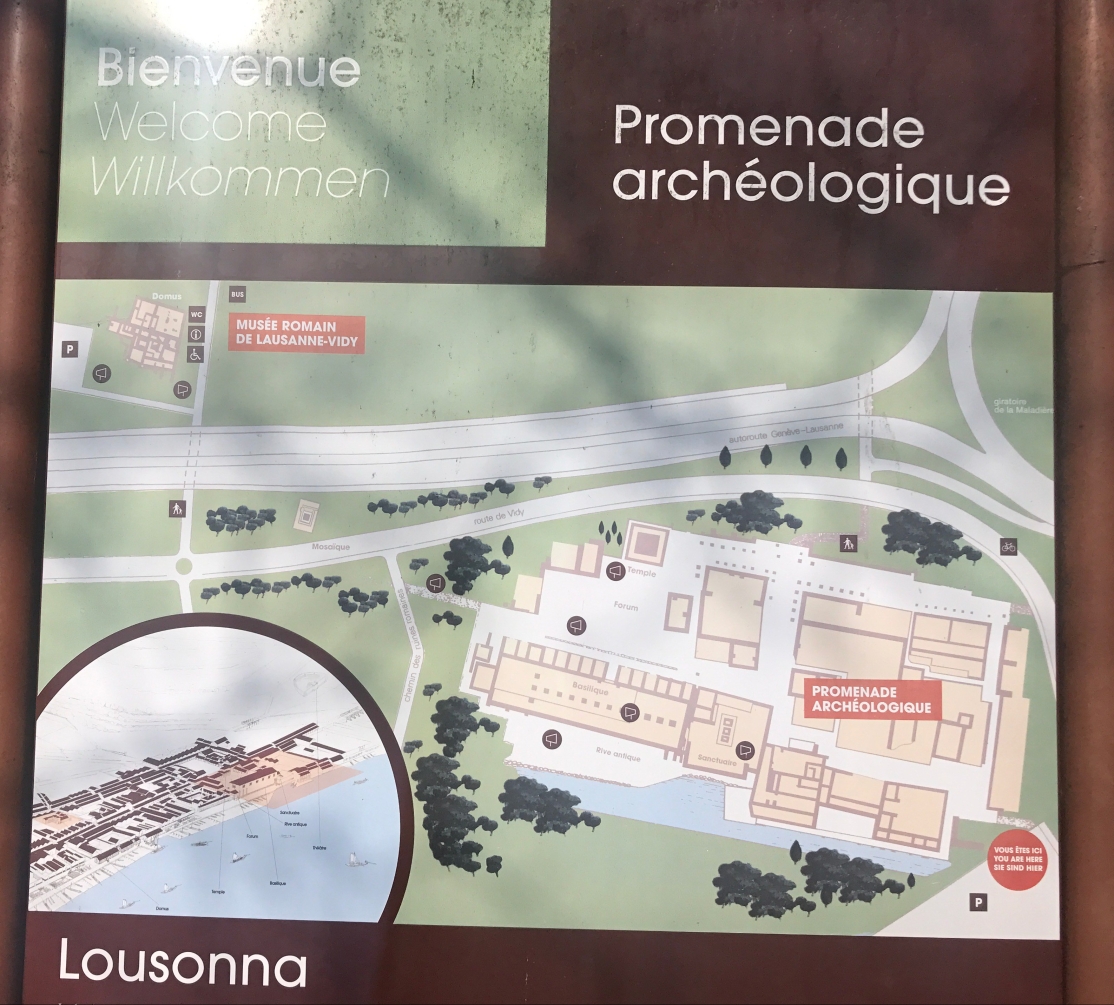
If you walk, cycle or drive along the shore of Lake Geneva (Lacus Lemannus) westwards from the Chateau of Ouchy, in the direction of Geneva, in about 2km (just past the modern offices of IMD) you come to a well-signposted Site Romain.  (Ouchy, by the way, is where Lord Byron wrote “The Prisoner of Chillon” in a comfortable lakeside cafe and where the Peace Treaty of Lausanne with Kemal Ataturk’s resurgent new state of Turkey  was signed in 1923.)

There is an extensive car park at the site, for those enjoying the lake and its many leisure facilities.  The site is open and generally well-cared for. Its reconstituted walls that will remind any of us who, as children, visited castles and abbeys across the UK of the well disciplined approach of the old Ministry of Public Building & Works!


IMG_4404

The plan is clear and presumably simplified for display purposes to a single final phase: here we see Lousonna at the height of its prosperity in the C3rd.  It is particularly helpful for understanding the site that the location of the former Roman waterfront of Lake Geneva has been recreated by a (slightly brackish) linear pond.   There are several plans set up around the site showing the key buildings, which consist of a rather impressive but curiously one-sided Basilica with the Hall on the lake-side and rooms opening off it on the land-side only.  The Basilica was 71m long by 19m wide with large pillars.  It is dated by the excavators to AD40 with later additions.


IMG_4412
The Basilica with its substantial pillars – note the very solid consolidation.

The Basilica has a open Forum behind it with a typical square ‘Celtic’ temple familiar from Britannia.  On the lakeside next to the Basilica there is a ‘sanctuary’ with three ‘chapels’.  Here, according to inscriptions and figures discovered there and interpreted in the explanatory leaflet, Neptune, Hercules and Mercury were worshipped in order to safeguard Navigation, Voyages and Commerce.   There was also on the lakeside another very solidly built building, possibly a warehouse?

Across the site are reconstructions interpreting the remaining foundations, which can be viewed through eye pieces set in very-solidly Swiss-built metal viewers.


IMG_4418
Looking through the viewer at an optical reconstruction based on the site foundations: here is the Temple.

All in all, you can get a feel for what this prosperous small Roman town on the lakeside grew into at its height.  The excavators estimate the population as 1,500 to 2,000, composed of merchants, fishermen, craftsmen and their families.  It was situated in a prime position on the routes between the Rhine and the Rhone, with good farming land beside the lake and a very pleasant climate facing south across the Lake.  Vines still fill the slopes of the Swiss Jura, with excellent wines that the Swiss very sensibly keep to themselves rather than export.

However, there is more: if you walk north-west past a (rather disappointing and poorly maintained) mosaic in a cover building in a road embankment and some current IOC construction, then through an underpass under the main road, you reach a modern Roman site Museum constructed within the foundations of a very grand house attached to workshops/warehouses: see our review of the Roman Museum of Lausanne – Vidy.  


IMG_4467
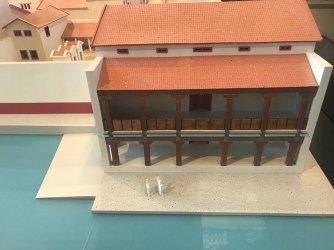
Reconstruction of the ruins of Lousonna in the C5th (in the Roman Museum).

In the C4th the town was partially abandoned and the inhabitants move to the defensible hilltop of medieval and modern Lausanne Cité.  There could be no clearer indication of the impact of the failure to secure the Empire’s border on the Rhine against barbarian raids in the C3rd and C4th.

Tarragona (Roman Tarraco)

We visited Tarragona just after the New Year when there were no crowds; it was chilly but with warming sunshine.  

If you are coming from Barcelona, come off the toll motorway AP7 onto the A7 and then the A340, so you can enter Tarragona along the course of the ancient long-distance road, the Via Augusta.  It is pleasing to see the city’s Roman name still celebrated today, with a large Tarraco sign at a roundabout.
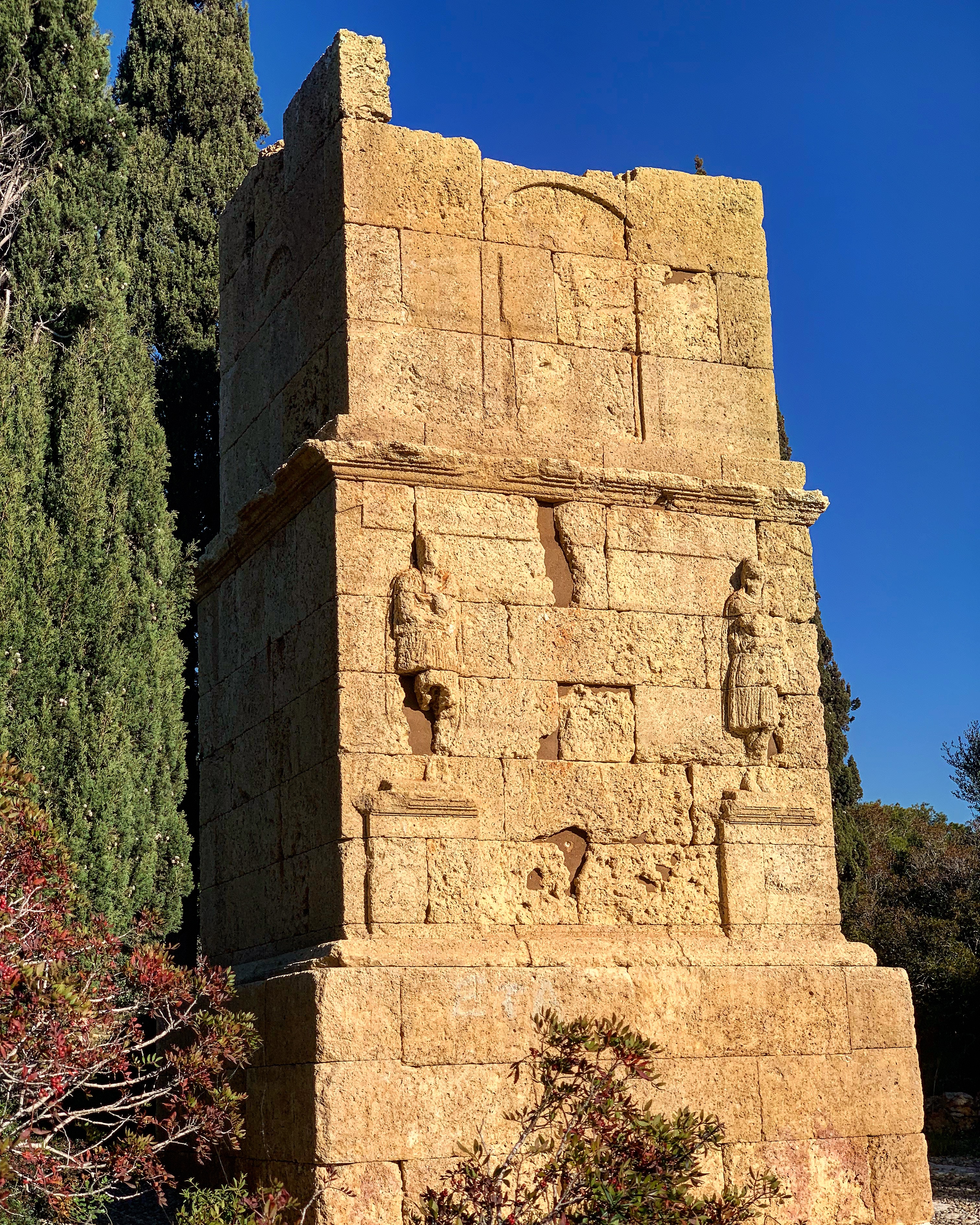
Another advantage of this route is that you pass the Tower of the Scipios, a late First-Century BC funerary monument.  Nothing to do with the Roman family of the Scipios themselves, but a striking survival and a taste of things to come!

Brief History of Tarraco

Tarraco was probably an Iberian settlement before its fortification by the brothers Gnaius Cornelius and Publius Scipio in 217BC at the start of the Second Punic War, and building of a military port – Tarraco Scipionum opus, as Pliny the Elder says.

It was Scipio Africanus’ base from 211 – 210BC, where he met the Iberian tribes in conventus.  During the long conquest of Hispania, Tarraco remained a supply base for the Roman military and capital of Hispania Citerior.  It became a Roman Colony around 45BC after Caesar’s victory at Munda in the Civil War, so added Iulia to its name.

Augustus resided in Tarraco in 27BC whilst overseeing the completion of the conquest and he reorganised the Provinces, Hispania Citerior becoming Hispania Tarraconensis,  with about two-thirds of the land area of the Iberian Peninsula ruled from Tarraco.  As befits a major provincial capital Tarraco prospered and a theatre was built.  The trans-Peninsular road was restored as the Via Augusta and a Temple to the Deified Augustus was erected in 15AD after his death.

Vespasian, as in Britain, was a keen organiser of and investor in the Provinces.  After his victory in the Civil War of AD69 he addressed Hispania, with Latin citizenship being granted to its inhabitants and the former tribal areas, and cities re-organised into areas focused around urban centres – both colonies and municipalities.  This required the establishment of the Provinciae Concilium as a centre of Roman and Hispanic pride.
This image has an empty alt attribute; its file name is 88556809-cd7a-413c-be88-a553bf7ededb.jpg

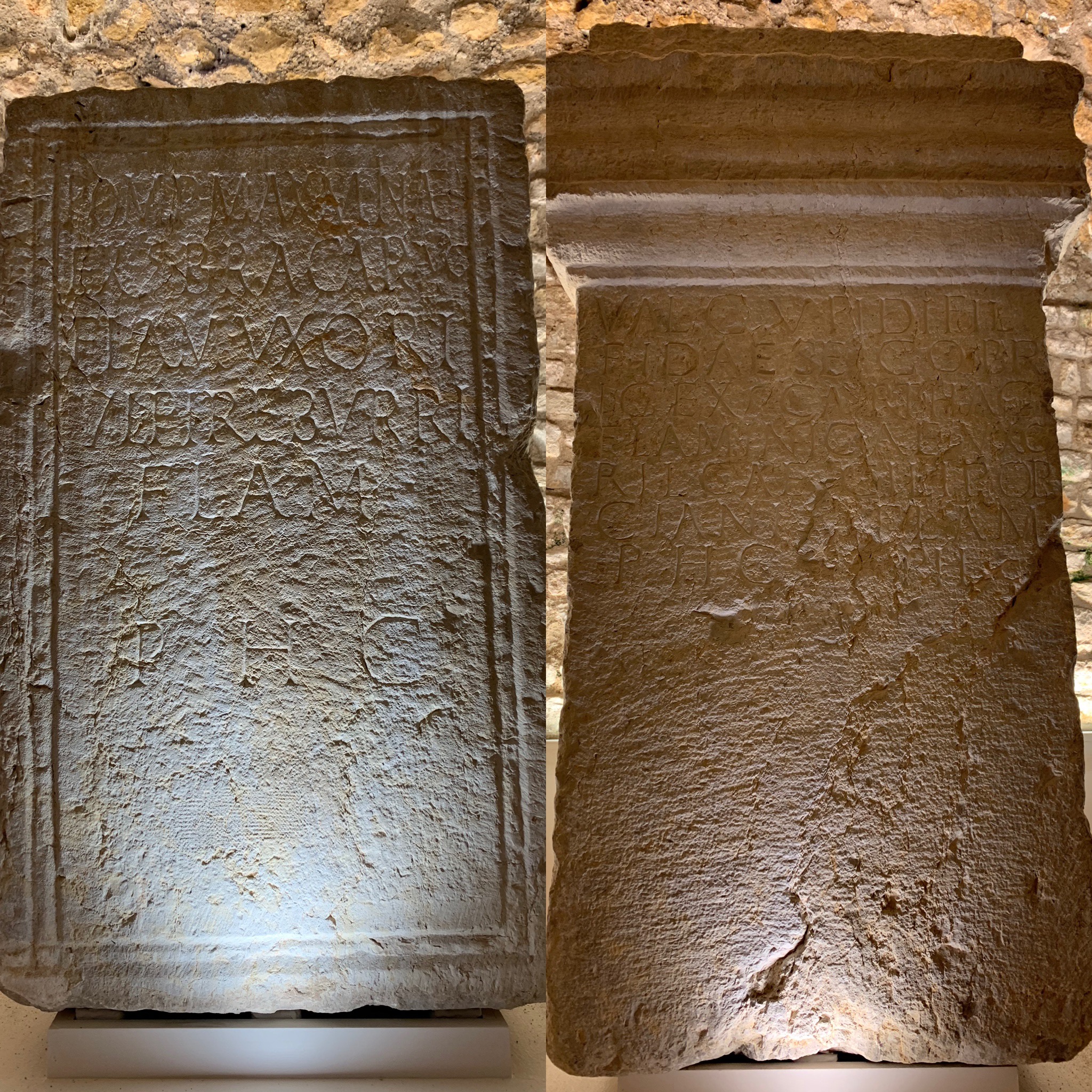
Inscriptions to Flamines and Flaminicae – priests and priestesses of the Provincial and Imperial Cult – have been found: these two are dedicated to Flaminicae from the Second Century AD?.This image has an empty alt attribute; its file name is img_2987.jpg
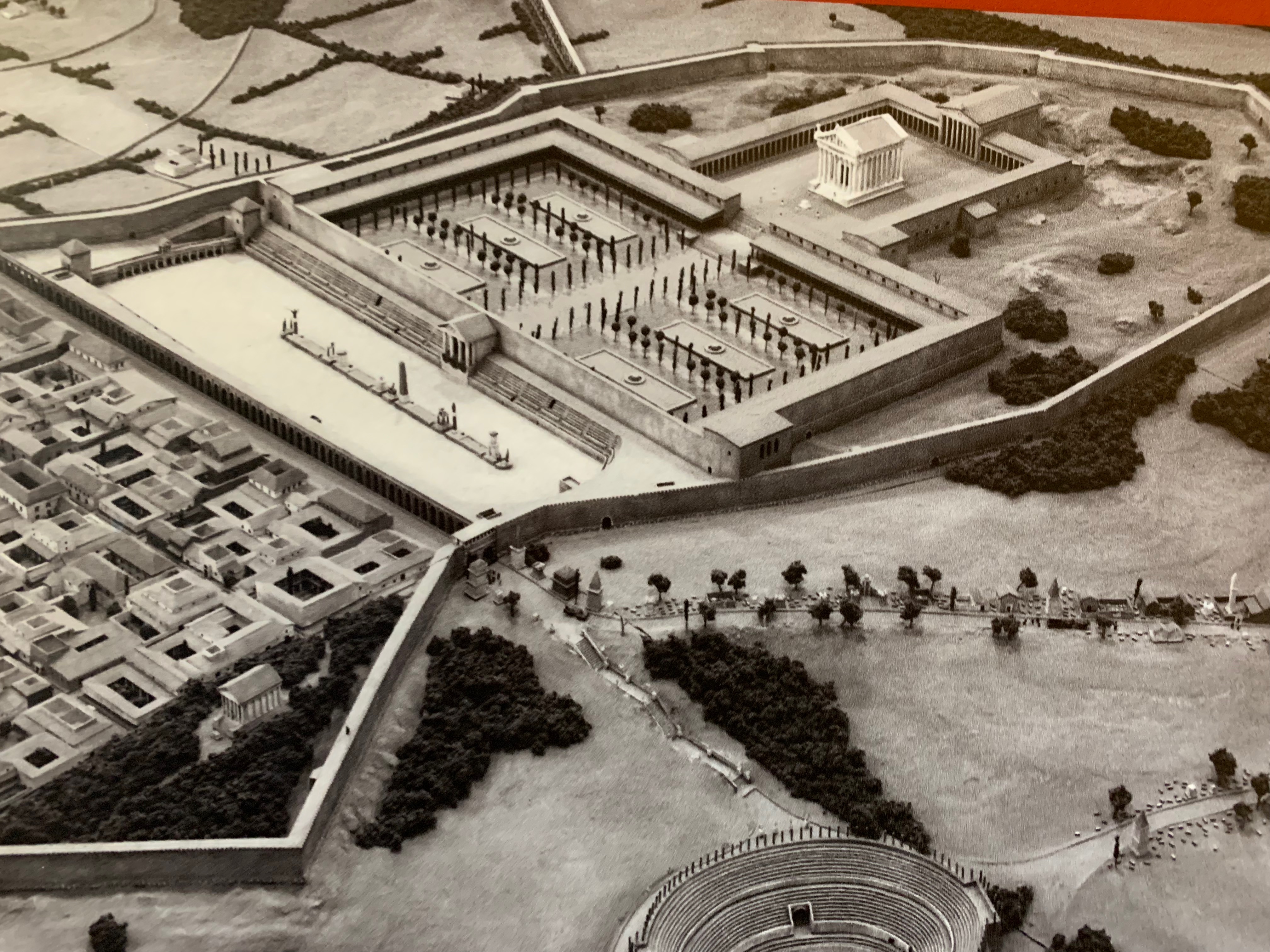
Tarraco, as befitted the provincial capital, received a whole new urban quarter with a provincial Forum for the administration, a Temple to the Imperial Cult and subsequently a Circus – see the model above.

Following this Tarraco prospered for 150 years but, along with the much of Roman Gaul and Spain, the city declined in the Third Century AD and was merely one of six provincial capitals under Diocletian.  It was occupied by the Visigoths in 476 and by the Muslims in 713.

The Remains 

The Roman Remains of Tarraco are deservedly a UNESCO World Heritage Site.  For the visitor they consist of three areas:

  • the original lower town around the port with its own ‘colonial forum’ and theatre
  • the upper town, probably occupied by military installations in the Republican Period but developed as the Provincial Centre under Vespasian and Domitian, with Temple, Provincial Forum and Administration, and Circus.
  • sites outside the city including an Aqueduct, Arch and roadside funerary monument.

The Circus

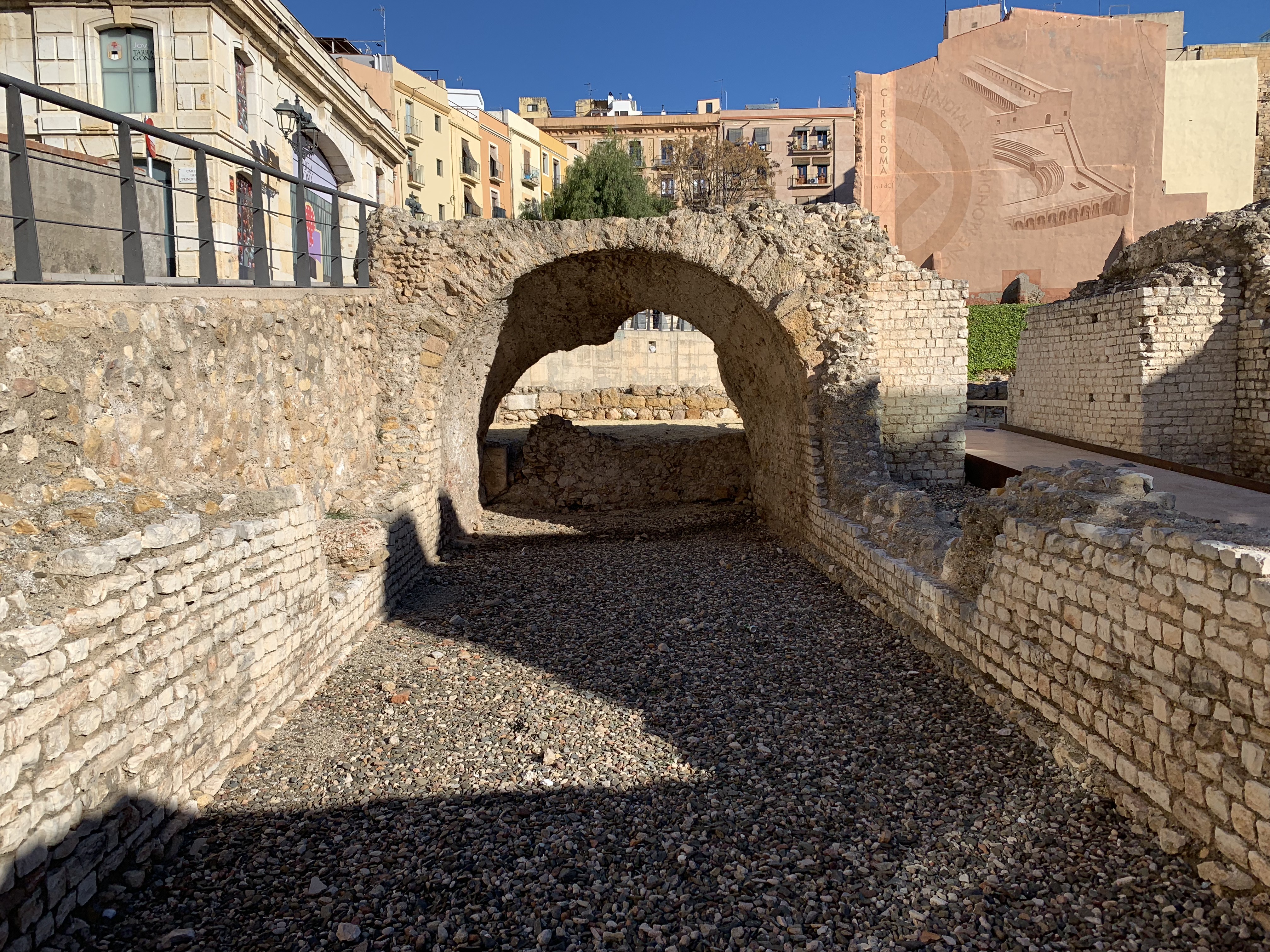
Entering by the Via Augusta you arrive in the centre of the old City, to be confronted on your right by medieval walls built around the Roman Circus.  Try and find the nearest car park (helpfully signed), which is conveniently situated under the Placa de la Font with the Ajuntament (City Hall) at its end.  This long rectangular space occupies more than a quarter of the former Circus.  Walk from the Placa towards the Sea and you will find the remains of the curved end of the Circus.
This image has an empty alt attribute; its file name is img_2963.jpg

The Circus was 290m long and 65m wide, and was part of the major investment in Tarraco as the Provincial Capital of a re-organised Hispania under Vespasian, with the work probably completed under Domitian.  The site is well displayed and, although converted into fortifications in the Middle Ages and partly blown up in the French Siege of 1811, provides a good impression of what the Circus looked like.  The Tarragona authorities have invested in digital tools and you can download a free location-based App that enables you to visualise the Circus and other key sites in Roman times.  All you need to do is to  download it onto your phone then scan the bar codes at the sites.
This image has an empty alt attribute; its file name is img_2970-1.jpg

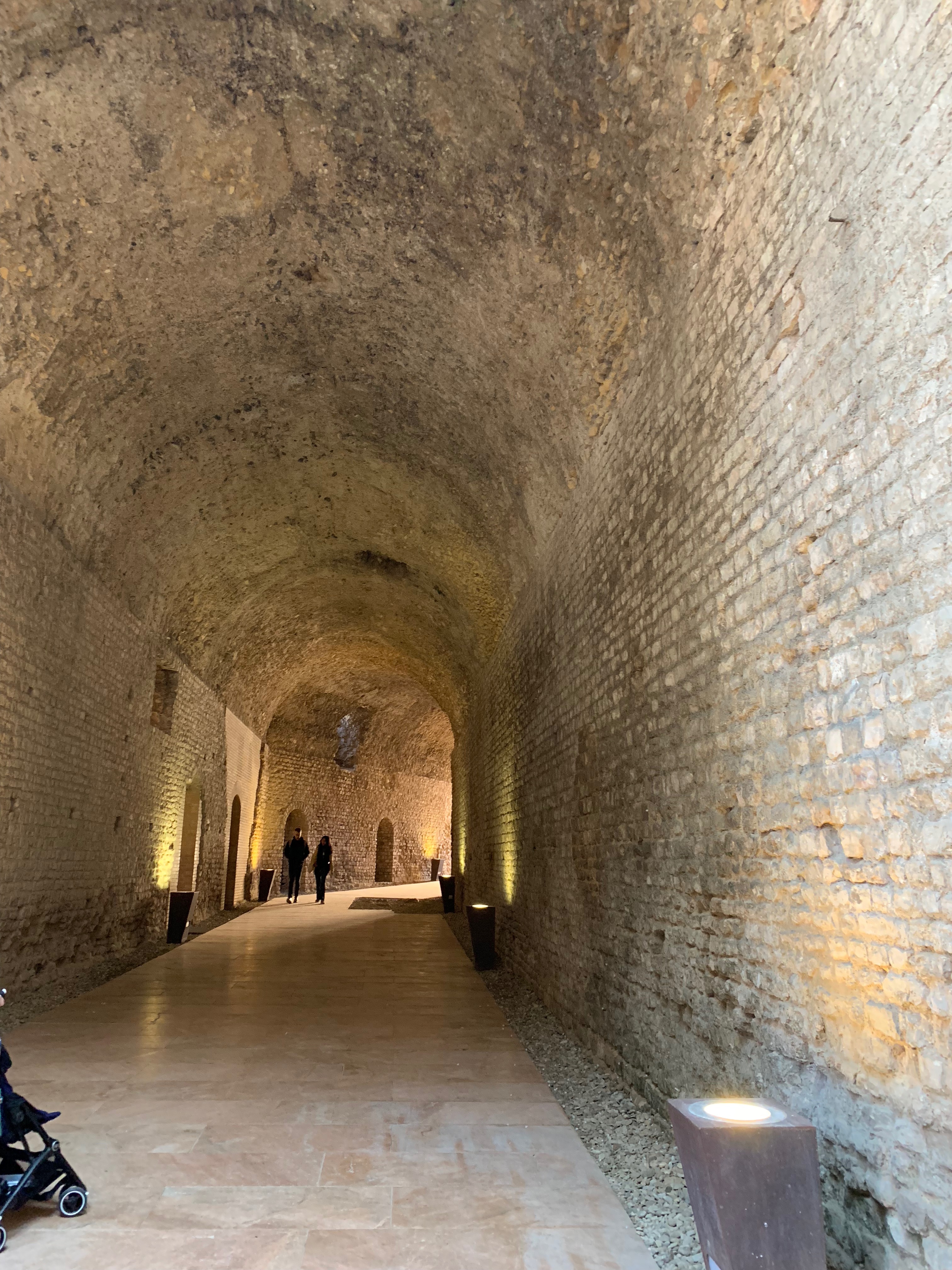
The key remains of the Circus are the remaining tunnels under the curving end of the course and for some way under part of the former seating on the north side of the Circus.
This image has an empty alt attribute; its file name is img_3069.jpg

The Temple of Augustus

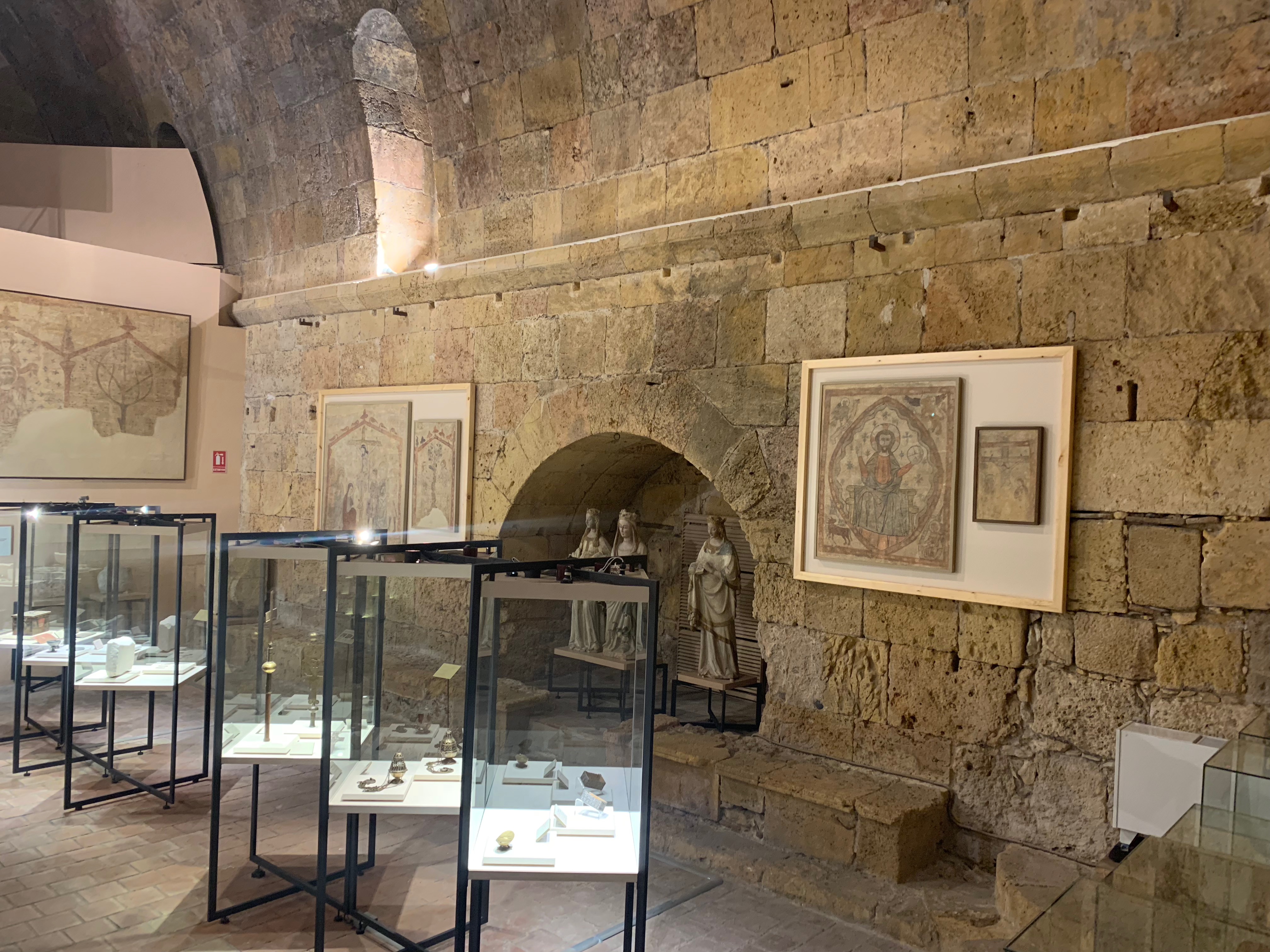
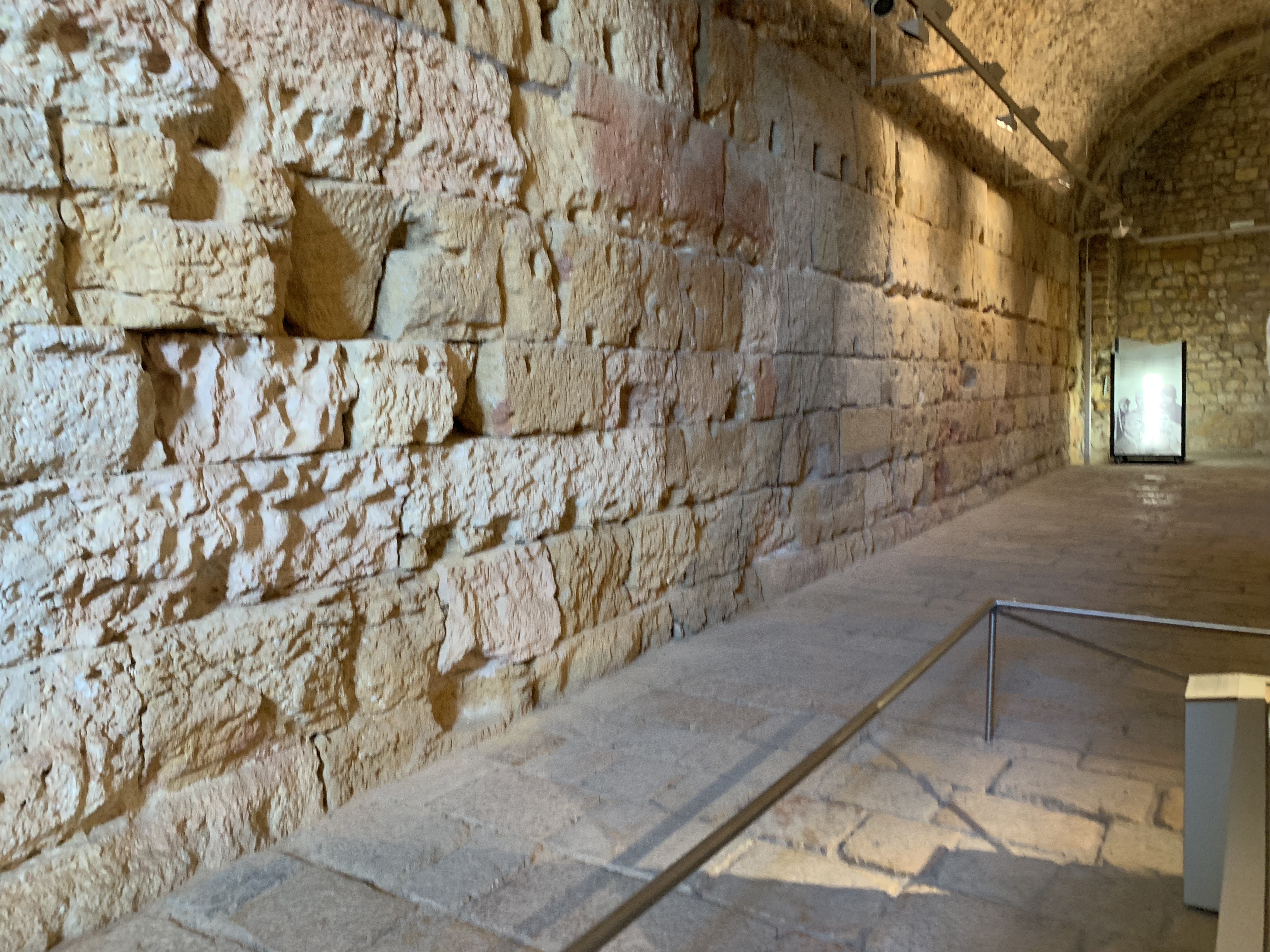
Remarkably, the walls of the temenos (the sacred enclosure) are preserved in the buildings around the Cathedral Cloisters, now the Cathedral Museum – see above.  Unsurprisingly, the 12th-Century Cathedral occupies the same site as the Temple of Augustus, at the highest point of the hill above Tarraco.
This image has an empty alt attribute; its file name is img_3023.jpg

The Provincial Forum

It was started in 73AD under Vespasian and was situated up the hill from the original settlement.  It is thought to have consisted of buildings for the Provincial Council (see above), a Curia (senate house), an Audience Hall for the Governor and the Temple of Augustus, plus offices for the provincial financial administration and archives.
This image has an empty alt attribute; its file name is img_3028-1.jpg

The Amphitheatre

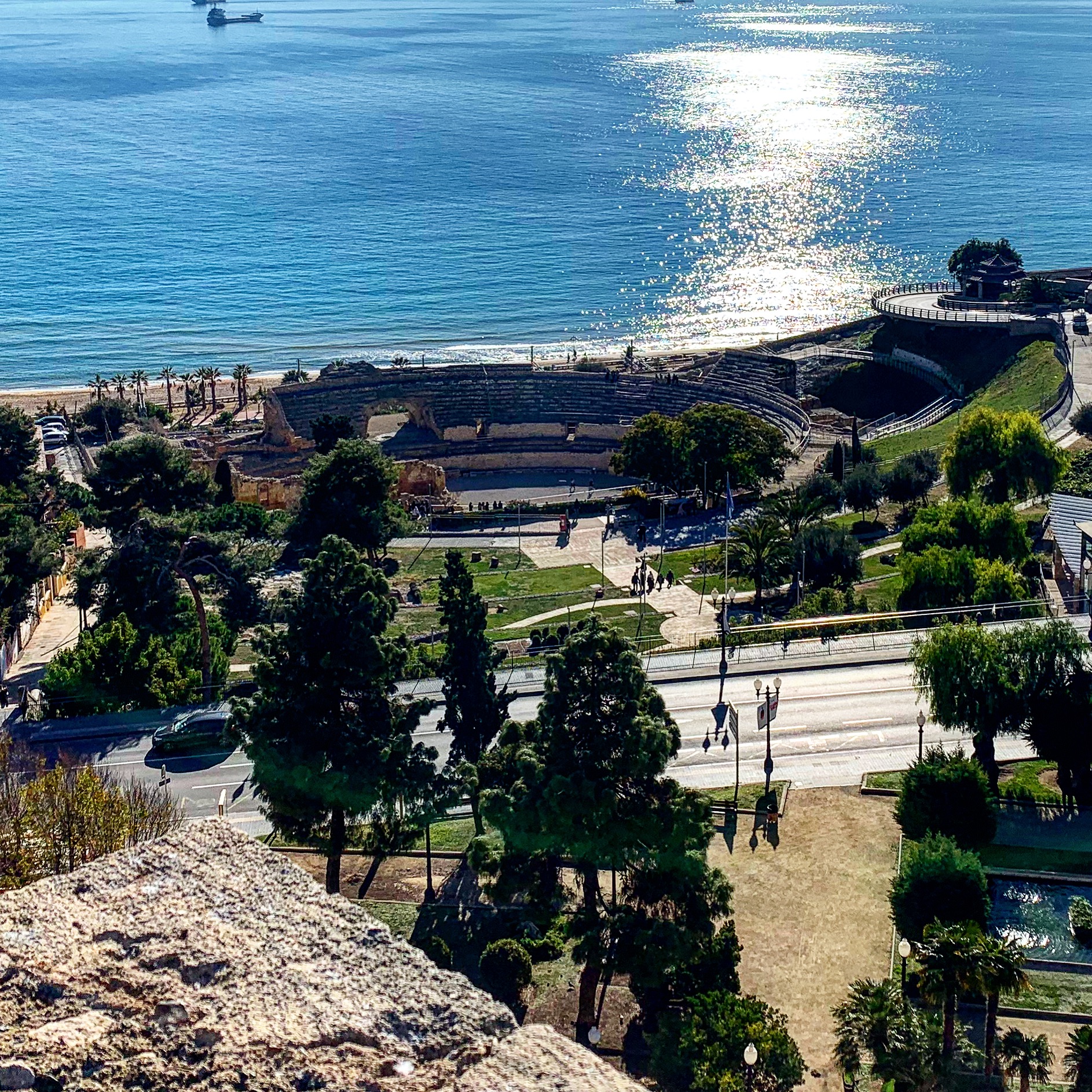
Given that gladiatorial combats had to take place outside the walls, Tarraco‘s Amphitheatre was situated towards the sea, and can be viewed well from the top of the Roman and Medieval tower termed the Praetorium.  It was built at the end of 1st Century BC, presumably when Tarraco became a Colony for Civil War veterans who liked and could afford such entertainments.  It is estimated that it could hold 15,000 spectators.

Having been through many vicissitudes over the millennia, as a prison, a convent and so forth, the seating on the sea-side is still there but the central arena, as so often, is cut by the under-surface corridors and remains of later buildings which spoils the effect somewhat.  This means that modern gladiatorial reconstructions are restricted to a quarter of the original surface area.

The Colonial Forum

Down the hill in the main town lie the remains of Forum of the Colony as opposed to the Province.  There is a reconstructed column, which you often find in excavated forums (see Thessaloniki) and a few arches – a site for the completists.

The Theatre

Taking advantage of the slope down to the port, under Augustus the Roman Theatre was built facing the port.  There is a viewing platform where the key remains can be seen, including some surviving seating and the foundations of the scaena.  However, it’s not Merida!

Walls of Tarraco

The Walls are, as with so many sites where there has been continuity of occupation (Exeter in Britain has similar layers), a confusing mixture of pre-Roman, Roman, late Roman, Muslim and Medieval additions.   However, it is claimed that the circuit of the old Quarter for over 1km are fundamentally Roman and there is a pleasant promenade – the Passeig Archeologic – from which they can be viewed.

Ferreres Aquaduct

The Aqueduct is located 4km north of the city and brought water from the River Francoli 15kms north of Tarraco.  It is thought to date from Augustus’s time in the City and is composed of two imposing levels of arches, with a maximum height of 27m and a remarkable length of 249m.
This image has an empty alt attribute; its file name is img_2940.jpg

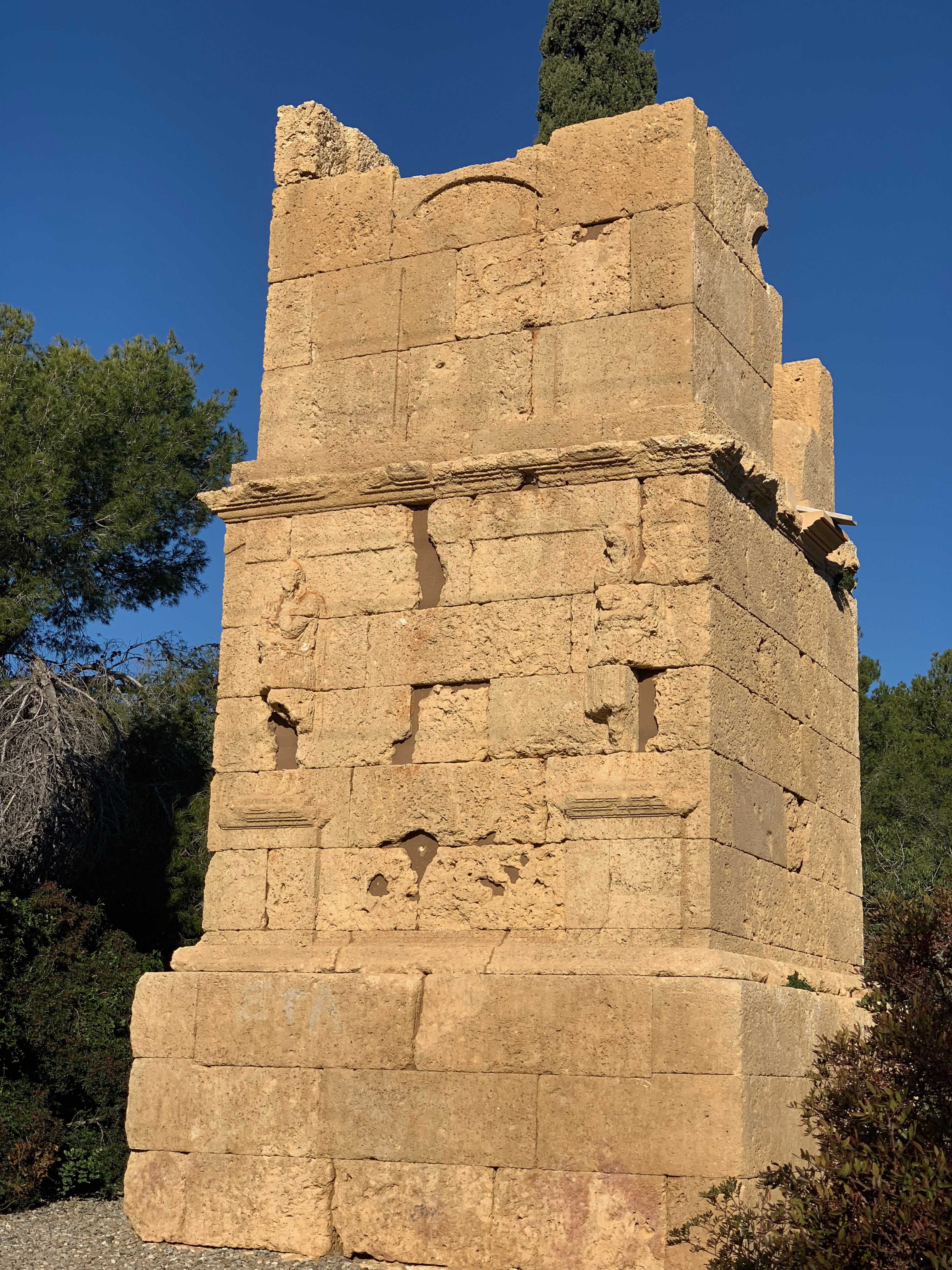
Tower of the Scipios

This is a a funerary monument situated on the Via Augusta 6km east of Tarraco.  It is decorated with two reliefs – now much weathered – of the god Attis, deity of death and resurrection.  For years these were identified as the Scipio brothers, founders of Roman Tarraco.
This image has an empty alt attribute; its file name is img_3096.jpg

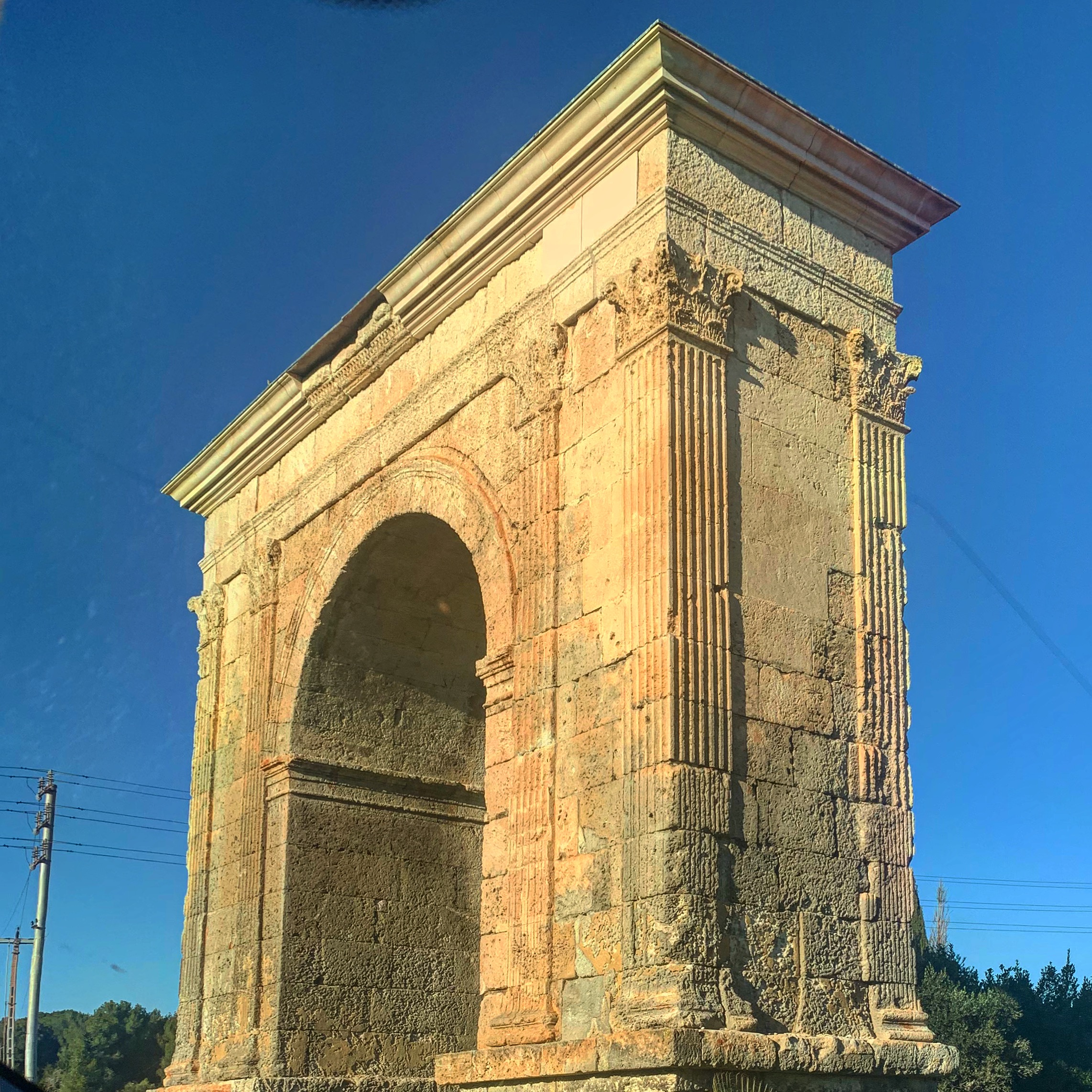
Triumphal Arch of Bera

A further 15kns NE of the Tower of the Scipios along the Via Augusta is the Arch of Bera.  It was erected, as its inscription informs us, because of a bequest by Lucius Licinius Sura in 13BC, and is thought to be dedicated to Augustus and to mark the limit of the Colony of Tarraco.

Tarraco in Summary

As can be seen from the descriptions above, none of the surviving remains is, individually, the best or (with the exception of the Aqueduct) even nearly the best in the Empire.  However, like one of your best creations in the wonderful game ‘Caesar III’, Tarraco has one of everything that matters – Amphitheatre, Theatre, Circus, Walls, Temple of Augustus and so forth.   It is also very well displayed and the citizens of Tarragona are clearly proud of their Roman heritage: a lot of effort has gone into their digital support to try and bring the ruins to life.  So it is well worth a visit.  

Top Tips

The Archaeological Museum is at present closed for renovations.  It was reputedly excellent. Avoid Sundays and Mondays when many of the sites are closed!

Tarraco – A Confession

We visited as a family with a toddler which meant that we could not in the time available, having driven down from Barcelona, visit all the sites ourselves.  Although we saw the main ones, as the photos prove, we have had to cover some of the others from online sources.  We wanted to do this so we could publish this blog and encourage Roman enthusiasts to visit this delightful and fascinating City that really values its Roman Heritage.


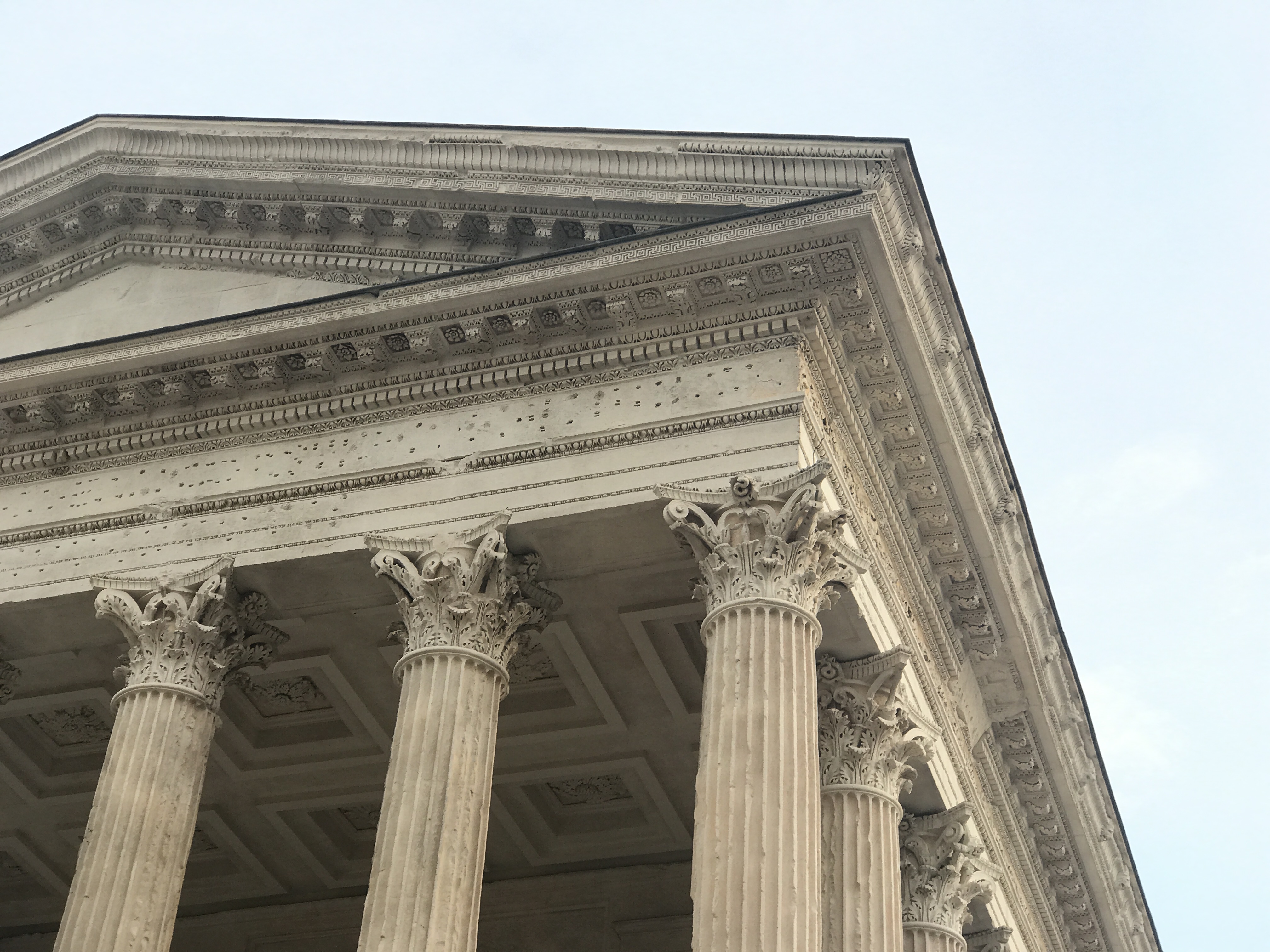
Maison Carée, Nîmes

Overall Impact:               ******6 stars – one of best preserved/restored Roman buildings

Access                                ****4 star – public square open 24/7 but parking in old town hard

Atmosphere                      *******7 stars – almost off the scale, especially now it’s cleaned

Other                                  **2 stars – alas, nothing Roman in heavily restored interior

IMG_3319

Almost unbelievably, as devoted fans of Roman architecture and remains (being the sort of people who will travel many miles to look some bumps in a field and see in our mind’s eye just what that Auxiliary Fort must have looked like), we had never been to see the Roman Sites of Provence (Provincia) until this New Year.

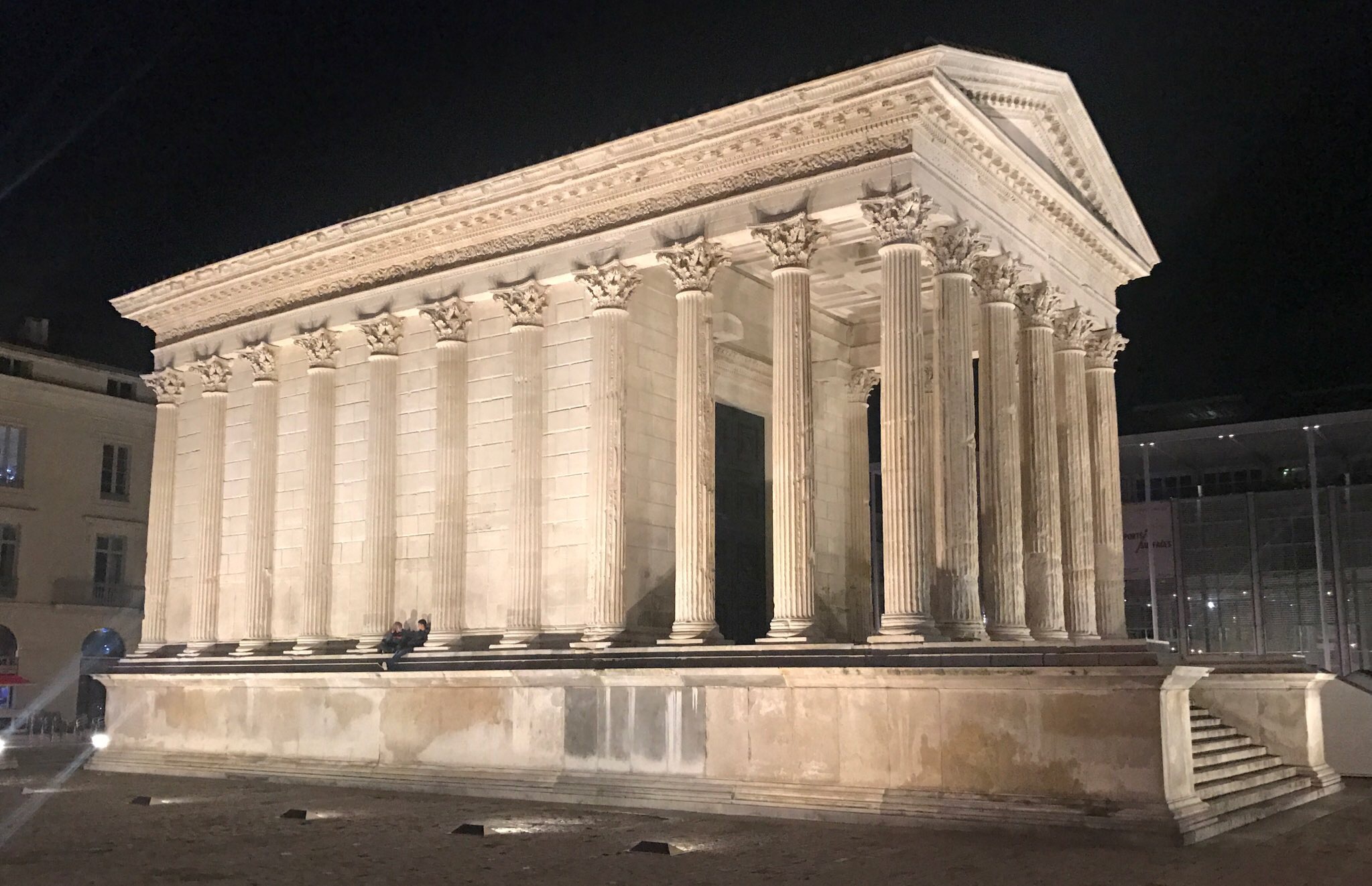
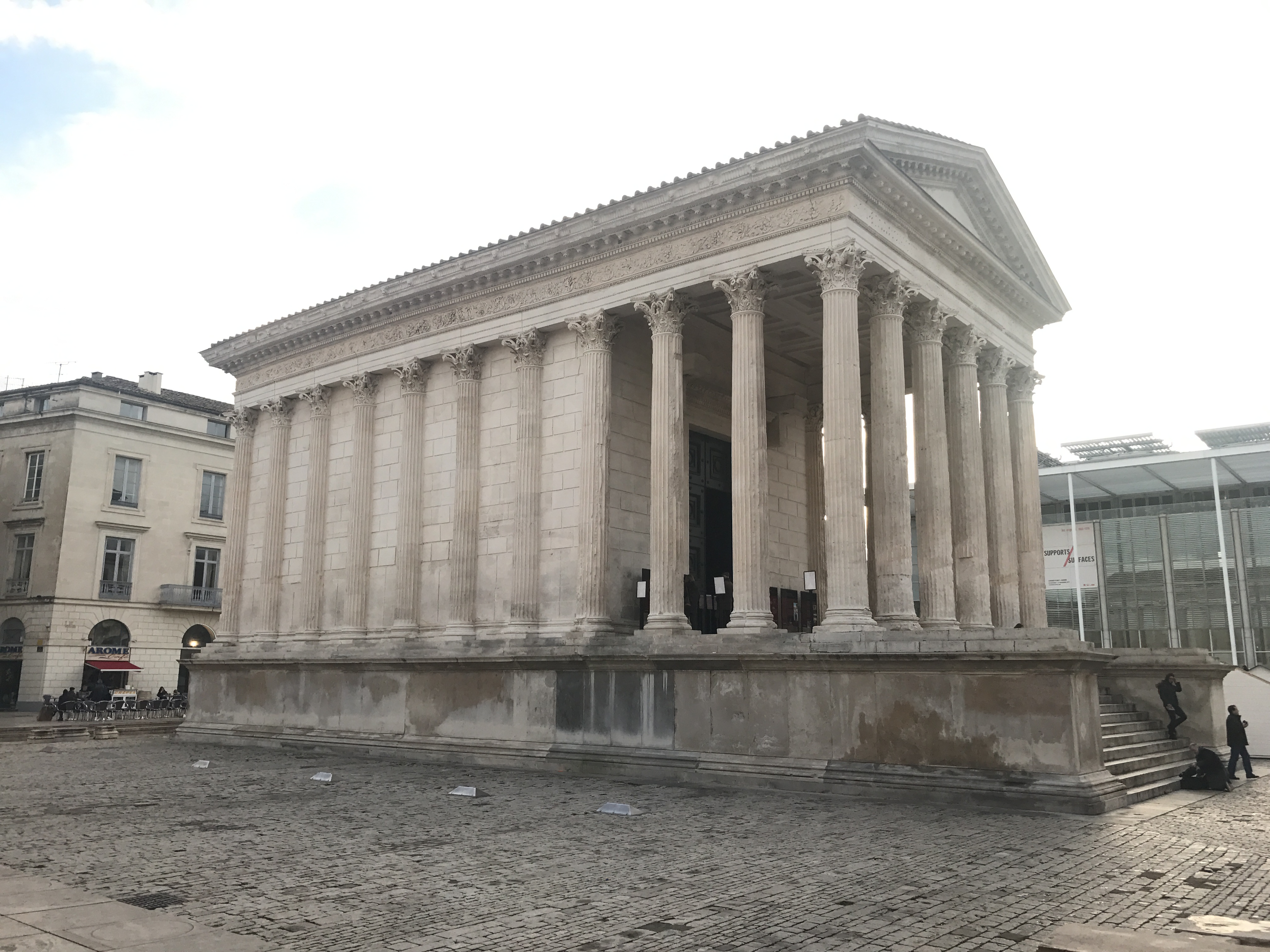
We were, of course, blown away by what we saw.  As many people reading this will know, the Maison Carée (literally, the square house – although it isn’t) in Nimes (Roman    Nemausus) is arguably one of the best, if not the best, preserved Roman Temple facades.   It sits in the original space of the Forum, high on its 2.8m plinth with its white marble glowing in the sunshine.  The impact remains dramatic two millennia after it was built.

IMG_3229

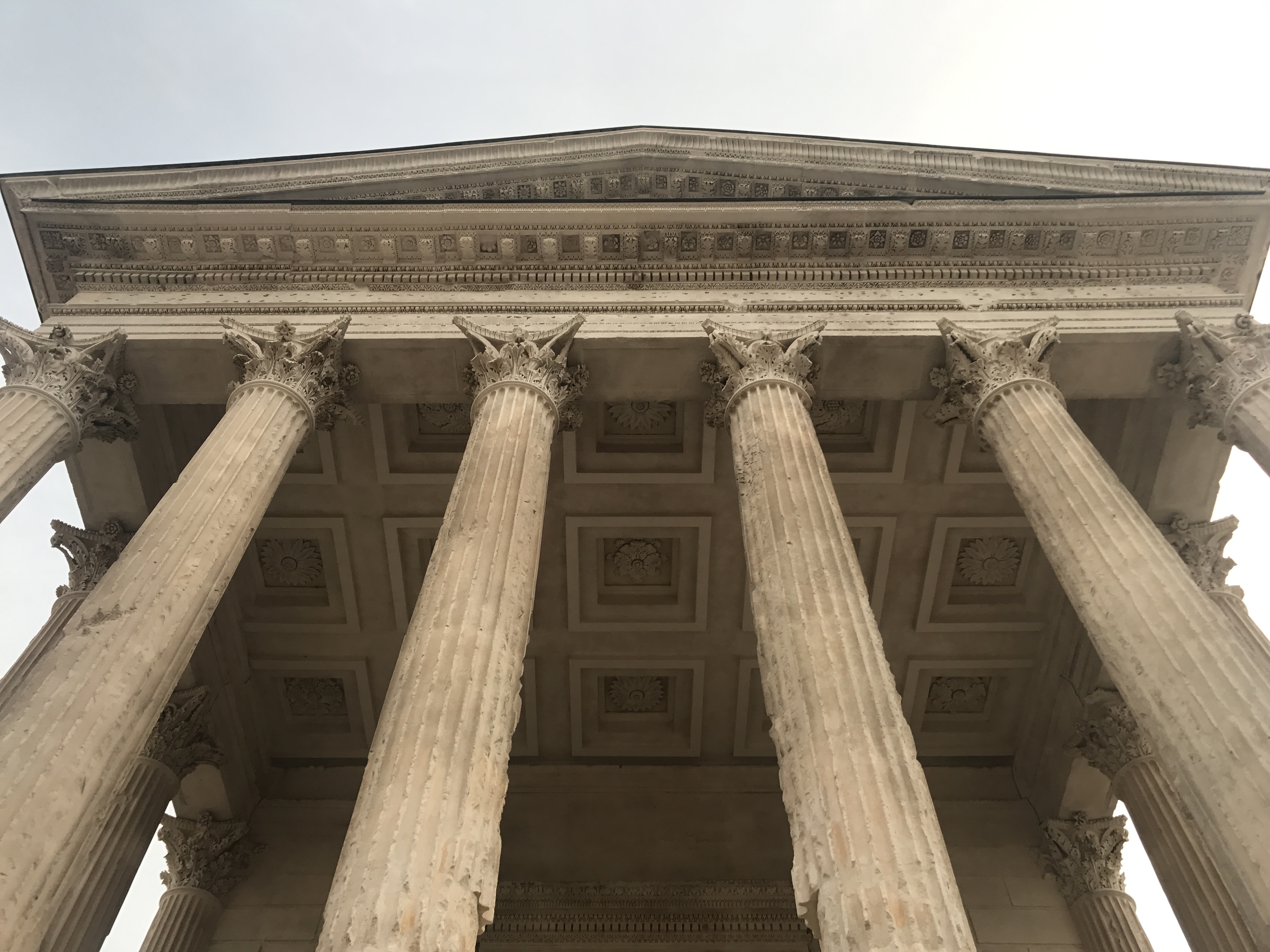
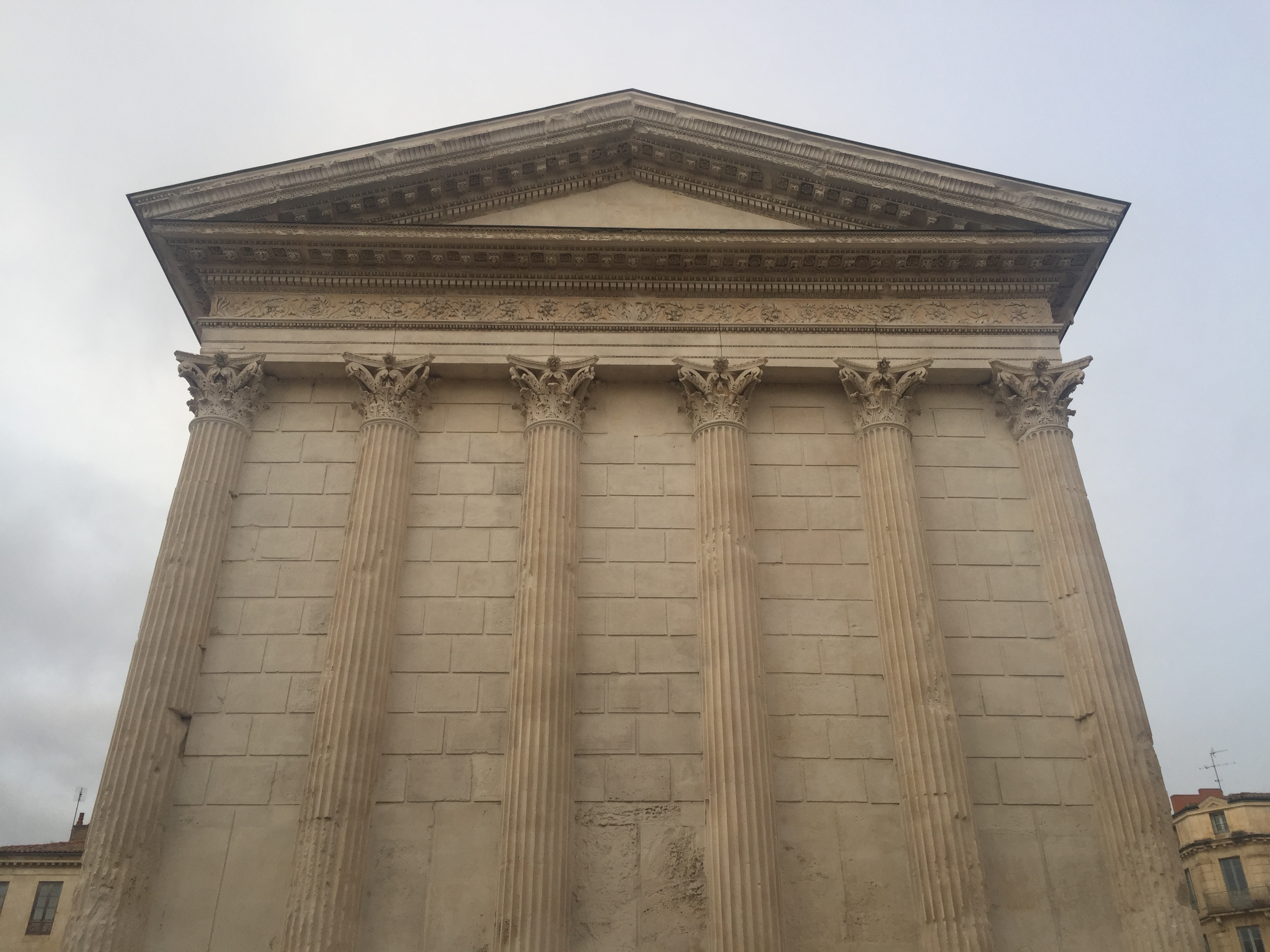
The Temple was dedicated c4-7AD to Gaius Caesar and Lucius Caesar, the grandsons and heirs of Augustus, who died tragically soon after.  If you believe Robert Graves, after Suetonius, both were poisoned by Augustus’ wife Livia to open the way for her son and Augustus’ step-son Tiberius to become Emperor.   The lettering of the dedication (“To Gaius Caesar, son of Augustus, Consul; to Lucius Caesar, son of Augustus, Consul-Designate; to the Princes of Youth”) had been removed from the facade in medieval times, but in 1758 a local scholar reconstructed it from the fixing holes left on the front frieze!

What we see today is the fruit of several reconstructions starting in Napoleonic times with the removal of accreted buildings, through to 1992 when the square around it was cleared. It inspired Thomas Jefferson’s design of the Virginian State Capitol.

IMG_1514

The building is remarkable in that the portico forms a third of the length of the building, and there are 20 columns engaged with the wall.  The frieze is exceptionally fine, decorated with rosettes and acanthus leaves.

There is nothing left inside of the sanctuary and altars that must have been there.  Perhaps more could be done to give a sense of the numinous atmosphere it would once have had.  There is, however, a good explanatory film which takes an unashamedly pro-Roman stance on the benefits to the local tribal leaders of joining Caesar as auxiliary cavalry and aiding him in suppressing their Gallic brothers and defeating Rome’s enemies.  The film then flashes forward to show the wealthy and now thoroughly Romanised citizens of Nemausus worshipping the Emperor.  It’s beautifully done and the re-enactors must have had a great time making it.  There is a gratuitous dig at Arles for being founded by former Roman soldiers rather than by the indigenous Gallo-Romans!  The master self-propagandist Julius Caesar would have been mightily impressed.

You could spend a lot of time describing the Maison Carée, but the key thing is how absolutely striking and atmospheric it is – in the sunlight (which we didn’t have much of at New Year) and especially when floodlit at night.

IMG_3213

IMG_3227

Où sont les Wisigoths en Toulouse?

Overall Impact:               – 0 stars – very little to see!

Access                                * 1 star – easy access to Museum, other areas difficult to find

Atmosphere                      * 1 star – you need to use your imagination to visualise Visigoths

Other                                  *** 3 stars – fascinating subject, but seemingly little local interest

Brief Historical Background

The Visigoths under Alaric sacked Rome in 410, seizing portable treasures.  Even Galla Placidia – the sister of Honorius, the Western Augustus – was captured.  On Alaric’s death his brother Athaulf succeeded him as leader and spent the years 410 to 415 operating in the Gallic and Spanish provinces, playing competing factions of Germanic and Roman commanders off against each another.  He captured Toulouse in 413 and married Galla Placidia in 414 as the Western Imperial Government started to come to terms with the Goths as useful allies.   Honorius’ regime used Athaulf to provide Visigothic assistance in regaining nominal Roman control of Hispania from the Vandals, Alans and Suevi.

In 418, Honorius’ regime rewarded his Visigothic allies, now under King  Wallia, by giving them land in Gallia Aquitania along the Garonne Valley with Tolosa (Toulouse) as their capital.  This is thought legally to have been achieved through hospitalitas – the rules for the billeting of soldiers.  At first the Visigoths were not given a large extent of landed estates in Aquitania but they did gain the right to the taxes of the region, so that the Gallic aristocrats, farmers and traders now paid their taxes to the Visigoths instead of to the Western Roman Government.


Settling a barbarian group effectively as a ‘state within a state’ within the boundary of the Empire was a novel and desperate measure, but it was a settlement which the Honorian regime – holed up within the walls of Ravenna, behind protecting marshes – grasped with some relief after Alaric’s sack of Rome in 410 and the chaos of the previous years.

Furthermore the Visigoths, like other barbarian tribes, were Arian Christians having been converted in the mid-Fourth Century when the Arian doctrine of the Trinity was the ‘orthodoxy’ of the Church and Emperor.  Arianism is the belief that Jesus Christ is the Son of God, who was begotten by God the Father at a point in time, and is therefore distinct from God the Father and therefore subordinate to the Father.  The Emperor Constantine at the Council of Nicaea in 325, and Theodosius at the Council of Constantinople in 381, had strengthened the Nicene formula of the co-essential divinity of the Son, applying to Jesus Christ the term “consubstantial”.  The 381 version speaks of the Holy Spirit as worshipped and glorified with the Father and the Son.  Thus Arians became heretics in the sight of the Empire.

The Visigothic Kingdom continued in Spain, but not in Toulouse, until the Muslim invasion of 711. Clovis welded together the Frankish Kingdom in the early Sixth Century, and in 507, with Burgundian assistance, he defeated the Visigothic King Alaric II at the Battle of Vouillé (Campus Vogladensis) near Poitiers and went on to capture Aquitania and sack Toulouse.  By 508 the Visigoths had lost their their grip on Aquitania and only retained the coastal strip called Septimania stretching from Narbonne and Nîmes.

Tolosa was the Visigothic capital for nearly a century – so can we find the remains of their regime?

They are very hard to find. We spent a few days haunting the museums and sites of Toulouse and there are not many traces and very little published information. What remains is generally described as ‘late antique’ rather than Visigothic, and there are few explicit references to the Visigothic period.

This post is about what we found.


IMG_3040
Map courtesy of ‘L’ancienne église Sainte-Marie ;a Daurade à Toulouse’ by Quitterie Cazes, published by Musée Saint-Raymond

Health Warnings

Two ‘health warnings’, though, are needed: first, it is not unreasonable to talk about ‘late antiquity’ since any existing buildings of Tolosa would, as part of the Empire, have been made use of by the new Visigothic rulers of the City after 413.  Furthermore, it is difficult to distinguish between the Orthodox (Nicene) churches and sarcophagi of the Fifth Century from the Arian ones of the Visigoths.

Secondly, because Alaric is thought in 410 to have carried off from Rome Titus’s booty from the Sack of the Jerusalem Temple, including the Menorah (the seven-branched candelabra), and because in the 13th Century Toulouse went on to become the centre of the Cathars and the Albigensian Crusade, one’s investigations can quickly stray into the misty world of pseudo-history and fictional conspiracy theory.  What follows in this blog does not touch on the fate of the Ark of the Covenant, the Priory of Sion – or the novels of Dan Brown!

Sarcophagi in the Musée Saint Raymond
In the museum basement there is a fine collection of late antique sarcophagi from across south-west France. The intriguing question is: are they from the Visigothic period, and are they Orthodox (Nicene) or Arian – and how would you tell?

IMG_0668
Model of the Apse of the Daurade Church in Arian Visigothic Days – model was in Musée Saint Raymond early 2017

The Daurade Church
One of the most tragic losses is the Daurade or ‘golden’ Church.  It seems likely that this was the Arian Church, close to the Visigothic Palace.  The church consisted of nave based on the classical Roman Temple of Apollo, a probably Fifth Century apse, and later additions. It was demolished for a grand but conventional French classical church of 1761. Frustratingly, we are left just with drawings of the impressive apse made before its destruction. One can only think, for a parallel, of the mosaics at San Appolinare Nuovo in Ravenna.

IMG_2886
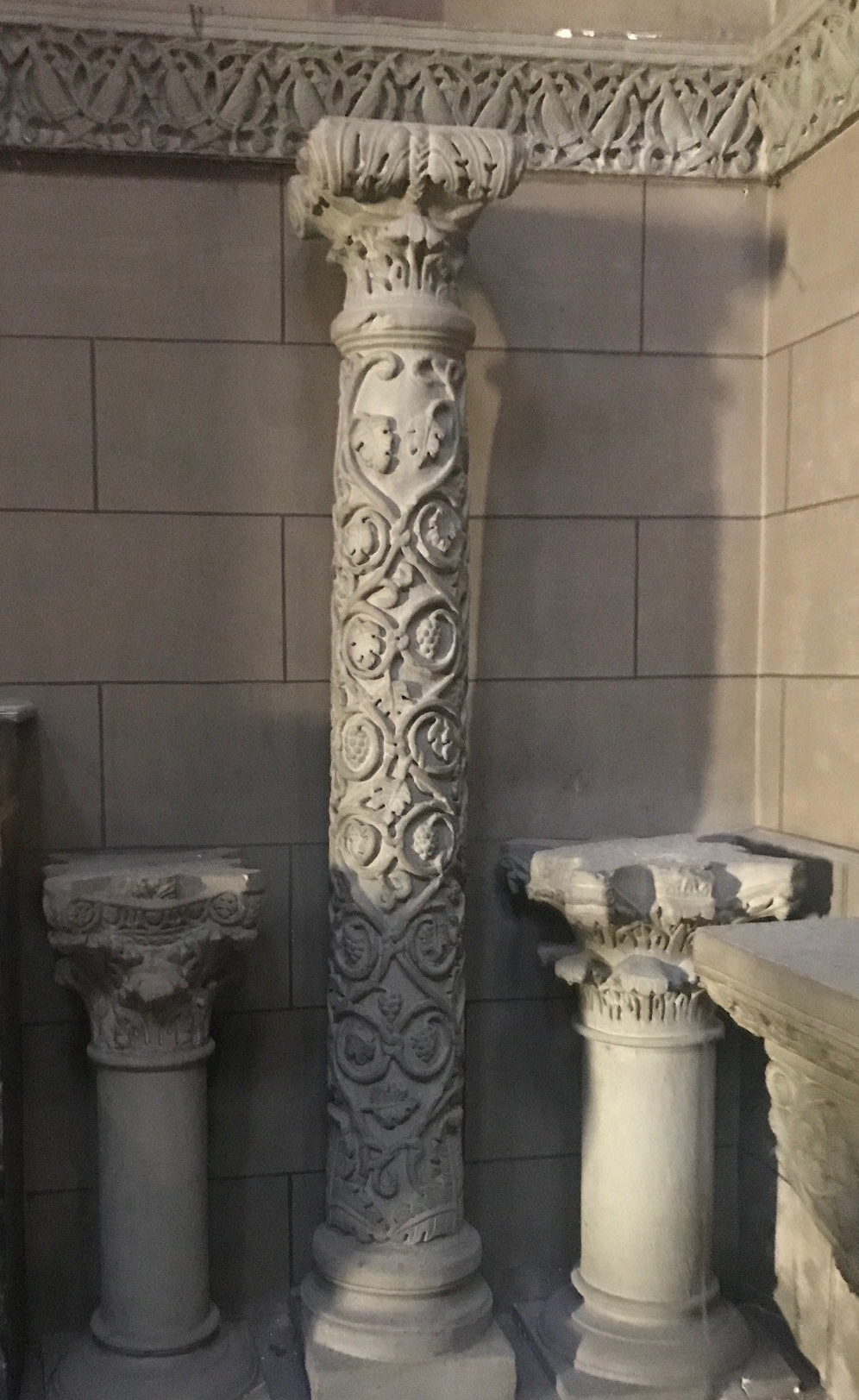
Surviving early column and capital (or replica?) in a Chapel of the current Daurade Church

The demolition of a classical Temple with late antique mosaics puts one in mind of Charles V’s comment when he learned that the stunning mosque at Córdoba had had a standard C16th church inserted at its core. He reputedly said: “You have built here what you or anyone might have built anywhere else, but you have destroyed what was unique in the world.

img_3039.jpeg
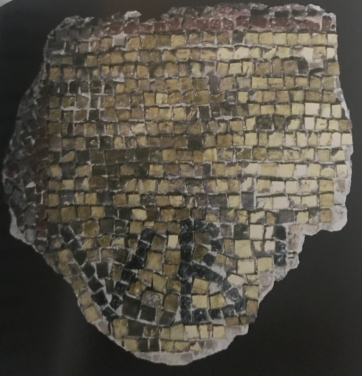
Only remaining piece of Daurade mosaics now in Avignon

All that survives are the late antique columns that were given away after the demolition in the C18th and a small fragment of mosaic with gold tesserae.

IMG_0667
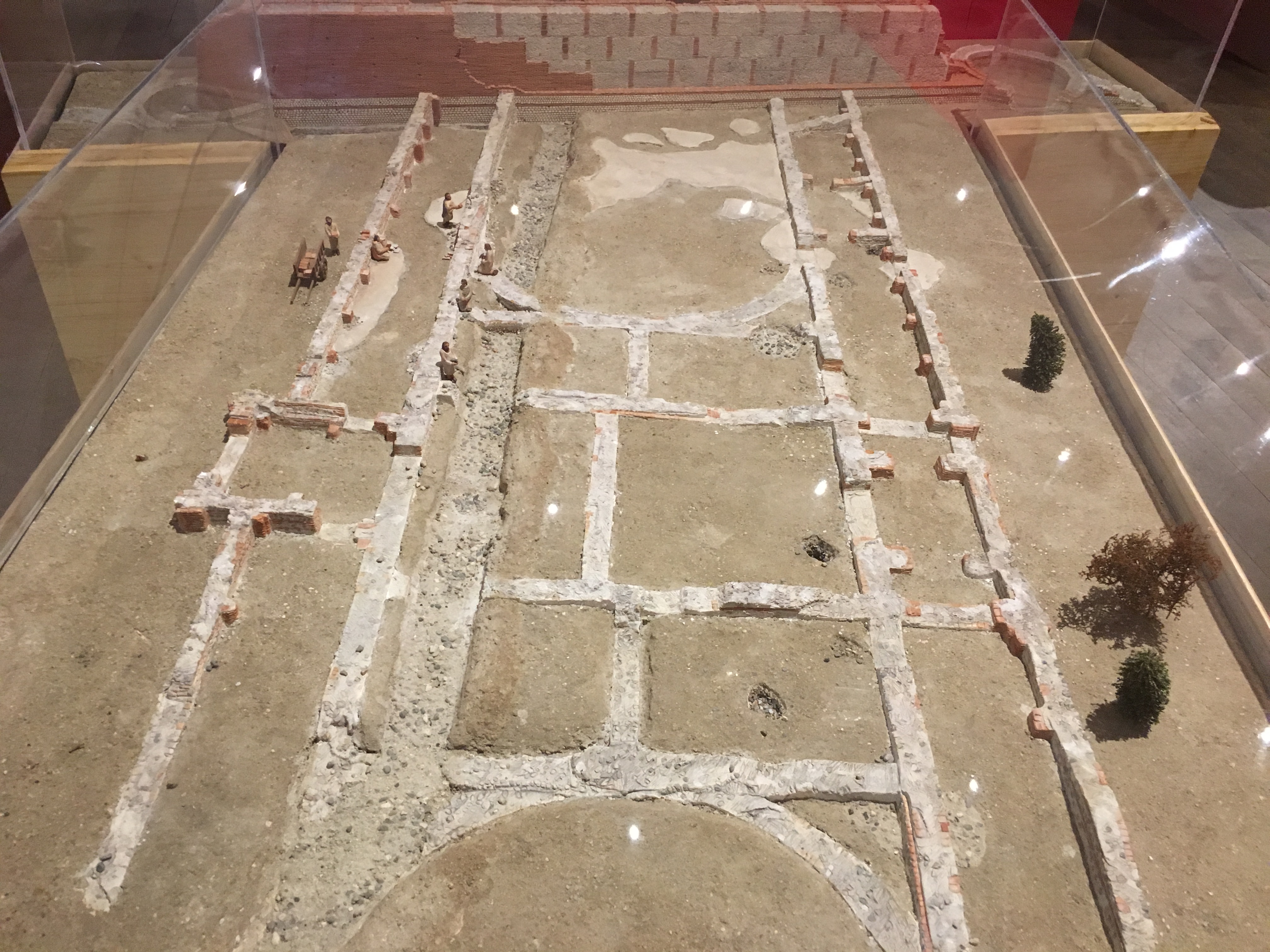
Model of the Remains of the Visigothic Palace revealed in 1989 before their destruction.  Model was in Musée Saint Raymond early 2017.

The Visigothic Palace
This was discovered in 1989 adjoining the Roman city walls on the bank of the River Garonne, near the site of the NW gate of the Roman City.  Although the site was excavated and photographed, there seems to have been no detailed recording made of this unique site and the ruins were not preserved. An undistinguished development of 1990s apartments is no substitute.

Saint Pierre-des-Cuisines

This Church just outside the Roman Walls opposite the Palace and near the Garonne dates from the C5th and was built around a necropolis.  Its core is early and would date to the Visigothic period.

Wall in Jardin des Plantes

There is also a small surviving section of late antique wall in the south of the city in the Jardin des Plantes

IMG_3041
Reconstruction of Wall, Palace and Dourade area of Visigothic Tolosa courtesy of ‘L’ancienne église Sainte-Marie ;a Daurade à Toulouse’ by Quitterie Cazes, published by Musée Saint-Raymond

Toulouse under the Visigoths

Under the Visigoths, Toulouse appears to have prospered more than cities that remained at that time under imperial Roman rule.  Given the dominance of the Garonne Valley down to Bordeaux, and the conquest of Hispania and the Gallic Mediterranean sea-board, Tolosa – unlike many late antique cities – appears to have maintained its population levels.  It was the centre of an expansionist, although barbarian, Arian kingdom, one which was dedicated to preserving the civilisation that had laid the golden eggs.

Imperial Villa of Chiragan – Sculptures at Musée Saint Raymond Toulouse

IMG_2793
Portrait Bust of Augustus Maximianus

Overall Impact:               *** 3 stars – remarkable collection of sculptures BUT little context

Access                                **** 4 stars – in Musée Saint Raymond MSR with lifts

Atmosphere                      ** 2 stars – there could be so much more to say…

Other                                  ***** 5 stars – the artistry of the works is top quality!

On the first floor of the Toulouse Archaeological Museum (le Musée Saint Raymond) are the remarkable remains from the Villa of Chiragan at Martres-Tolosane on the River Garonne, some 60kms south-west of Toulouse. The museum claims, with only a little exaggeration, that ‘the sculptures extracted from this site are exceptional. No other villa in Europe has yielded so many works in marble’.

img_2738.jpeg

Known of from the 17th Century, portrait busts of remarkable quality have been excavated. In 1826 the excavator wrote ‘every quarter of an hour I see a god, a goddess, an emperor come out of the bosom of the earth’. Many are recognisable imperial portraits while others have been interpreted as the procurators and administrators of the imperial domain of forests and quarries and of the imperial tolls and customs.

Excavations at the end of the 18th Century revealed a massive complex of buildings comprising both agricultural production with barns, stables and granaries, and a residence of over 200 rooms with a portico, baths and gardens. They cover 16 hectares in total!

Three broad phases of occupation have been identified. First, a modest villa from the time of Augustus with baths and a peristyle. Secondly, at the time of Trajan, an atrium and two peristyles are added. Finally, at the end of the Second Century, the villa reaches its largest extent and is occupied through to the reign of Arcadius and Honorius at the start of the Fifth Century.

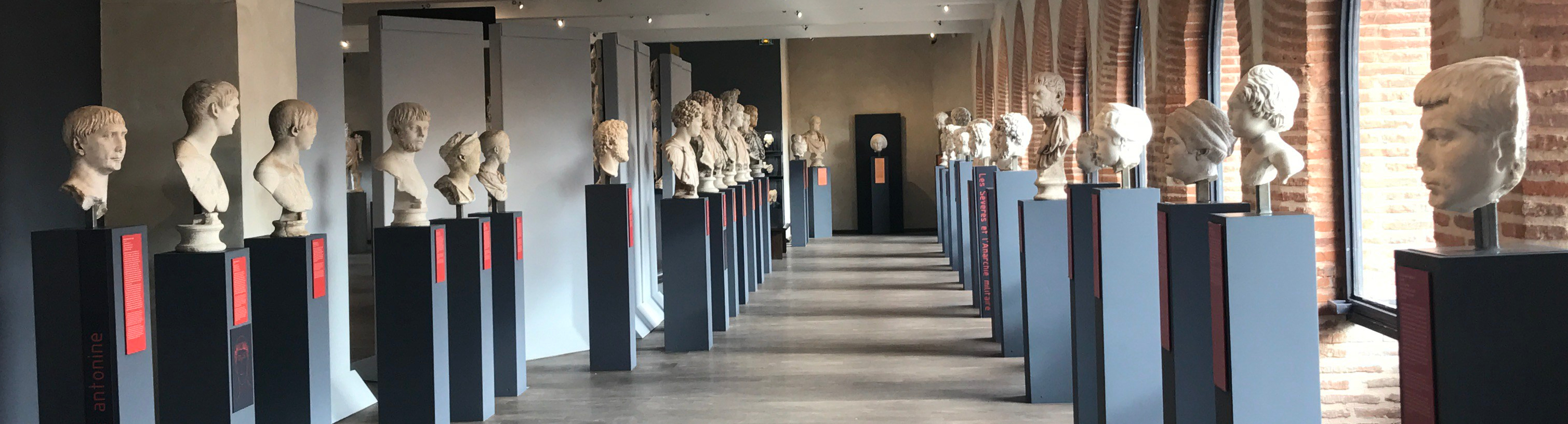
The villa appears to have had a gallery where the portrait busts of Emperors from the First to Fourth Centuries were displayed. There were also many copies of famous Greek works of antiquity, of gods and goddesses, philosophers and satyrs.

The Labours of Hercules. To our mind the most exciting sculptures from the Villa of Chiragan are the reliefs of Hercules. They have been described as ‘baroque’ in style, which is anachronistic, but they are undeniably different from earlier classical statues. Given their scale and energy, they must have been extraordinarily arresting, especially since they were probably painted. It is thought that they were placed on a wall and separated by pilasters.

So what is this villa? It is clearly ‘Imperial’. The key clue seems to be in the largest central panel of the Labours of Hercules. Here we see Hercules killing Geryon, a giant who lived in Southern Spain, before stealing his cattle. The face of Hercules bears a striking resemblance to the portraits of Maximian, who Diocletian appointed in 286 as his fellow-Augustus of the West to share the burden of empire.

Curiously, the giant which Hercules/Maximian is subduing is depicted wearing a cuirass like a Roman general. Could this possibly allude to Maximian’s victories during his campaign against raiding Moors in 296 in Spain, before he crosses the Straits of Gibraltar and crushes the Berbers in 297-8? But the imagery surely makes better sense if it relates to Maximian and his Caesar Constantius crushing Roman usurpers such as the breakaway state of Carausius and Allectus in Britiannia?

IMG_2786
Hercules, who has the face of Maximian, defeating the 3 headed Giant Geryon who is clearly wearing Roman military gear and possibly represents the Usurpers defeated by Maximian and Diocletian as Augusti

Further credence is given to this identification by the strong association which Maximian had with the god Hercules and Diocletian with Jupiter – the premier Legiones Palatinae in the late Roman Army lists are the Ioviani and the Herculiani.

Also, there are portrait busts from Chiragan of Maximian and his wife Galeria Valeria Eutropia, and a youthful portrait of Maximian’s son Maxentius and his wife Valeria Maximilla. (Maxentius, who would have been 18 in 296, went on to be defeated at the Milvian Bridge by Constantine the Great in 312.)

So there must be a strong presumption that Maximian and his family stayed at Chiragan around 295-6 and had the Labours of Hercules carved for them. Maybe they also caused some other wonders to be built here in the foothills of the Pyrenees?


‘Trajan: Building the Empire, Creating Europe’ Exhibition at the Museum of the Imperial Fora at Trajan’s Market, Rome

Overall Impact:               *** 3 stars – fascinating (but did he create Europe?)

Access                                *** 3 stars – Roman stairs and pavement!

Atmosphere                      ***** 5 stars – Italian design, dramatic lighting

Other                                  *** 3 stars – does not quite hold together!

Exhibition is on 29th November 2017 to 16th September 2018

It is very welcome to have a focus on the Emperor Trajan, in many people’s view the “best” Roman Emperor. Adopted from outside the Imperial Family, he was the Emperor who expanded the borders to their greatest extent through the annexation of first Dacia and then Armenia, Assyria and Mesopotamia.

He is in many ways an attractive character who looks out at you from his realistic and unflattering portrait busts with a knowing and somewhat world-weary air.

IMG_1860
Late bronze of the Emperor Trajan

The exhibition is superimposed on the excellent permanent exhibits and restoration of Trajan’s Markets, which contains artefacts from the Imperial Fora and their temples.

You enter through a recreation of the base of Trajan’s Column, which stands a mere 100metres distant. Inside, in deep darkness, a modern Trajan on film exhorts you in Italian and you see two glass vessels old enough that they could have contained the ashes of Trajan and his wife Plotina.

Then in the central hall of the markets there are plaster casts of scenes from the Column indicating his virtues as Creator and Conqueror.

IMG_1876
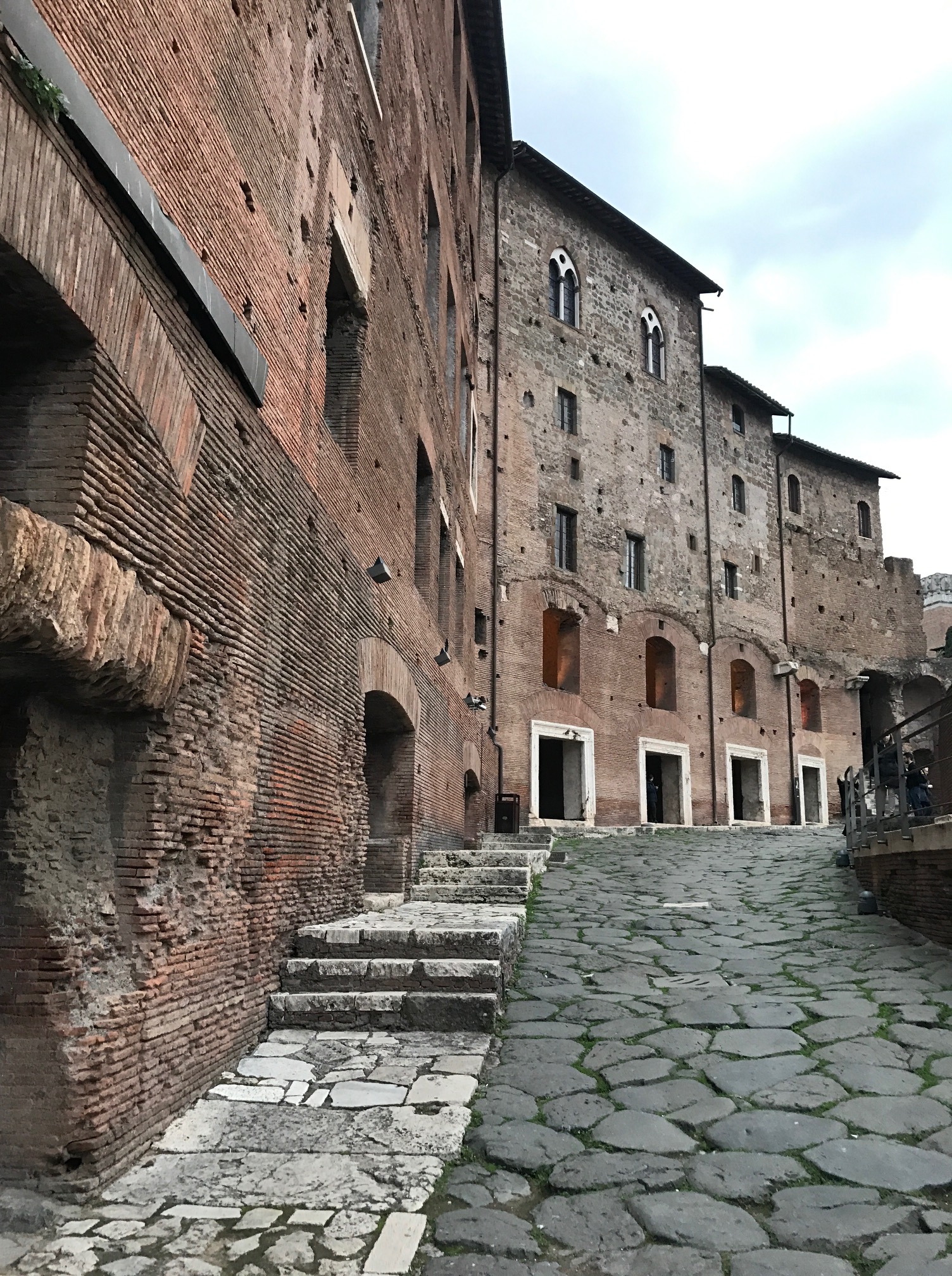
The remarkably surviving Roman street that survives and runs past Trajan’s Market

Opening off the central hall are a number of rooms with exhibits relating to Trajan. The best, to our mind, are the model from the 1930s of an Imperial Triumph, including realistically downcast captives (carried aloft and presumably awaiting their unpleasant fate), and the recreations of the rebuilt Tropaeum from Adamklissi in Dacia (modern Romania), and images of the crude but vital representations of the Dacian Wars that formed its frieze, probably carved by specialists from the legion who fought there.

IMG_1868
Two reconstructions of the Tropaeum at Adamklissi

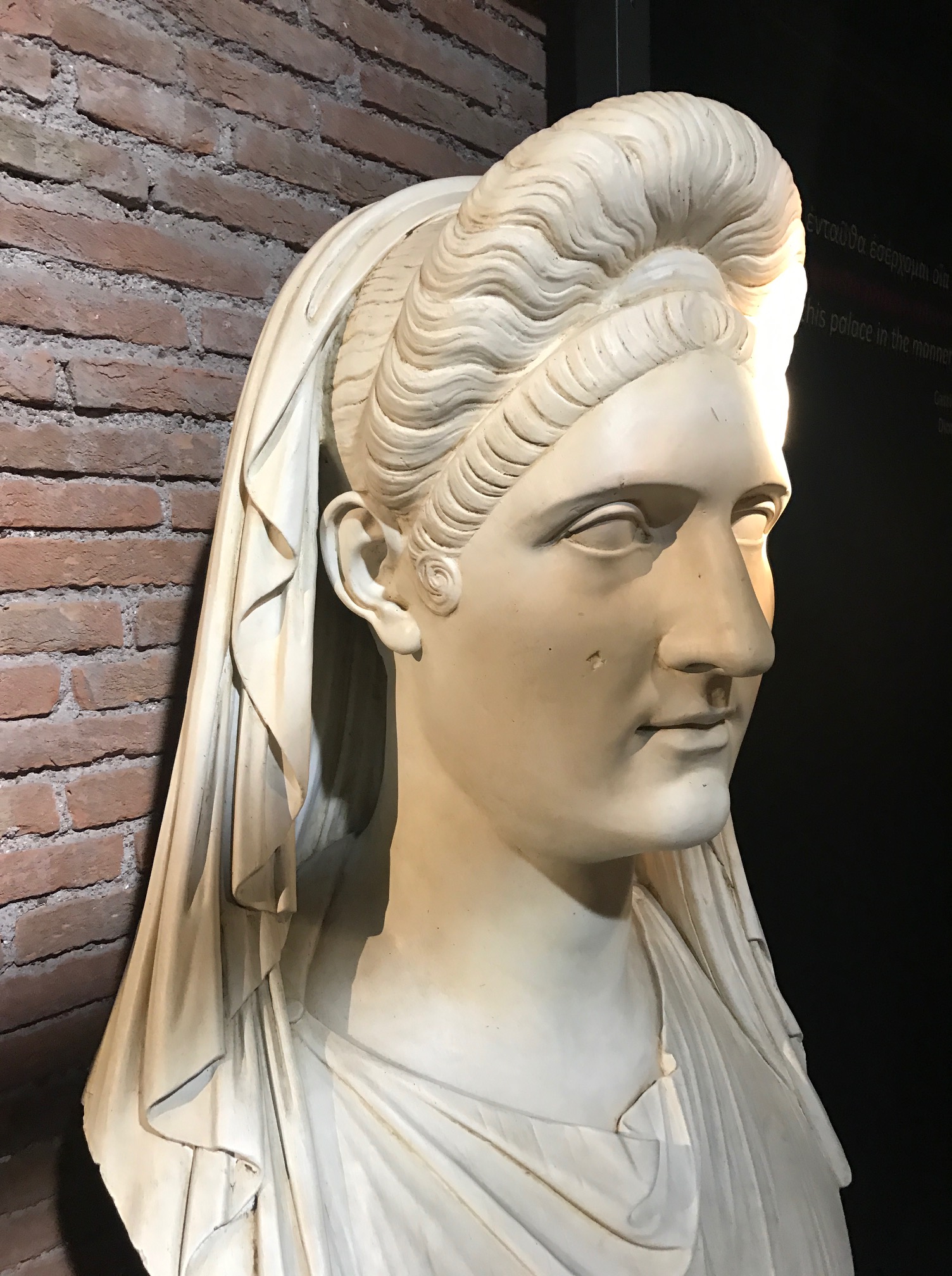
There are well-explained casts of military tombstones and a room featuring busts of Trajan, his father, and his role model, Alexander.  A “large headless statue of a man wearing a cuirass” found in his own Forum is not explicitly identified as Trajan but surely depicts him, particularly as the tabs round the bottom of the cuirass show the emblems of a number of different legions who served in his armies.

IMG_0022
Possible legionary emblems on cuirass

Further on are rooms featuring stunning models of the bridge over the Danube from the Dacian Wars, the bridge at Alcantara in Spain and Trajan’s Temple, the Trajaneum  in Pergamum.

IMG_1911
Model of the Trajanic-era Bridge at Alcantara in Spain

Going upstairs there are features on Trajan’s much-loved and influential wife Plotina, his sister Ulpia Marciana, and her niece Vibia Matidia, and their iconography, complemented by a feature on the activities of women during his reign. This is by far the best coverage of women in an antique exhibition we have seen, showing their role in the Imperial family and in society.

IMG_1924
Bust of Trajanic period

The small collection of stamps on ceramics recording businesswomen’s identities is particularly good.  We also learn about Trajan’s frumentarium (a tax-funded social security scheme) for poor families.

IMG_0046
Brick stamp from Julia Procula’s brick works

We then progress to a fascinating video about what may have been his house before he became Emperor, a site now only accessible by descending through a manhole into the depths below a car park. One can but hope that this will be restored and opened up to the public in the future, allowing us to admire the painted rooms. Then we see images off his rural palace at Arcinazzo in the mountains, highlighted by amazing and painstaking recreations of delicate plaster work and wall paintings.

IMG_0051
Brilliantly restored plaster-work from Trajan’s Country Palace at Arcinazzo

So, as you can see from the above description; there is much here that is unmissable and every Romanist should try and visit it if possible.

However, we have three caveats, two minor and one major. Let’s get the two minor ones out of the way. The exhibition in each room is shoe-horned in amongst the already excellent Trajan’s Markets exhibits, so it is somewhat incoherent. Some rooms beyond the main hall are also very easy to miss, unless one picks up the very modest leaflet in the ticket hall, which forms the only English guide. Secondly, the catalogue is large and sumptuous – but entirely in Italian. As the good information panels in the exhibition itself are bilingual, it is a pity even that relatively brief material is not included in the catalogue. We would then have loved to buy it!

Thirdly, it is to our mind misconceived – although understandable in these uncertain times – to claim that Trajan “founded Europe”. He ruled and extended an Empire that spanned three continents – Europe, Africa and Asia – which was built around Mare Nostrum, the Mediterranean.   Furthermore, he was a great Emperor – arguably indeed the best – but he was Emperor of Rome, all-powerful crusher of the Dacians and Persians, benefactor of the poor, builder of infrastructure, and supreme ruler of the Roman World. The Empire of AD117 was at its height a unitary super-state of the Ancient World and vastly different in almost all dimensions – economy, governance, culture and values – from the Europe of Charlemagne, Charles V or the present day. (It is therefore interesting that all three claim to be the heir of Rome!)

Paul and Sally

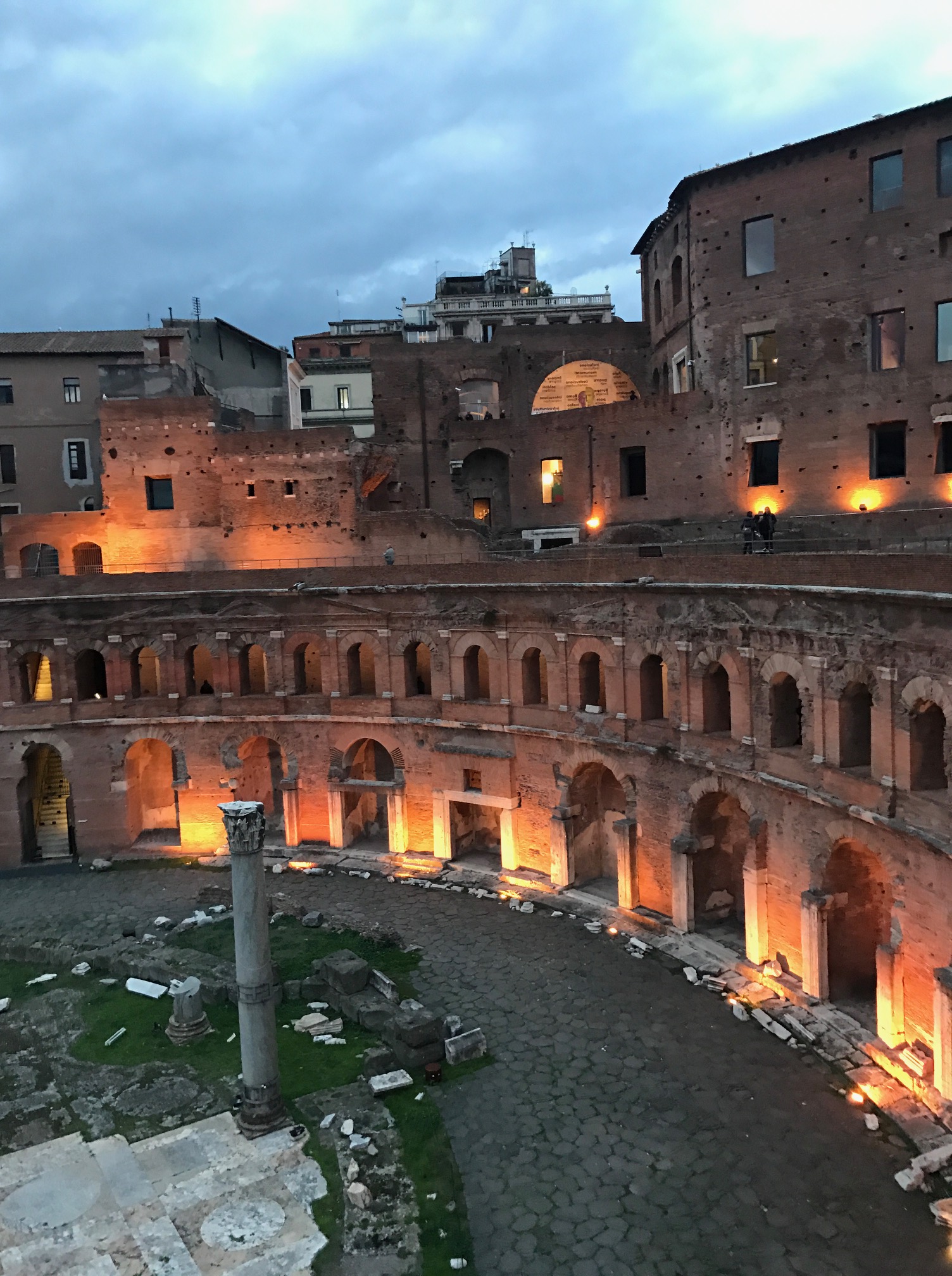
IMG_1896
Trajan’s Market at dusk. In reality these were more likely offices than markets.

Dura Europos Room at Yale University Art Museum

Overall 4**** A hotly-disputed four, given the points below. 
Display 3*** Let down by minimal labelling and not much context. Very much the academic art-historical approach – given where it is, not surprising. 

Access 4**** It’s at Yale in New Haven CT, so a long way to go – we drove for 2 hours from Boston!  But it’s free and there is easy parking near. 

Atmosphere 3*** Studious art-historical setting. Given what they have, they could make of their unique Roman exhibits. 

Other 6****** This rating is in recognition of the uniqueness of the finds – the only legionary shield – and its decoration intact; the only figurative synagogue decorations; the only intact Mithraeum decorations; and one of only three sets of cataphract armour!
In  1920 a British Army unit occupying former Ottoman territory stumbled across wall paintings in the ruins of the City of Dura Europos on the banks of the River Euphrates.  They notified the eminent American archaeologist Professor Breasted of the University of Chicago.

Dura had been founded on the upper Euphrates by the Hellenistic ‘Successor’ Seleucids around 300BCE, and had been taken over by the Parthians in C2BCE, becoming a major fortified crossroads of East-West trade.  It was captured by the Romans in AD166 during Verus’ Parthian War.  It then formed a frontier garrison on the Euphrates for the Romans with strong influence and troops from the Roman ally of Palymra.  In 256AD the Sassanids, the successors of the Parthians in the East, besieged Dura successfully and sacked it.  

The excavations at the site at Dura in the 1920s and 1930s were led by a Yale University team lead by the Russian emigré Prof Rostovtzeff and the French Academy of Inscription and Letters.  Owing to the siege that led to the end of Dura and its abandonment, many remarkable and unique finds dating principally from the Tge Third Century AD were uncovered.  The Romans had reinforced their most vulnerable sector on the west of the city by piling up earth and sand behind the walls, thus hermetically sealing a whole sector of the city.  Furthermore, the Sassanids and Romans mined and countermined under a tower which then collapsed, entombing both Roman and Sassanid soldiers.

The Yale expedition took their share of the finds home and these are well displayed in the Yale Art Gallery in New Haven, Connecticut.  

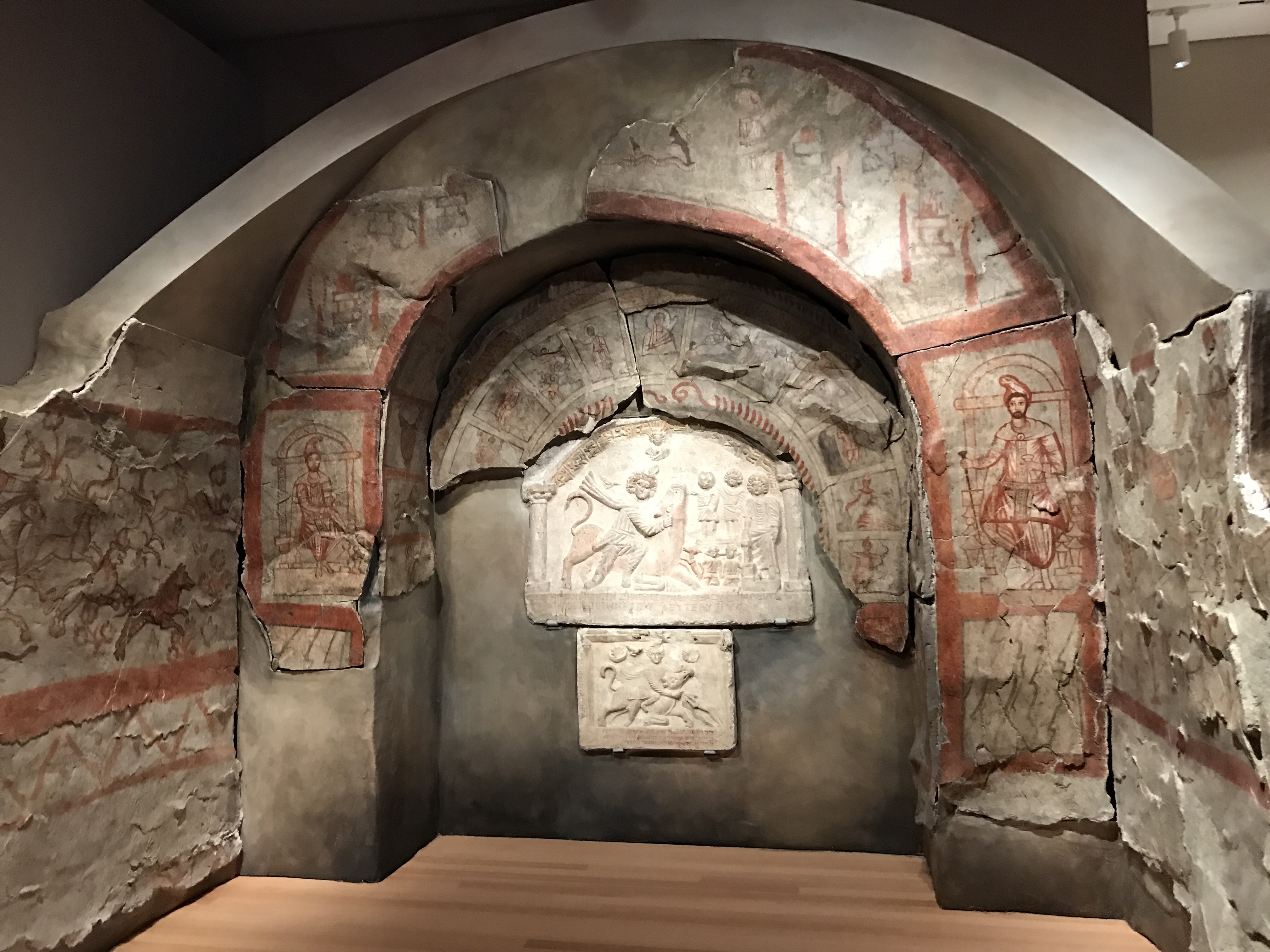
A connecting theme of the Yale displays is the co-existence of many cultures and religions in this Roman frontier city.  There is evidence of Latin, Greek, Palmyrenean, Hebrew, Safaitic and Pahlavi being spoken.  Turning to religion, there are temples to the eastern gods of Syria, the local deity Dolichenus being associated with Jupiter from the Roman Pantheon.  There is an early example of a Christian house church with a baptistery.  There is synagogue with painted ceiling tiles, showing figurative art previously not recognised in Jewish art.  Perhaps most extraordinary of all is a well-preserved Roman Mithraeum intact paintings, set up by a unit of Palmyran horse archers.  Finally, there is a painting of a dedication by a Roman tribune and his unit to three deified Emperors in military uniform.  Taken together, this is a stunning assemblage of mid-Third Century AD religious items and paintings reflecting the great diversity of beliefs and religions in the Empire at this period.  

The other extraordinary assemblage of finds is the military remains.  There is a unique legionary semi-cylindrical scutum and a large oval auxiliary shield.  Both are painted, with the scutum preserving remarkably clear decorations. The display does not offer any interpretation of the motifs on the scutum, but we think the lion suggests an association with Legio XVI Flavia Firma which was based in the Province in that era and had proven tunnelling expertise from the port of Selucia.

Alas, the oval shield has not been so well preserved, but watercolour paintings of this and two others made at the time of the excavations fortunately record the very intricate and colourful patterns.  
Even more remarkable are the circumstances of the finds.  Deducing what happened from the excavations, it seems that in AD265 the Sassanid besiegers dug a mine under a tower of the western wall of Dura. The Romans, hearing their approach, dug a counter-mine and broke in to the diggings.  However, the Sassanids had prepared counter measures of pitch, sulphur and bitumen that gave off deadly gases in the confined space. 

The Sassanids then seem to have piled up about 20 dead Roman soldiers, complete with their shields, into a barrier whilst they prepared to demolish the tower by setting fire to the props of the tunnel with more bitumen.  The Sassanid soldier who set the fire put down his helmet and sword, but lingered too long and was overcome in his turn by the fumes.


There are many other interesting finds in the Museum including Palmyran sculptures and everyday items of life from the city. 

Here are some more photos from this stunning set of finds. 

The Ara Pacis in Rome

IMG_0680 (1)

Overall          5***** uniquely interesting memorial of Age of Augustus (and his PR machine)

Display          5***** super display of the altar and explanations; coloured lighting at night

Access           5***** we liked windows in the controversial cover building; good disabled access

Atmosphere 4**** not particularly numinous, being rather clinical and art-historical

Other             5***** Our first site with 3 ***** main criteria!

The Ara Pacis Augustae was commissioned by the Roman Senate in 13BCE to commemorate Augustus’ return to Rome after his three years re-ordering Gaul and Spain.  It was consecrated in 9BCE. It was located on the open Campus Martius to the north of Rome, to the west of the Via Flaminia, and dedicated to Pax – the Goddess of Peace.

The exterior is decorated with allegorical and historical panels in the upper part, including scenes of Augustus and his family processing to a sacrifice.  The men are in priestly clothing and there are women and children in the procession.  The historical scenes have seated figures of Roma and Pax, with the discovery of Romulus and Remus and possibly the sacrifice by Aeneas.  The lower part has natural themes with intertwined vines, flowers and wildlife.

This is an important example of Augustan propaganda, combining nature and prosperity with themes of traditional Roman religion and establishing his family as Rome’s ‘first family’.  It shows how tightly he controlled the Respublica 20 years after Actium.

From the outset the Ara Pacis began to sink into the marshy ground and it was only rediscovered in the C16th.  Parts were excavated over time until, in 1937, Mussolini decided to re-assemble the Altar to mark the 2,000th anniversary of Augustus’ birth, and to place it next to Augustus’ Mausoleum to create a fascist ‘Augustus Theme Park’.

The hastily constructed 1930s cover building decayed and a new replacement by Richard Meier opened in 2006 to great controversy.  We rather liked it, as the Altar is displayed with lots of natural light and is visible from outside the building.

IMG_0659

IMG_0681
Model with original arrangements – Ara Pacis to left background on Campus Martius, with Augustan Mausoleum in foreground, and Pantheon in background.


Introducing Caerleon Legionary Fortress

Overall         4**** A lot to see: for Britannia, these are substantial visible remains

Display         3*** Museum brilliant and Cadw great at Baths (amphitheatre & barracks less so)

Access           4**** You can walk around whole site with Caerleon village; easy parking

Atmosphere 4**** Once you have walked around you can start to imagine the Fortress

Other            5***** Caerleon is very rare in Britannia, since the other Legionary Fortresses (Colchester, Gloucester, Exeter, Lincoln, Chester and York) are under modern cities and there is little of the Fortress to see at Wroxeter (and nothing at Inchtuthil)

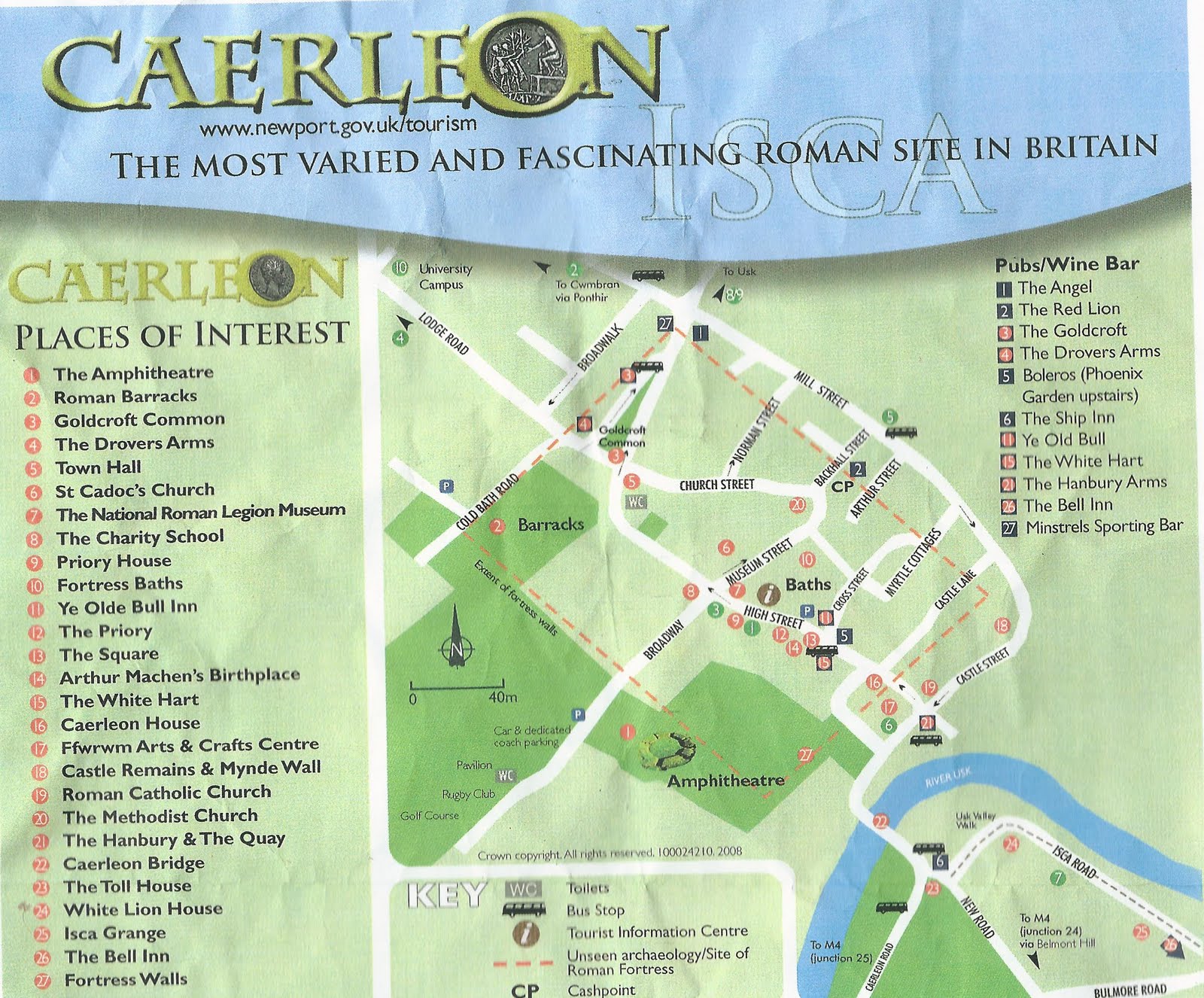
Caerleon Legionary Fortress of Legio II Augusta consistes of:

  • The Natatio and part of Frigidarium and Apodyterium of the internal Fortress Baths
  • The exposed Ramparts on the South and West sides
  • The Amphitheatre, just outside the South-West Gate
  • The ‘only exposed legionary barrack block in the Empire (?)’
  • The Legion Museum of the National Museum of Wales

Having failed to complete the conquest of the resident Iron Age tribe the Silures in South Wales in the AD50s, in AD75 Legio II Augusta moves from Exeter (Isca Dumnoniorum) to Caerleon (Isca) to complete the conquest. Unsurprisingly, the Romans have to quell determined military resistance.

The first fortress is constructed of timber with turf and earth ramparts. At a date quite soon after (probably around AD80) the whole fortress is rebuilt in stone, and a set of impressive fortress Baths are built in stone from the outset. By now, conditions for the occupiers are improving significantly .

In AD90 the Amphitheatre is begun and the fortress Baths receive their first refurbishment.  Then, in AD122, most of Legio II Augusta moves north to build Hadrian’s Wall, but Caerleon remains operational.

In AD 130 the Baths receive a total reshape, including new changing rooms, and the pool is shortened.

In AD193 under Septimius Severus, despite an apparent rebuild of the Principia (HQ), Isca is abandoned or at least ‘mothballed’.  This presumably reflects Legio II Augusta’s role campaigning in Scotland with the Emperor, with plans for permanent deployment in the North.  (Severus had deployed legions in his new Province of Mesopotamia in AD197.)

In AD211 the plan to abandon Isca is dropped and under Emperor Caracalla major repairs are undertaken  to the Fortress, Amphitheatre and Baths.  Legio II Augusta gains the title Anoniniana – ‘Caracalla’s Own’.

By AD250 major components of the Legion have left as vexillations (detachments) to fight in the Anarchy of the C3rd, leaving large parts of the Fortress unoccupied.

There is some rebuilding of barracks in AD253-258 and around AD274.

Between AD287 and 296 the main buildings of the Fortress are demolished and Legio II Augusta is moved to Richborough, possibly by the military commander – then usurper – Carausius, in order to defend against Channel raiders and, thereafter, against the legitimate Empire.

Caerleon

pf_sf_interpretation
The plan of the Stone Fortress, courtesy of Caerleon Research Committee