Overall Impact: *** 3 stars – remarkable collection of sculptures BUT little context
Access **** 4 stars – in Musée Saint Raymond MSR with lifts
Atmosphere ** 2 stars – there could be so much more to say…
Other ***** 5 stars – the artistry of the works is top quality!
On the first floor of the Toulouse Archaeological Museum (le Musée Saint Raymond) are the remarkable remains from the Villa of Chiragan at Martres-Tolosane on the River Garonne, some 60kms south-west of Toulouse. The museum claims, with only a little exaggeration, that ‘the sculptures extracted from this site are exceptional. No other villa in Europe has yielded so many works in marble’.
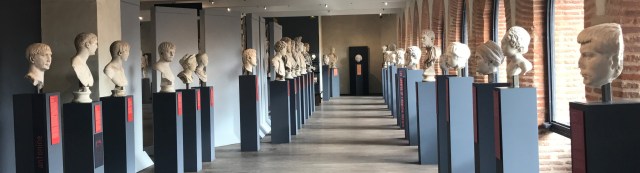
Known of from the 17th Century, portrait busts of remarkable quality have been excavated. In 1826 the excavator wrote ‘every quarter of an hour I see a god, a goddess, an emperor come out of the bosom of the earth’. Many are recognisable imperial portraits while others have been interpreted as the procurators and administrators of the imperial domain of forests and quarries and of the imperial tolls and customs.
Excavations at the end of the 18th Century revealed a massive complex of buildings comprising both agricultural production with barns, stables and granaries, and a residence of over 200 rooms with a portico, baths and gardens. They cover 16 hectares in total!
Three broad phases of occupation have been identified. First, a modest villa from the time of Augustus with baths and a peristyle. Secondly, at the time of Trajan, an atrium and two peristyles are added. Finally, at the end of the Second Century, the villa reaches its largest extent and is occupied through to the reign of Arcadius and Honorius at the start of the Fifth Century.


The villa appears to have had a gallery where the portrait busts of Emperors from the First to Fourth Centuries were displayed. There were also many copies of famous Greek works of antiquity, of gods and goddesses, philosophers and satyrs.
The Labours of Hercules. To our mind the most exciting sculptures from the Villa of Chiragan are the reliefs of Hercules. They have been described as ‘baroque’ in style, which is anachronistic, but they are undeniably different from earlier classical statues. Given their scale and energy, they must have been extraordinarily arresting, especially since they were probably painted. It is thought that they were placed on a wall and separated by pilasters.
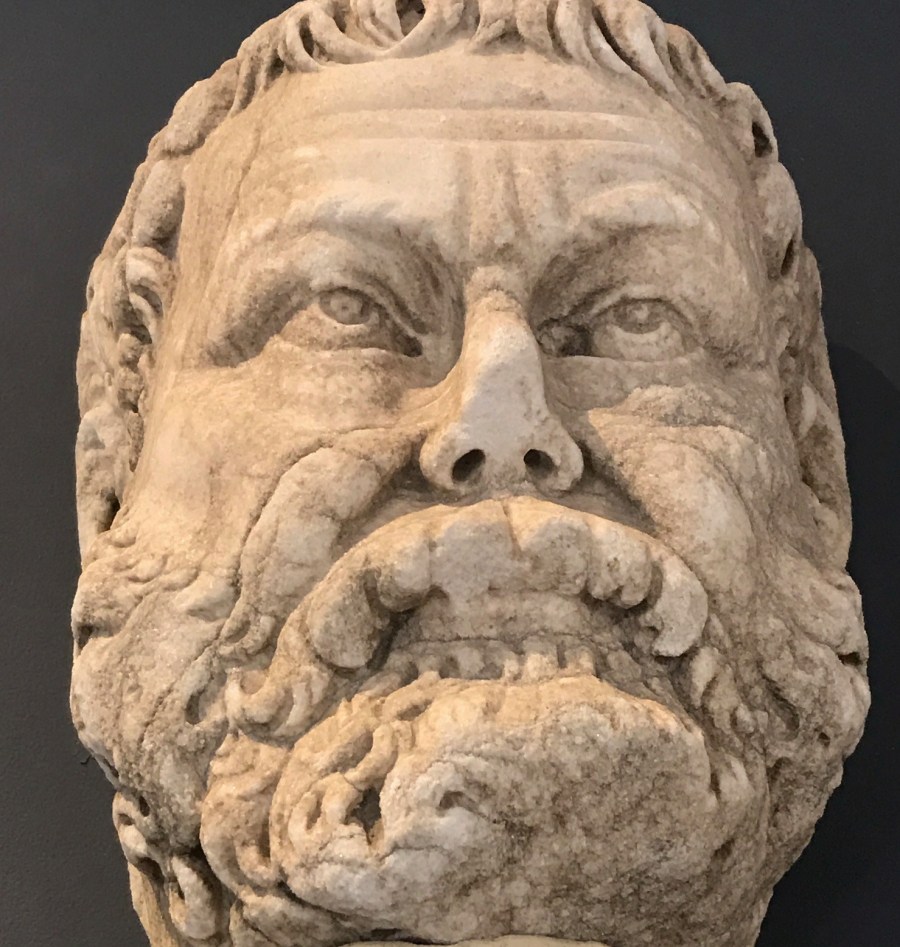
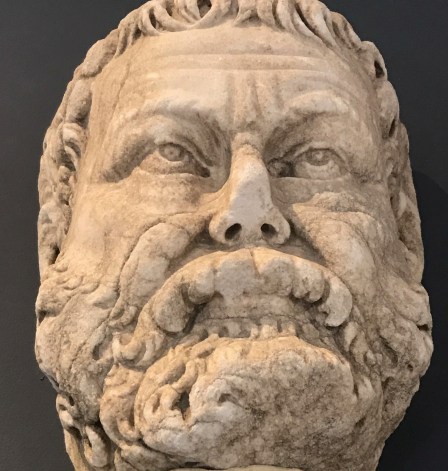
So what is this villa? It is clearly ‘Imperial’. The key clue seems to be in the largest central panel of the Labours of Hercules. Here we see Hercules killing Geryon, a giant who lived in Southern Spain, before stealing his cattle. The face of Hercules bears a striking resemblance to the portraits of Maximian, who Diocletian appointed in 286 as his fellow-Augustus of the West to share the burden of empire.
Curiously, the giant which Hercules/Maximian is subduing is depicted wearing a cuirass like a Roman general. Could this possibly allude to Maximian’s victories during his campaign against raiding Moors in 296 in Spain, before he crosses the Straits of Gibraltar and crushes the Berbers in 297-8? But the imagery surely makes better sense if it relates to Maximian and his Caesar Constantius crushing Roman usurpers such as the breakaway state of Carausius and Allectus in Britiannia?

Further credence is given to this identification by the strong association which Maximian had with the god Hercules and Diocletian with Jupiter – the premier Legiones Palatinae in the late Roman Army lists are the Ioviani and the Herculiani.
Also, there are portrait busts from Chiragan of Maximian and his wife Galeria Valeria Eutropia, and a youthful portrait of Maximian’s son Maxentius and his wife Valeria Maximilla. (Maxentius, who would have been 18 in 296, went on to be defeated at the Milvian Bridge by Constantine the Great in 312.)


So there must be a strong presumption that Maximian and his family stayed at Chiragan around 295-6 and had the Labours of Hercules carved for them. Maybe they also caused some other wonders to be built here in the foothills of the Pyrenees?

