

Overall 6 ****** a must-see Roman Colonia with ‘one of everything’
Display 5 ***** informative bilingual display boards all around the City
Access 3 *** in a well laid-out archaeological park – parking is difficult
Atmosphere 6 ****** remarkable assemblage of Roman remains
Other 4 **** Merida has Spain’s Roman Museum (closed on Mondays of course!)
The Roman Colonia of Emerita Augusta was founded in 25 BCE by P. Carisius, legate of Augustus, for veteran soldiers (emeriti) from the bloody wars against the Cantabri in the north of the Iberian Peninsular. The soldiers originally came from Legio V Alaudae and Legio X Gemina, and later from VI Victrix and VII Gemina.
Emerita guarded the principal crossing of the River Guardiana (Fl. Ana in Latin) and became the capital of the Roman Province of Lusitania. The territorium of the Colonia stretched out as far as 100kms from the City.
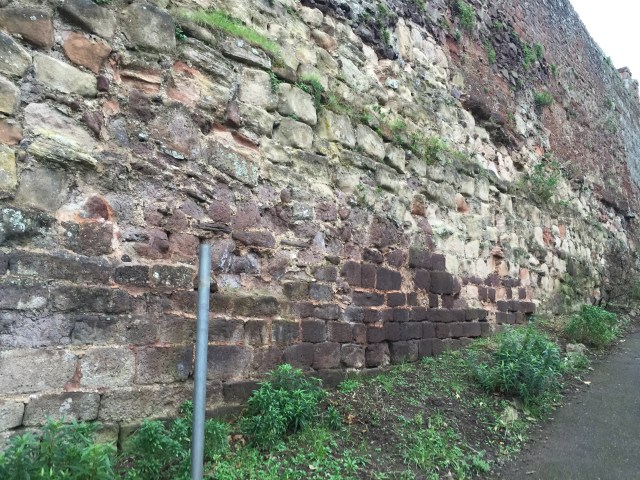
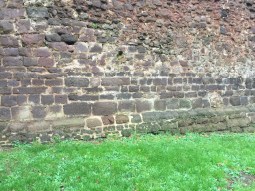
The original settlement was probably a rectangle like a military camp, possibly with the surviving Arch of Trajan marking one of its gates. Later, in the 3rd Century, a much larger city wall was built enclosing the amphitheatre and theatre in the north-east, to protect the City against the rampaging Franks and Alamanni who had by then broken into the Empire.

Emerita contains a remarkable assemblage of Roman remains including a bridge of 57 arches over the Guardiana which carried the Roman road from Asturica Augusta in the north to Italica in the south. (See our separate post about the bridge.)
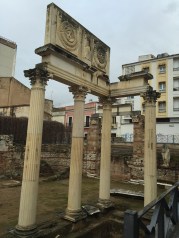

There are remains of the Forum and porticos, a Temple to Rome (wrongly called the Temple of Diana) adjacent to the Forum, and the remains of the Temple of Mars under the Church of Santa Eulalia in the west.
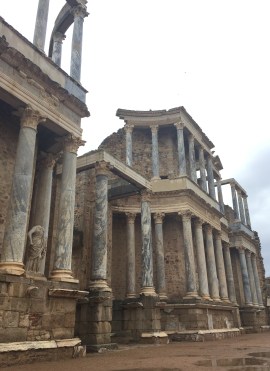
The most remarkable remains are the “entertainment quarter” in the north-east, containing arguably the best-preserved Theatre in the Roman World for refined entertainment, a large Amphitheatre for gladiatorial games, and a Circus for chariot racing.
Excavations at the Alcazabar (later Arab citadel) have revealed Roman streets and insulae inside a Roman wall, and remains of the Roman dyke that protected the river quality, an ancient forerunner of Bazalgette’s ‘interceptor sewer’ in London.
Emerita had a large population whose water consumption required advanced hydraulic systems fed by two large reservoirs, both of which are still in working order. The Proserpina Reservoir could hold 8 million cubic metres of water. Two aqueducts fed the town.
There is also a stunning Roman Archaeological Museum with the finds from Emerita, in a modern building made out of replica Roman brick. Sadly the museum was closed on our Monday visit to Merida (although we did see it years ago), so we will need to review it on a future occasion.
So why the very high score of 6 stars? The Bridge, Amphitheatre and especially the Theatre are wonderfully preserved, they are well presented and there are enough other key Roman buildings preserved (temples, porticos and aquaducts) that it gives you a real feeling for what a major Roman Colonia was like.


 Roman Sites
