

Overall Impact: *** 3 stars – fascinating (but did he create Europe?)
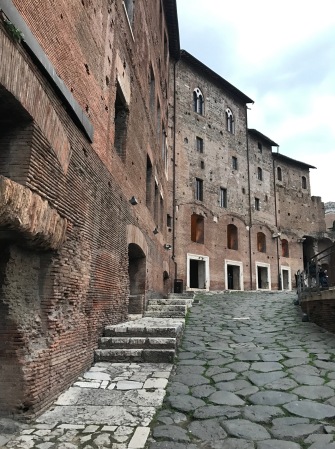
Access *** 3 stars – Roman stairs and pavement!
Atmosphere ***** 5 stars – Italian design, dramatic lighting
Other *** 3 stars – does not quite hold together!
Exhibition is on 29th November 2017 to 16th September 2018
It is very welcome to have a focus on the Emperor Trajan, in many people’s view the “best” Roman Emperor. Adopted from outside the Imperial Family, he was the Emperor who expanded the borders to their greatest extent through the annexation of first Dacia and then Armenia, Assyria and Mesopotamia.
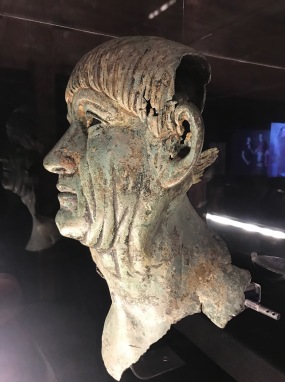
He is in many ways an attractive character who looks out at you from his realistic and unflattering portrait busts with a knowing and somewhat world-weary air.
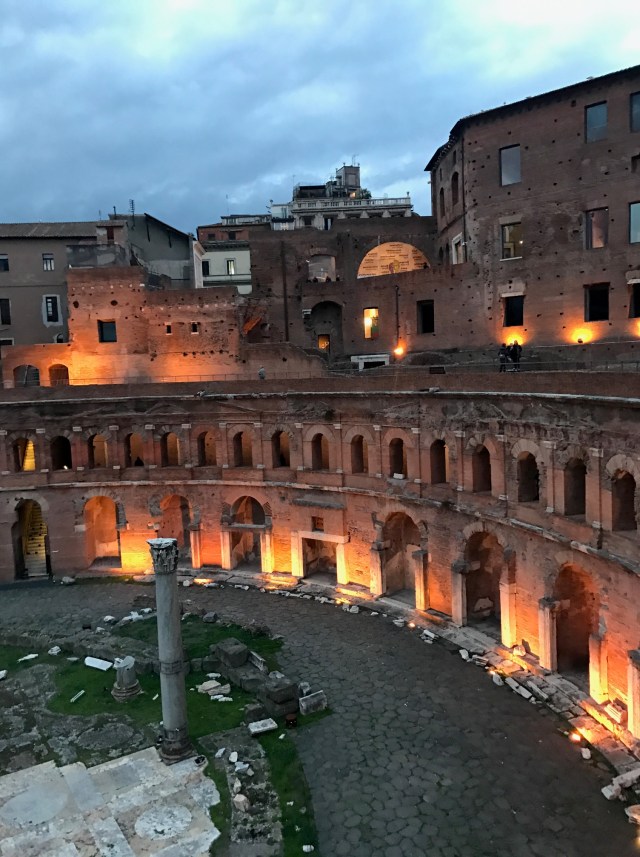
The exhibition is superimposed on the excellent permanent exhibits and restoration of Trajan’s Markets, which contains artefacts from the Imperial Fora and their temples.
You enter through a recreation of the base of Trajan’s Column, which stands a mere 100metres distant. Inside, in deep darkness, a modern Trajan on film exhorts you in Italian and you see two glass vessels old enough that they could have contained the ashes of Trajan and his wife Plotina.
Then in the central hall of the markets there are plaster casts of scenes from the Column indicating his virtues as Creator and Conqueror.
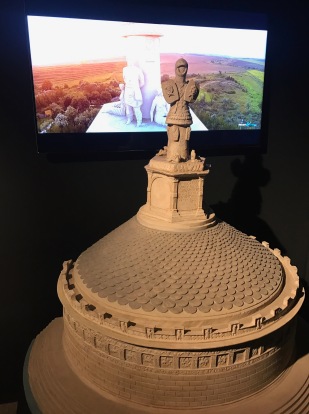
Opening off the central hall are a number of rooms with exhibits relating to Trajan. The best, to our mind, are the model from the 1930s of an Imperial Triumph, including realistically downcast captives (carried aloft and presumably awaiting their unpleasant fate), and the recreations of the rebuilt Tropaeum from Adamklissi in Dacia (modern Romania), and images of the crude but vital representations of the Dacian Wars that formed its frieze, probably carved by specialists from the legion who fought there.
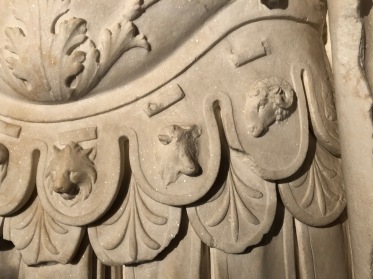
There are well-explained casts of military tombstones and a room featuring busts of Trajan, his father, and his role model, Alexander. A “large headless statue of a man wearing a cuirass” found in his own Forum is not explicitly identified as Trajan but surely depicts him, particularly as the tabs round the bottom of the cuirass show the emblems of a number of different legions who served in his armies.
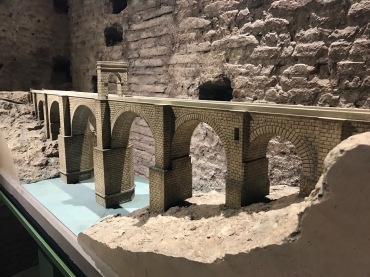
Further on are rooms featuring stunning models of the bridge over the Danube from the Dacian Wars, the bridge at Alcantara in Spain and Trajan’s Temple, the Trajaneum in Pergamum.
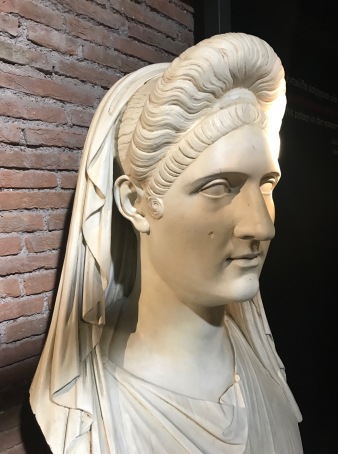
Going upstairs there are features on Trajan’s much-loved and influential wife Plotina, his sister Ulpia Marciana, and her niece Vibia Matidia, and their iconography, complemented by a feature on the activities of women during his reign. This is by far the best coverage of women in an antique exhibition we have seen, showing their role in the Imperial family and in society.
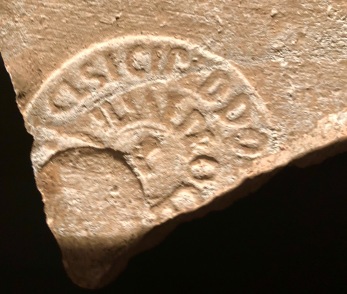
The small collection of stamps on ceramics recording businesswomen’s identities is particularly good. We also learn about Trajan’s frumentarium (a tax-funded social security scheme) for poor families.
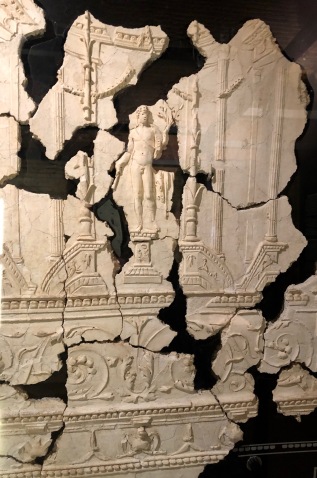
We then progress to a fascinating video about what may have been his house before he became Emperor, a site now only accessible by descending through a manhole into the depths below a car park. One can but hope that this will be restored and opened up to the public in the future, allowing us to admire the painted rooms. Then we see images off his rural palace at Arcinazzo in the mountains, highlighted by amazing and painstaking recreations of delicate plaster work and wall paintings.
So, as you can see from the above description; there is much here that is unmissable and every Romanist should try and visit it if possible.
However, we have three caveats, two minor and one major. Let’s get the two minor ones out of the way. The exhibition in each room is shoe-horned in amongst the already excellent Trajan’s Markets exhibits, so it is somewhat incoherent. Some rooms beyond the main hall are also very easy to miss, unless one picks up the very modest leaflet in the ticket hall, which forms the only English guide. Secondly, the catalogue is large and sumptuous – but entirely in Italian. As the good information panels in the exhibition itself are bilingual, it is a pity even that relatively brief material is not included in the catalogue. We would then have loved to buy it!
Thirdly, it is to our mind misconceived – although understandable in these uncertain times – to claim that Trajan “founded Europe”. He ruled and extended an Empire that spanned three continents – Europe, Africa and Asia – which was built around Mare Nostrum, the Mediterranean. Furthermore, he was a great Emperor – arguably indeed the best – but he was Emperor of Rome, all-powerful crusher of the Dacians and Persians, benefactor of the poor, builder of infrastructure, and supreme ruler of the Roman World. The Empire of AD117 was at its height a unitary super-state of the Ancient World and vastly different in almost all dimensions – economy, governance, culture and values – from the Europe of Charlemagne, Charles V or the present day. (It is therefore interesting that all three claim to be the heir of Rome!)
Paul and Sally
 Roman Sites