Featured

Brading Villa IoW

Overall Impact *** 3 stars, good – if damaged – mosaics under an ultra-modern cover building, with a rather nice café attached!

Roman Features **** 4 stars, there are several mosaics in situ, unusually for a British site, so they deserve to be seen.

Reconstruction None

Access **** 4 stars, once reached (local roads narrow), very good with disabled access.

Atmosphere ** 2 stars, it’s quite hard to get the feel of the villa, although the computer reconstructions are good.

Other ***** 5 stars, keen volunteers. Any site that’s maintained on local enthusiasm and acts as a community hub deserves all our encouragement!

We were spending the night in Winchester and were looking forward to following in Vespasian’s caligae through the hill forts of the Durotriges the next day, when we happened across a tweet from @bradingromanvilla.org.uk Since we had never visited Brading Villa and it claimed to have some of the best mosaics in the country (and furthermore one of us had never crossed the Solent), we decided on the spur of the moment to visit it.

We recommend you cross the Solent too, if you have the chance…

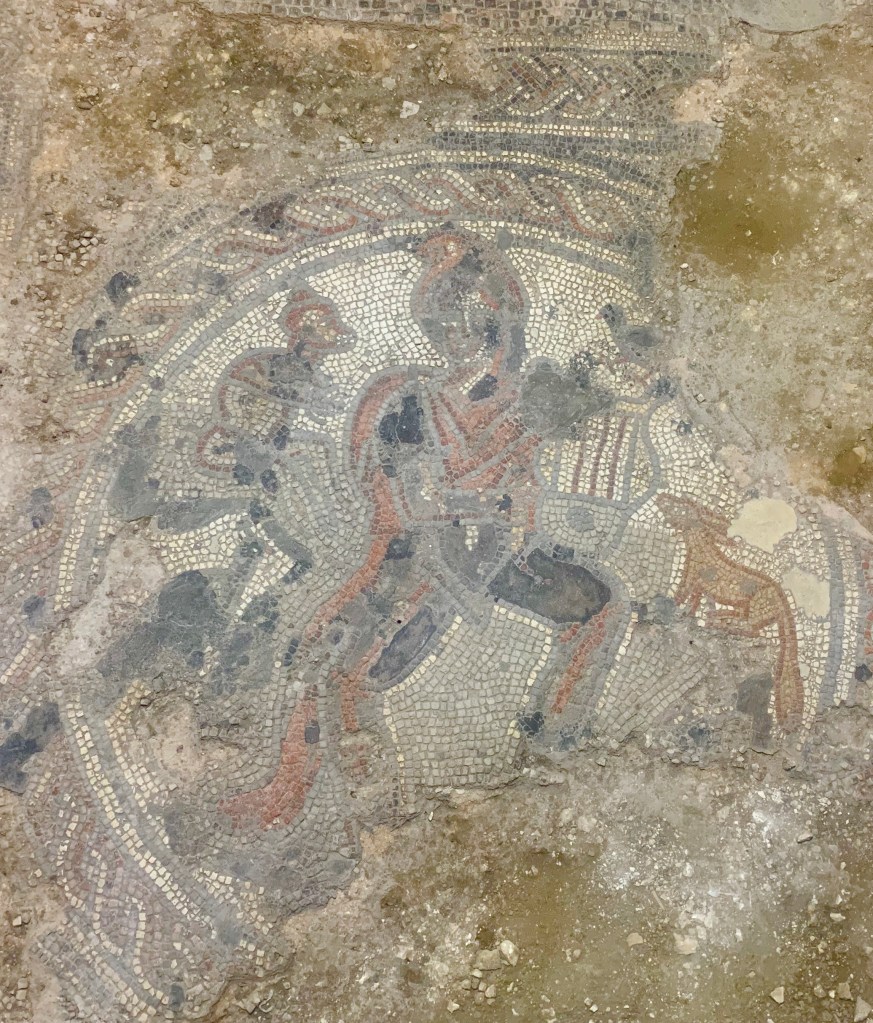
Orpheus charming the animals – alas, much damaged.

If we are really honest, the mosaics are good but they suffered, first, from the occupation of squatters in the villa in the C5th who put in a corn-dryer in part of the floor, then started fires in the wooden structure. Then, following discovery of the mosaics were left in the open with only temporary covers by the Victorian owners for 10 years. Finally, flooding in January 2004 deposited water from the fields above the villa on to the mosaics. The water. being fertiliser impregnated, alas bleached out much of the remaining colour from the mosaics.

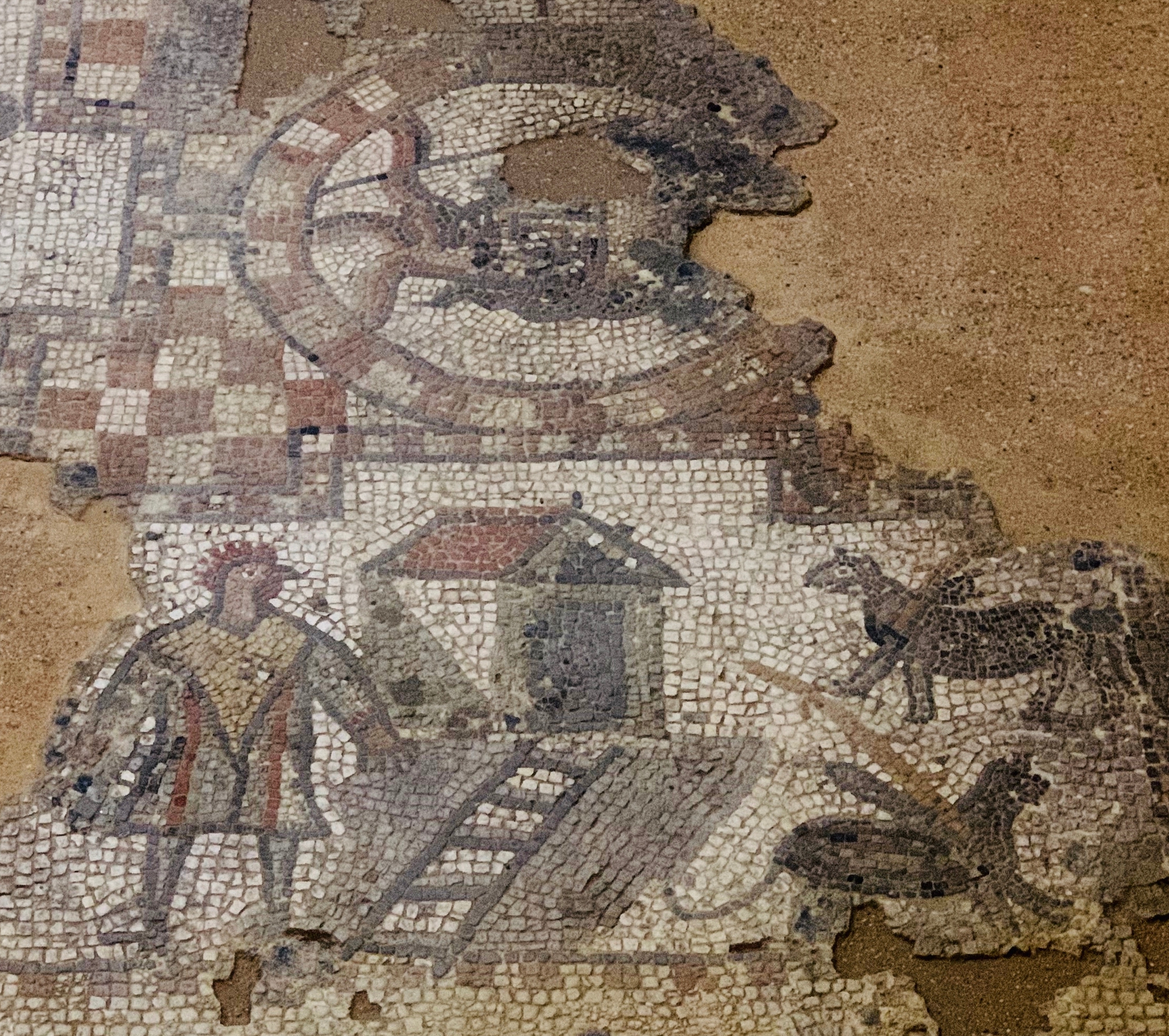
Detail of a Seasons Mosaic with Winter wrapped up against the cold.

None of this should deter a visit. Brading has been run by a Charitable Trust since 1994 and they have, after the disaster of the floods, raised funds to erect a startlingly excellent environmentally-sensitive cover building, complete with a strong room for travelling exhibitions – the British Museum’s Hoards exhibition was on display when were were there. There are up-to-the-moment digital reconstructions of the local landscape and how a hypocaust works. There are games for child visitors and much explanation. (There are some idiosyncratic assertions in the displays – for instance on the ‘degeneracy’ of the C4th Army. ) All good fun.

Nice reconstruction of the Villa at its height in the C3rd with both the main Western Building in occupation and the North Building with barn and baths.

The Villa was discovered in 1870 by the local farmer, Mr Munns. A local retired army officer, Captain Thorp, was looking for antiquities and he realised what this was, and he and Munns uncovered the famous ‘Gallus Mosaic’. The local landowners, the Oglanders, purchased the whole site and got in some London archaeologists to excavate the rest of the villa – none too carefully, it appears: Captain Thorp had been keeping better records!

The star attraction the Gallus mosaic. There are various explanations that this is a Gladiator called ‘Gallus’, or a satire on C4th politics and the Eastern Emperor Gallus (unlikely).

The Villa is in three parts which, following recent re-excavations by Oxford University, have been interpreted as three successive stages in its development, reflecting the social prestige of its inhabitants. The enthusiastic and knowledgeable volunteer curator explained to us that, on the conquest of the Isle of Wight (Vectis) the leaders of the Iron Age village which was situated just east of the villa site, moved and built a villa on the South Range in the second half of the C1st. Then, around AD200 the North Range was added with a baths suite. Finally, the luxurious West Range dates from AD300 and was a final upgrade to the living conditions, complete with mosaics with classical references.

Since the disastrous flood, the site has been purchased by a Charitable Trust who operates the site in an enterprising fashion. There is a well-stocked gift shop ranging from the usual Roman souvenirs up to replica mosaics, should you fancy upgrading your dining room or bathroom! They also have a large café/restaurant which was doing a roaring trade in Sunday lunches. And on Saturday nights, mainstream movies are screened there – good for them. The cover building is a modern architectural masterpiece designed to touch the site as little as possible and spans the area spectacularly. Finally, the Trust has built a secure gallery so that visiting exhibitions can be accommodated.

Iron Age torcs from a Norfolk hoard, visiting Brading when we were there.
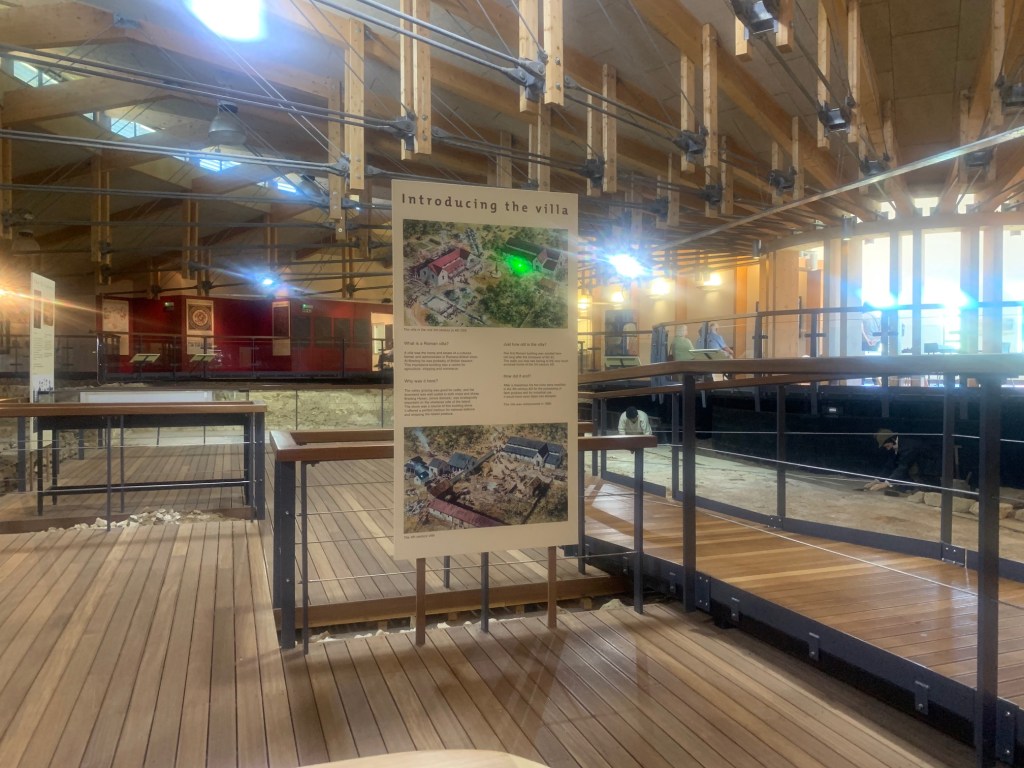
The modern cover building.

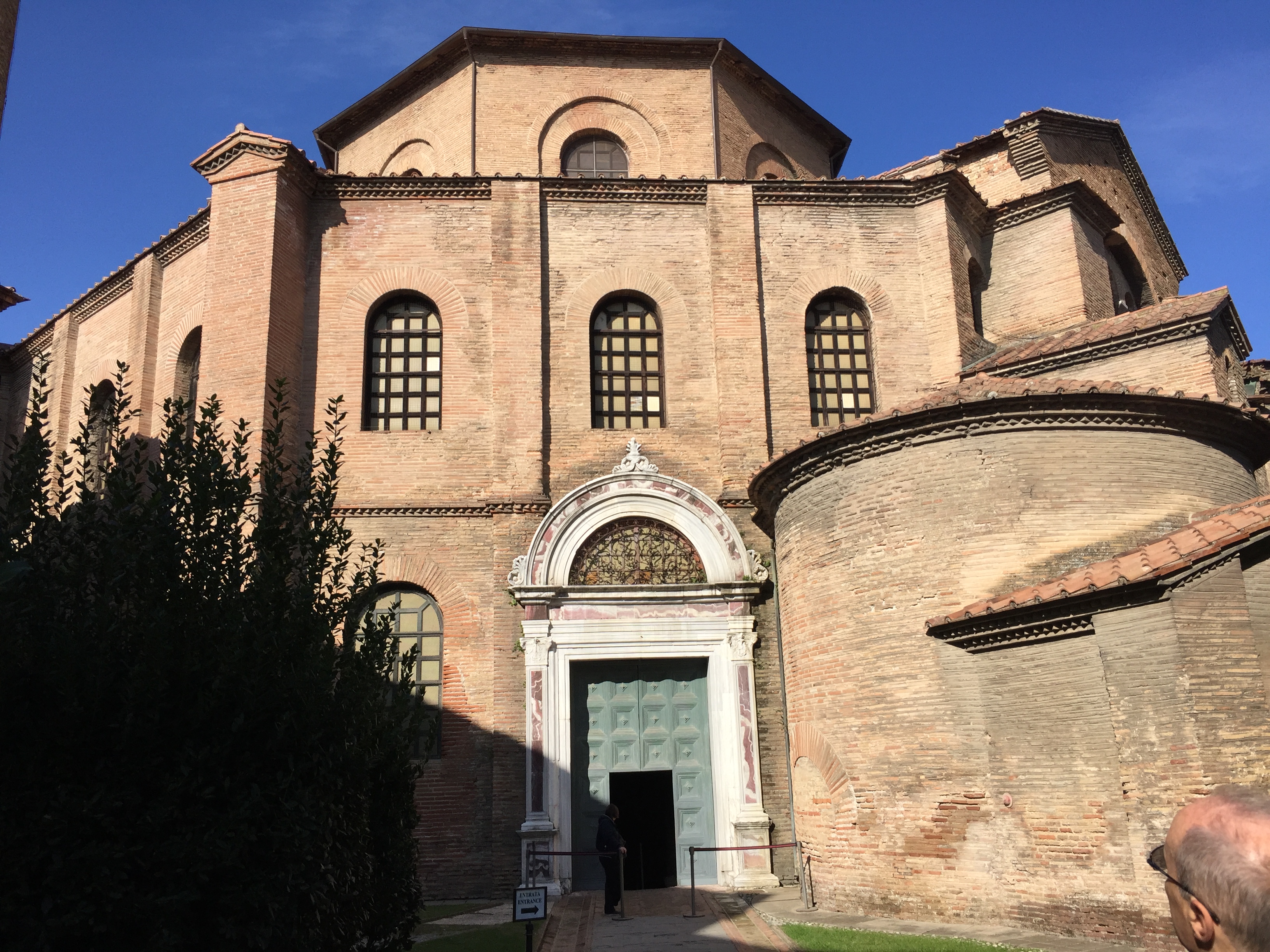
Basilica of San Vitale Ravenna

IMG_0196

Overall          *****  5 stars – original building and superb mosiacs

Display         3 – very good guide books available, little on site

Access           4 – open and accessible on UNESCO trail

Other             Marks the re-imposition of Roman orthodoxy

San Vitale was begun in 526 under Ostrogothic rule, by the Orthodox (Roman) Bishop Ecclesius.  It was finished under Bishop Maximian who was sent out from Constantinople after the reconquest by Belisarius.  It was paid for by Julius Argentarius.  Maximian is definitely depicted in the courtiers behind Justinian in the mosaic in the apse, as Julian may be.

IMG_0173

San Vitale is octagonal in plan, preceded by a narthex, flanked by two towers and appears to be heavily influenced by contemporary architecture in Constantinople, where Ecclesius had long resided.  The apse is as usual semi-circular on the inside and polygonal on the outside.  Above the main body of the Church is a polygonal lantern.  It is supposedly is of the same design as the Imperial Audience Chamber in Constantinople.  There are no parallels of this design in Italy.

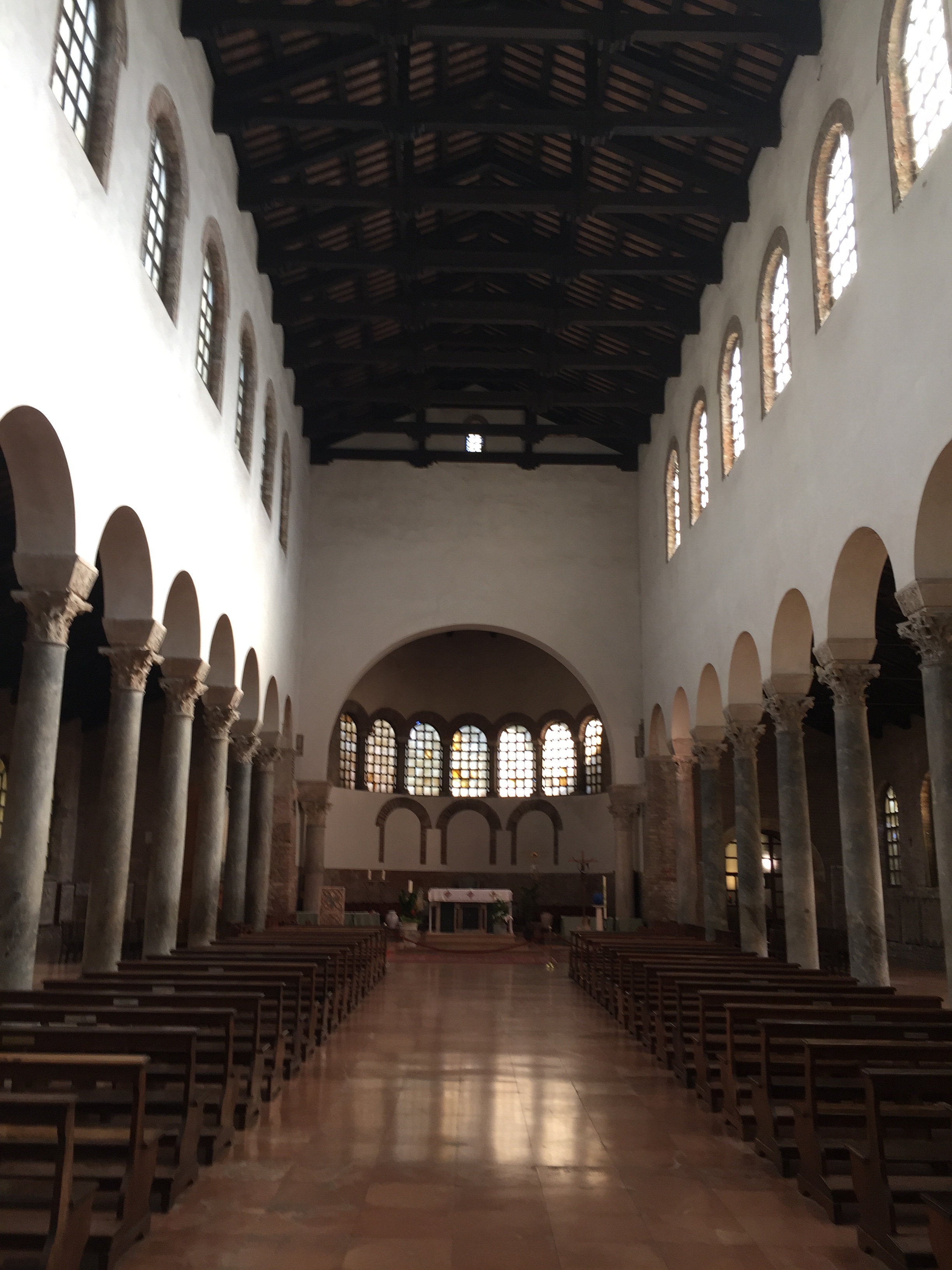
On entering S. Vitale on a sunny day you are struck by the varied play of light and dark, with shafts of sun-light slanting down and illuminating the columns, capitals and above all causing the mosaics to shine and sparkle.

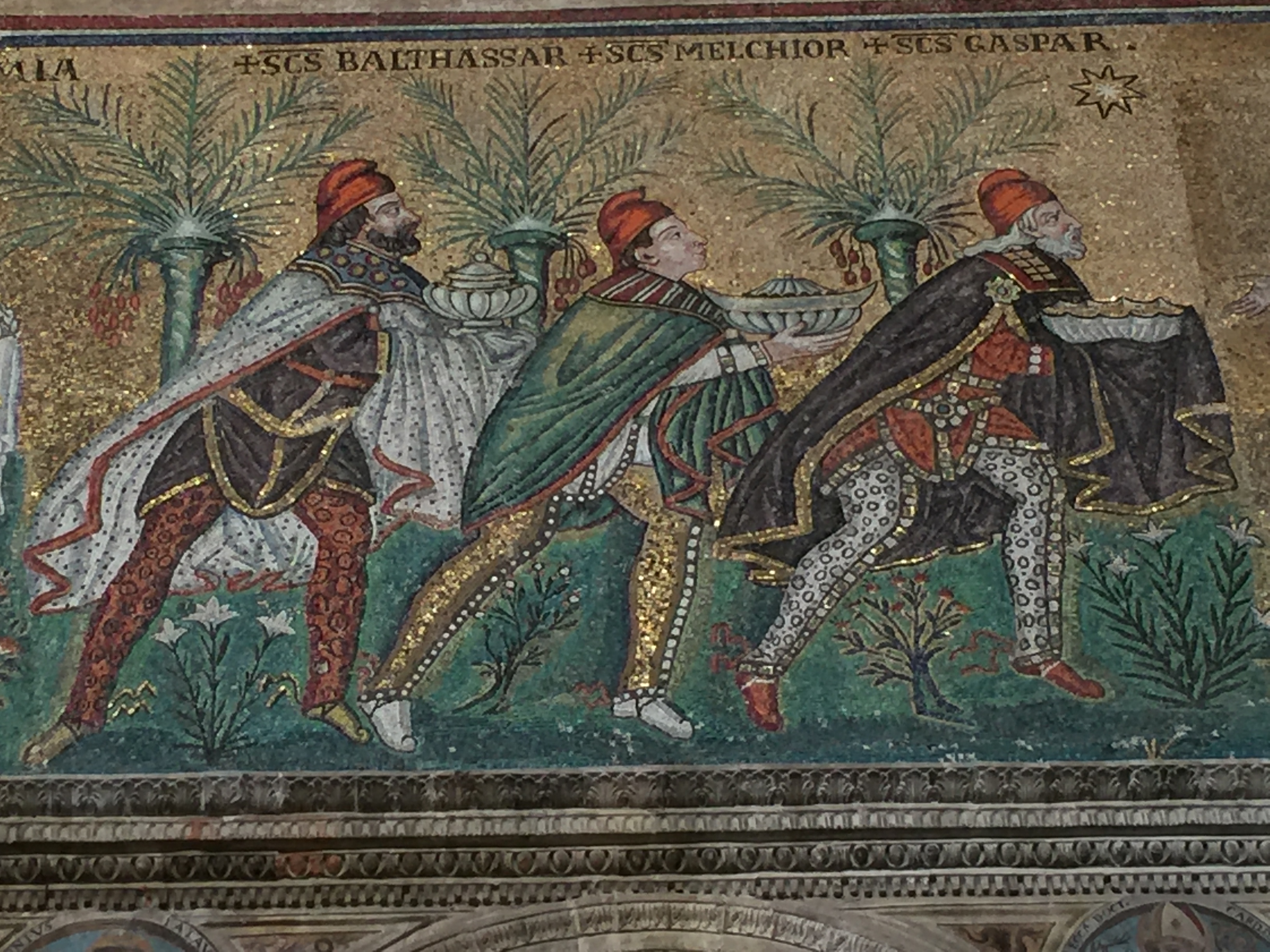
The main glory of S. Vitale are the magnificent mosaics, which testify to the brilliance of the artists and craftsmen of 6th Century Ravenna.  It is tempting to describe them but no words can do them justice, nor indeed photos or professional portraits.  You just have to see them!

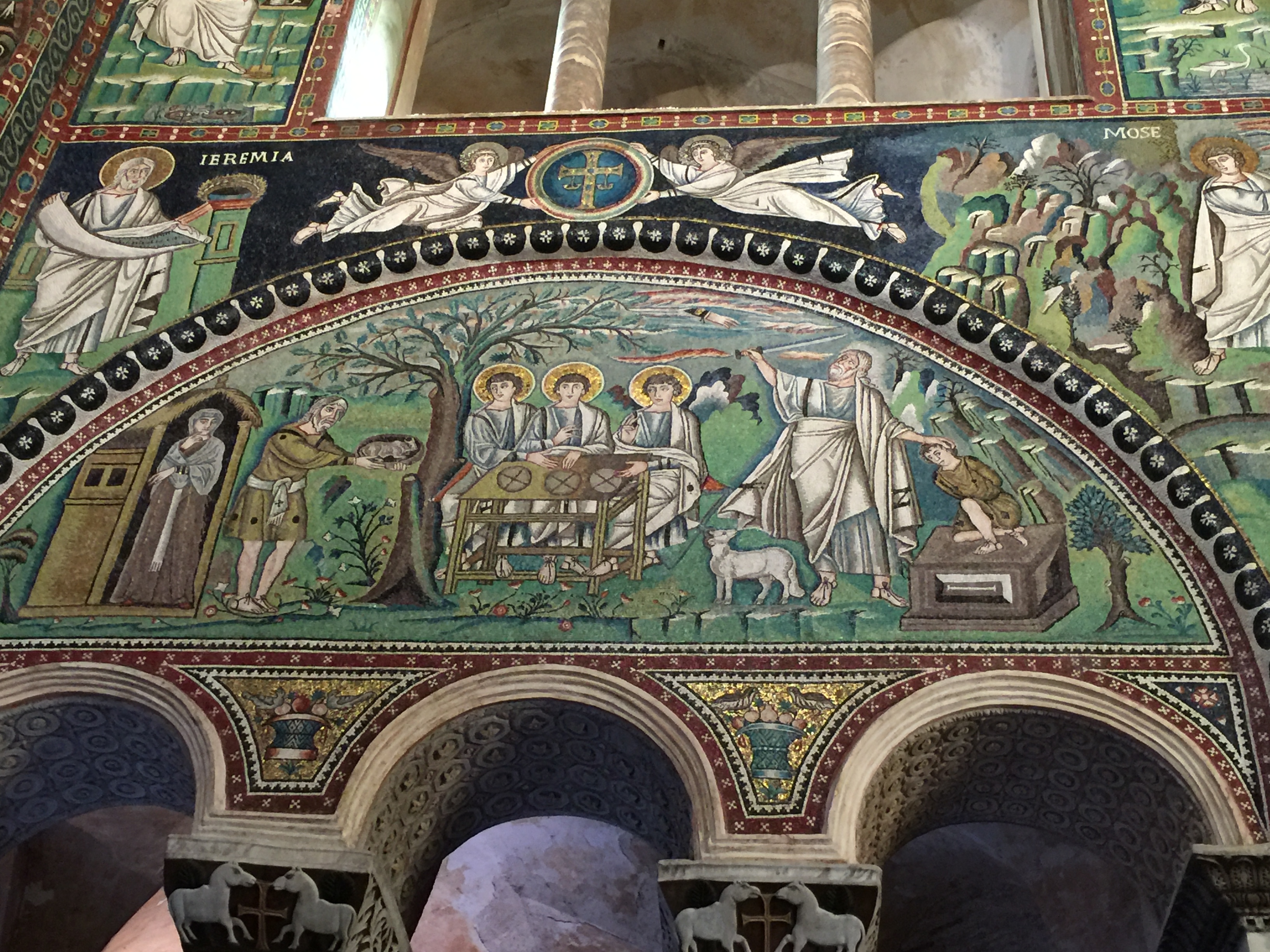
The Presbytery mosaics are all about the Sacrifice of the Eucharist.  Thus the triumphal arch leading into the Presbytery is decorated with 15 busts of Christ, the Apostles and Ss. Gervais and Protassius, said to be the sons of S. Vitale.   In the ceiling at the centre stands the Mystic Lamb supported by four praying angels.  On the side walls next to figures of the evangelists, prophets and Moses are scenes of sacrifice from the Book of Genesis – the Hospitality of Abraham and the Sacrifice of Issac, and the Offered Sacrifces of Abel and Melchizedek.

IMG_0186

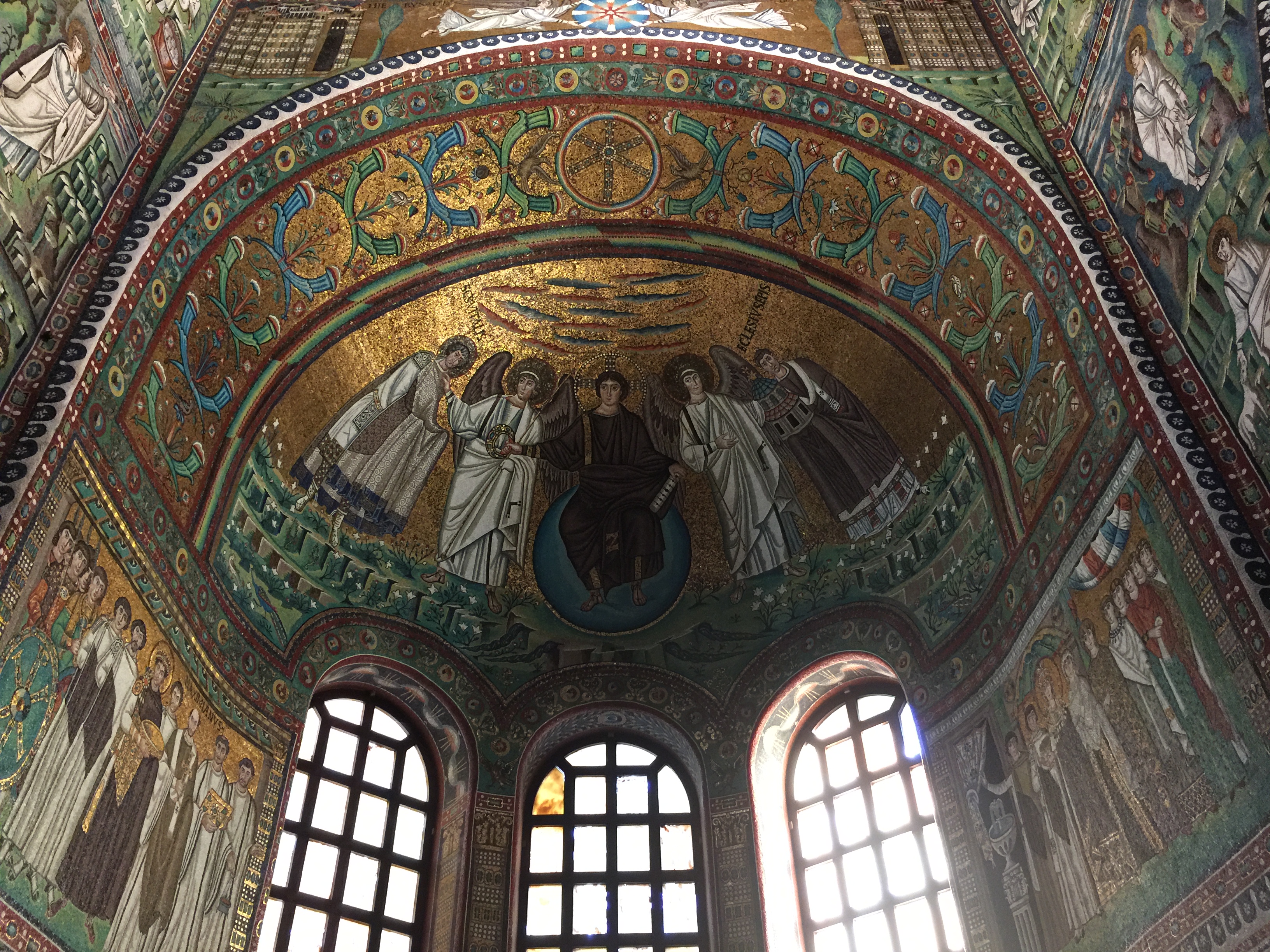
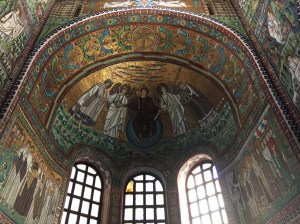
In the Apse the figure of Christ sits on a blue globe flanked by two angels.  The right hand angel offers the crown of martyrdom to S. Vitalis and the left hand offers a scroll to Bishop Ecclesius,  the Church founder who carries a model of the Church itself.  Interestingly Christ wears the Imperial purple and the angels traditional Roman dress.

IMG_0319

Perhaps the most famous mosaics, are the panels facing each other on the side walls of the apse.  On the right is the Emperor Justinian in purple with a golden halo, surrounded by court officials, Bishop Maximian is named and speculatively one of the men is Julius Argentarius the patron, and possibly on his right General Belisarius, who re-conquered Ravenna in 540.  Palatine Guards with chi-rho symbol on their shields are also shown.  Opposite is the Empress Theodora with her court ladies.   In typical Byzantine fashion the Emperor and Empress are shown face on looking impassively forward.   Showing the Imperial Family in the same way as saints, prophets and angels expresses the authority of both the Emperor and the Church and inextricably links them.  This is something first seen in the now lost mosaics of St John the Evangelist.

Introduction to Late Roman, Ostrogothic and Byzantine Ravenna

IMG_0173

Overall Rating      ******    6 stars – stunning mosaics in sites across the City

Other                       Wow Factor!  The mosaics will blow your socks off!

Ravenna has been called the ‘Late Roman Pompeii’.  The marketing hype does not quite work since unlike Pompeii Ravenna has been continuously inhabited.  However it does contain the largest assembly of surviving Late Roman mosaics in a collection of remarkable buildings of the 5th and 6th Centuries.

The fact that although they are in one place over a period of 150 years and are stylistically similar, they are variously classified as Later Roman (or Late Antiquity), Ostrogothic or Byzantine demonstrates how fast the Mediterranean World was changing.  This is why we are writing this introduction to Ravenna to save repeating the history at each site.

This history is complex.  In the 4th Century Constantine and his dynasty, followed by Valentinian and his dynasty waged largely successful defensive wars against invading German tribes – Franks, Goths, Huns and Vandals.  They also divided the Empire into more easily defended zones, sometimes East and West but often more complicated, which although better defensively, resulted in destructive civil wars between rival Augusti who wanted to rule the whole Roman World.  These wars sapped the fighting strength of the field armies and the economic sustainability of the Empire.  Also German mercenaries and recruits became integrated not just into the armies, but also the high command of the Roman state.

Theodosius I (379-395) restored the East after the calamitous defeat by the Goths at Adrianople in 378.  He conquered the West twice, defeating his rivals at the Battle of Frigidus in 394, using German mercenaries as well as the Eastern Field Army to defeat the West.  He then died in Milan in 395, leaving the East to his eldest son Arcadius and the West to his younger son Honorius.  Guided by his half Vandal generalissimo Stilicho, Honorius ruled from Milan, but when in 402 Alaric and the Visigoths began rampaging round Italy, he retreated to Ravenna.

Ravenna was safe since it was surrounded by marshes and connected by a deep water canal to the long time Roman port and fleet base at a Classis.  It remained the “capital” of Italy until 751.  Ravenna in this period was the most prosperous city in the West, since it was the seat of authority and the principal port between Eastern and Western Empires.   There is evidence for more than 60 churches in use at this time.  Rome in contrast was sacked 6 times, its aqueducts cut and its grain supply from Egypt and North Africa stopped, declined catastrophically.

The magnificent surviving churches of Ravenna and their mosaics are connected with three great personalities of the period: the Augusta (Empress) Galla Placidia, the Ostrogothic King Theodoric and Bishop Maximian of Ravenna.

Galla Placidia was the half sister of Honorius, and after the Visigothic Sack of Rome by Alaric in 410, she was taken by the Goths as a hostage, and married in 414 to Alaric’s successor Athaulf.  On Athaulf’s death she returned to the Empire and joined Honorius in Ravenna.  She married the consul and general Constantius in Ravenna, who briefly deposed Honorius in 421.  After his death Galla Placidia was banished to Constantinople.  After Honorius’ death in 423 she returned to Ravenna in 425, ruling what was left of the Western Empire as Augusta, in her own right and in the name of her son Valentinian III.  She died in Rome in 450, and Valentinian was murdered in 455.
IMG_0072

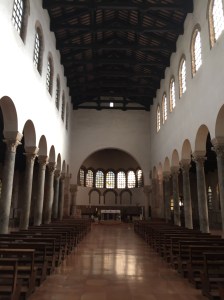
Galla Placidia was the most important church builder in Ravenna over this period and built St John the Evangelist, in thanks for her safe return from Constantinople by sea in 425.

IMG_0228

She also built a large cross shaped church, to house a relic of the True Cross (Santa Croce).  Attached to the southern end of the narthex (vestibule) of Santa Croce she also built a smaller cross shaped building, which is traditionally seen (certainly from the 9th century) as the Mausoleum of Galla Placidia.

A Late Roman capital city must have a Cathedral and there is evidence that the Basilica Ursiana, was built by Bishop Ursus in the last decade of the 4th Century.  Alas the original cathedral was demolished in 1733!  However the baptistry built by Bishop Neon around 458 survives and is known as the Neonian Baptistry or the Baptistry of the Orthodox for reasons which will soon be apparent.  Also around the end of the 5th Century, Bishop Peter II decorated a chapel with mosaics, now known as the Capella Arcivescovile.

After Valentininan III’s murder, the Western Empire spiralled into extinction with Emperors little more than puppets of their Germanic generalissimos, until in 476 the last Emperor appropriate called Romulus Augustus was deposed by Odavacer the Herul, sending the Imperial insignia to Constantinople and ruling Italy nominally in the name of the Eastern Emperor Zeno.  By this time Spain and South West Gaul were in the hands of the Visigoths, Africa the Vandals and the rest of Gaul the Franks and Burgundians – Britain had long departed the imperial orbit, losing the use of money and central administration.

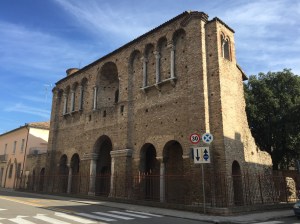
Zeno encouraged the Ostrogothic leader Theodoric to attack Odavacer and Theodoric took Ravenna in 493, stabbing it is said, his adversary to death in the Ad Laurata Palace in the City.  Theodoric was recognised as King of Italy by the Eastern Emperor Anastasius (491-518).
IMG_0050

Theodoric was a Goth but no barbarian.  He had been brought up in the Imperial Palace in Constantinople as privileged hostage.  He ran Italy with the advice of Romans like the philosopher Boethius and the administrator Cassiodorus.  Theodoric built himself a Palace in Ravenna, and its principal gate was known as the Chalke (bronze) Gate, like the gate of the palace in Constantinople.

Theodoric was a Goth and a Christian.  The Goths were converted in the mid 4th Century by Bishop Ulfilas.  Ulfilas followed the then prevailing orthodoxy of the Emperor Constantius of Arianism.  That is he followed Arius of Alexandria in believing that because Christ had been created by God he could not be fully divine.  This view of the Trinity was over-thrown at the Council of Constantinople in 381 when the doctrine of the Father Son and Holy Ghost Trinity won the day, and Arians became heretics.  So when Theodoric took over Ravenna and Italy the Arians were in charge.  Theodoric built a huge Arian basilica next to his Palace, which is now called S. Apollinare in Nuovo.   On Theodoric’s death in 526 he was buried in a splendid stone Mausoleum.

IMG_0136

He was succeeded by his daughter Queen Amalaswentha, who ruled in the name of her son or husband until 536, when she was succeeded by King Vitiges.  In 535 the Eastern Emperor Justinian launched a campaign to recapture Italy lead by his general Belisarius, who captured Ravenna in 540.  From then until 751, Ravenna was the seat of the Exarch who ruled whatever lands Constantinople held in Italy.

The arrival of Belisarius meant that the heretic Arians had been defeated and in 561 Theodoric’s Palace Church was rededicated and he and his court removed from the mosaics.
IMG_0196IMG_0191

The next great phase of building in Ravenna is associated with Bishop Maximian the orthodox bishop who arrived in 546.  Bishop Maximian dedicated S. Vitale in the City in 547, and S. Apollinare in Classe in 549, at the port some 5kms outside.  However it should be noted that both of these magnificent buildings were begun long before Maximian’s arrival and even before the Eastern Empire’s take-over of Ravenna in 540.  We know that they were both funded by one Julianus Argentarius, a banker.  So although totally Byzantine – the Imperial couple Justinian and Theodora feature on the mosaics, these churches also represent continuity across regime change in Ravenna.

In addition to the magnificent churches and palaces Ravenna  must have had fine buildings to house the administrators and generals of the Roman, Gothic and Byzantine regimes.  Most of these houses and baths have disappeared, but in the so-called House of Stone Carpets, we can see just how magnificent these dwellings would have been.

Ravenna eventually fell to the Lombards and then the Franks, Charlemagne borrowing statues and ideas for his new Holy Roman Empire capital in Aachen.  It is a remarkable survival of Roman Christian culture of different kinds, that disappeared from the West after the 8th and 9th Centuries.

Gallo-Roman Museum Saint-Romain-en-Gal, Vienne

IMG_9509IMG_9493

Overall          *** 3 stars – remarkable mosaics

Display         5  artefacts displayed as works of art, models exceptional

Access           4 large car park with underpass to Museum

Other             Museum almost overwhelms the exhibits!

Vienne was originally the capital (oppidum) of the civitas of the Allobroges, which stretched from the Rhone at Vienne to Lake Geneva.

This is a massive modern museum opened in 1996.  It displays the finds from ancient Vienne in a spare and light modern manner.  We saw it the day after the Museum in Lyon at Fouvière and although the permanent collection here contains some stunning exhibits – the mosaics stand out and are beautifully displayed, it is not quite its equal.

Outside there are the remains of the suburb of Roman Vienne, where the houses of wealthy citizens lined the road next to the palatial baths and exercise ground net to the Rhone.  There is a workshop for the mosaic restorers and a space of temporary exhibitions in a second building, which forms the entrance.IMG_9499

IMG_9477

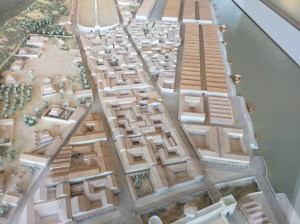
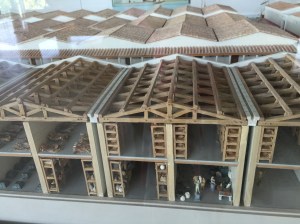
Vienna became a Roman colony in 47 BCE under Caesar and was in the old Transapline Gaul – Provincia.  Herod Archaelaus was exiled here in 6 CE.  In the later Empire it became the place of collection of the annona or tax in kind from the Gauls.  As a result there are remains of massive warehouses lining the Rhone where the taxes were assembled before being transported to Rome.  These are displayed by a series of model reconstructions.

Perhaps as a result of this role, Vienne (Vienna) became the capital of the late Roman Diocese of Vienensis, at last equalling its rival just up the Rhone at Lyon.

Again as an inhabitant of Britannia you are left wondering at the wealth and display of the Gauls compared to our off-shore island!

When we visited there was a Roman festival of re-enactors in progress, one of several events staged each year at the Museum.  French re-enactment groups dressed appropriately lived like free-Gauls and Roman soldiers – sensibly kept well apart here.  Also various groups re-constructed ancient wine and beer making, medicinal herb preparation, Celtic and Gallo-Roman cuisine.  The tasting measures were alas depressingly small, although the re-enactments were impressive!

IMG_9463