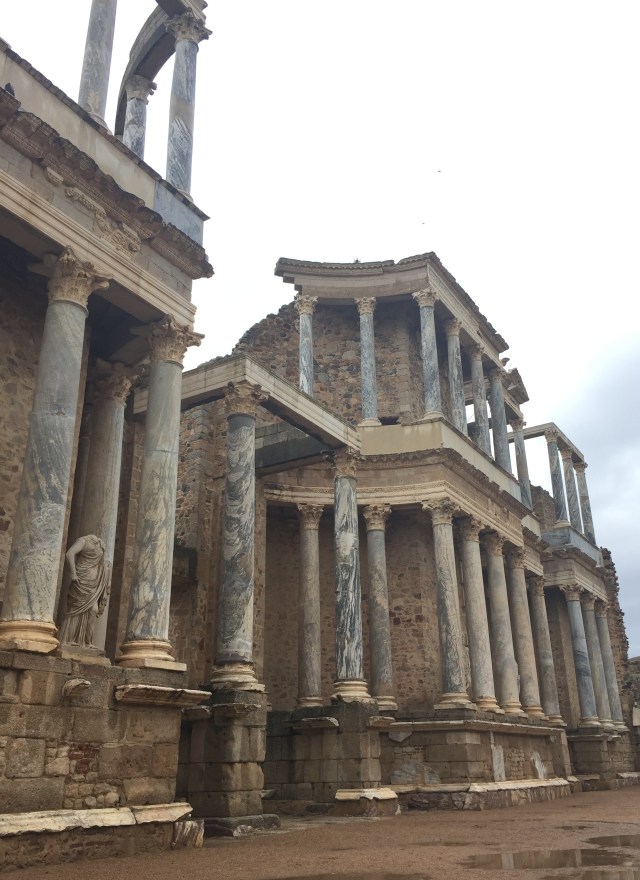
Theatre at Merida

IMG_2315

Overall          5 ***** beautifully preserved large theatre with scaena

Display         4 **** informative bilingual display boards

Access           3 *** well laid-out archaeological park – parking difficult

Atmosphere 5 ***** almost unique impression of what a Roman Theatre looked like

Other             4 **** next door to Spain’s magnificent Roman Museum and other sites

The Theatre at Emerita Augusta is without doubt the ‘star attraction’ of the city and is arguably the best preserved Theatre in the Roman Empire.

It is constructed of concrete and granite ashlars. Most of the cavea (seating) tiers are set back into the hillside, as is normal, and it has 13 entrances.  Its maximum diameter is 87m and it could seat 6,000 people.

The orchestra is a semi-circle paved with white and blue marble in front of the stage.  Around it are 3 tiers of seats separated from the rest by a marble parapet.  Three doors allow for the entrance of actors onto the stage.

What really makes the Theatre at Emerita outstanding is the survival of the beautiful scaena (back scene), most of which is still in place including the statues and the columns of the tiered colonnades.  The statues are of Ceres, Pluto and Proserpina, with others interpreted as imperial portraits.

It is built according to the rules of Vitruvius and is, as a result, similar to other surviving theatres at Orange in Southern France and Dougga in Tunisia.

Inscriptions show that the Theatre was begun by the remarkable Marcus Agrippa, Augustus’s right-hand man, in 16 BCE when he was campaigning in Iberia. It was modified over the centuries of use: the current scaena was erected under Trajan, and under Constantine (330-40CE) new decorative elements were added.

IMG_2319

What was performed in a Roman Theatre?  There were comedies and tragedies, most being re-workings of  Greek subjects.  The Roman comedies that have survived are the work of Plautus and Terentius, who took Greek subjects, removed the role of the chorus and introduced musical accompaniment.   Action is set on a street with complications following from overhearing what the stock characters are saying to each other. When you watch Shakespeare’s ‘Two Gentlemen of Verona’, you get a pretty good impression of the kind of plays the citizens of Emerita would have enjoyed here. The most prominent tragedian was the Stoic philosopher Seneca, who also adapted Greek originals for a Latin audience.

For a Colonia, building a Theatre was a very visible statement of its Romanitas or ‘Roman-ness’, as well as a way for the urban elite to show off in the front rows. Theatres were maintained in major settlements throughout the Roman World – clearly, gladiators and games had their place in popular culture, but so did comedies and tragedies!
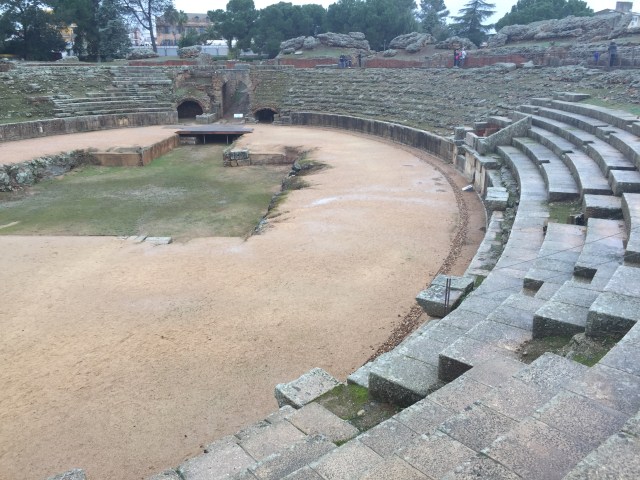
Amphitheatre at Merida

IMG_2237

Overall          5 ***** well preserved large amphitheatre

Display         4 **** informative bilingual display boards

Access           3 *** well laid out archaeological park – parking difficult

Atmosphere 4 **** has the melancholy air of most Roman amphitheatres

Other             4 **** next door to Spain’s magificent Roman Museum

We don’t particularly like Amphitheatres, for the simple reason of what happened there and the brutal and bloody aspect of Roman ‘civilisation’ it forces you to confront.  (The feeling of ‘preserved misery’ in the passages under the Amphitheatre at El Djem in Tunisia was palpable for us.) However, you cannot escape them: no provincial capital worth the name could afford not to have its Amphitheatre and the one at Merida is magnificent.

It formed of a large ellipse some 126m by 103m.  Crowd control was  as usual excellent, with 16 entrances, each of which accessed a stairway connecting the 32 vomitoria (entrance/exits) that opened onto the cavea (seating) for as many as 15,000 spectators.  There was a grandstand for local VIPs.  Clearly, as with Directors’ Boxes at the Emirates or the Etihad Stadiums, being visible in the best seats mattered in the  City’s social pecking order.

Inscriptions give the probable date of construction as 8 BCE, when Emerita Augusta was still only 16 years old and was expanding fast.  The emeriti – retired legionaries after whom the City is named – would no doubt have wanted their fill of games both to show their status and civilisation, and also for entertainment as in their ‘good old days under the eagles’.

Construction, like the Theatre next door, is of concrete and ashlars.  There is a fossa bestiaria (large pit) in the arena floor which was used for release of wild animals and other unpleasant surprises for the gladiators and victims of the games.

The Amphitheatre, as with all sites in Merida, has informative bilingual displays.  The more blood-thirsty in your party can learn that there were many different types of gladiator for the Roman ‘games enthusiast’ in addition to the retarii (net men) and the murmillones (full armour specialists).

The Amphitheatre is only part of a large well-displayed archaeological park in the north-east of the old city of Merida, complete with a world class Roman Museum devoted to Roman Spain.  There are some pretty good tapas bars and a brew pub opposite.  A ticket gives entrance to this zone and four other Roman sites.

Roman Bridge over the River Guardiana Merida

IMG_2390

Overall          4 **** remarkable survival through wars and floods

Display         5 ***** bilingual information with diagrams, some on Alcazaba above

Access           5 ***** a pedestrian bridge open at all times, parking on road nearby

Atmosphere 3 *** the view form the Moorish Alcazaba is superb

Other            4 **** a tribute to Roman engineering and construction

The Roman Road from Asturica to Italica crossed the River Guardiana (Latin Ana plus later Arabic Wadi = Wadi-ana).

In the river there is a central island that serves to break the force of the water in spate.  The original Roman bridges connected the City with the island and the island with the southern bank.  In the 17th Century the two bridges were connected with arches in the middle as well.

Today the bridge now has 57 arches of various periods and spans 792m making it the longest surviving bridge from Antiquity.  The best preserved Roman section is the one from the City to the island, identified by curved breakwaters up-stream.  Within the arches are spillways to reduce the resistance to flood-waters and no doubt a key reason this magnificent bridge is still here.  A remarkable survival!