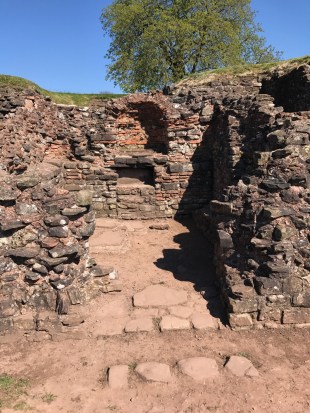
Prsyg Field Barracks, Caerleon

IMG_1732

Overall         2 ** interesting site, unique display of a legionary barrack block

Display         1 * one barrack block is original the other three are surface representations

Access           3 *** you can park in adjacent rugby club car park unless a match is on

Atmosphere 1 * the multiplicity of walls are confusing in the ‘real’ barrack block

Other             3 *** However all of this is part of the fabulous displays at Caerleon

In the North West of the Fortress there is a block of four barracks on view.  These constitute two-thirds of the barracks of a single Cohort.  The first line of barracks are the actual stone buildings, and are below ground level.   The other three barracks are much higher at current ground level are are modern.

The original barracks from 75AD were wooden, but the Fortress was rebuilt in stone over the next few years.  There is controversy as to whether only the bottom parts of the barracks were stone with timber top halves, or completely of stone.

The II Augusta was composed of 10 cohorts, each of six centuries composed of 80 legionaries.  The centuries were twinned reflecting the old Republican maniple, and the barrack blocks faced each other.  There were 10 contuburnia each of 8 legionaries in each century.  Each contubernium had two rooms in the barracks, one at the back with bunks and cooking equipment, and a room at the front for storage of weapons, armour and shields.

The excavated remains show 12 pairs of rooms, which allows for some to be used as store-rooms or new recruits.  At the other end of the barrack-block are the Centurion’s quarters, which combine quite lavish accommodation with the offices of the Century.

In summary this is rather a disappointing site, given what we are looking at here.  Unlike the Roman Baths where the site is brought to life through finds, light effects and models, here we are presented with the confusing multi period jig-saw of walls which make it very hard to envisage what life was like for the legionaries who built this and lived here. The best place to feel this is perhaps the admittedly auxiliary reconstructed barracks at the Saalburg.
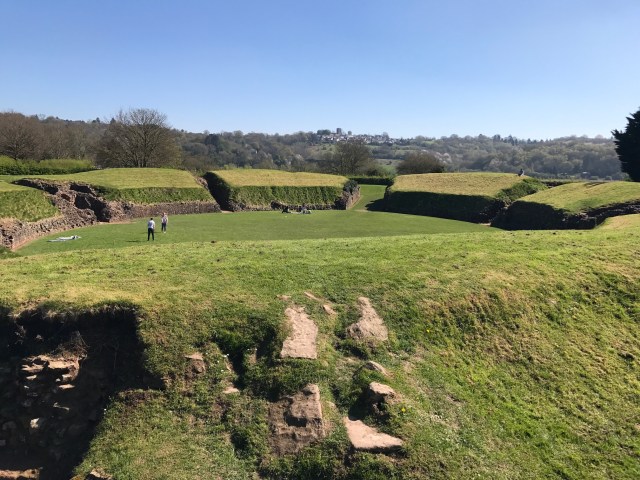
The Legionary Amphitheatre at Caerleon

IMG_1711

Overall         3 *** important site, impressive scale and great setting

Display         2 ** site remains excellently consolidated, little information on site

Access           3 *** you can park in adjacent rugby club car park unless a match is on

Atmosphere 2 ** great impression, but far too pleasant for its original purpose!

Other             3 *** best amphitheatre in Britannia!

This is the only fully visible Legionary Amphitheatre in Britannia, and is another Mortimer Wheeler production, excavated in 1926-7.

It was constructed in cAD90 outside the South-West Gate of the Fortress on the Via Principalis, now called Broadway  It is c80m by c65m in size and elliptical in shape.  Its surviving lower part was made of stone and earth, with an upper part constructed of timber, forming a grandstand with tiers of wooden seating.  It is calculated that it could hold the full 6,000-man complement of Legio II Augusta.

There are two processional entries facing each other on the long axis, and two other entrances with waiting rooms for gladiators, prisoners and beasts, facing each other on the short axis.  The legionary stonemasons included inscribed stones with the name of the centurion of the Century that had built that section, sometimes with the Capricorn badge of II Augusta.  The originals are now in the Legion Museum, but replicas have been put in place and can be spotted.

IMG_1713
Entrance to Arena from Waiting Room
IMG_1717
The Shrine to Nemesis

There is a niche on the East with a shrine to Nemesis, which was identified by a curse tablet found nearby.  This added in 212-22, dated by brick work dating to Caracalla when Leg II Augusta held the title of Antonina.

Together with the vast Baths Complex, the Amphitheatre gives you an insight into the daily world of a Roman Legionary – certainly, in the late 1st and 2nd Centuries, not a humble ‘grunt’ but an accomplished professional military engineer, probably literate, well-paid and forming the sinews that held the Empire together.  A grateful Emperor and Respublica would provide him with all the comforts that could be built – not just bread and circuses, but baths and regular donatives of cash on special occasions.  As Septimius Severus said to his sons on his deathbed, ‘Be harmonious, enrich the soldiers, scorn everybody else’.

Most Roman amphitheatres have a thoroughly miserable and acutely depressing atmosphere; you only have to think of what happened in them.  However, at Caerleon, where the grass is frequented by picnicking families and boys kicking footballs, it is actually quite cheerful.

Unlike the rest of Caerleon, on site the information provided is meagre, so you need Cadw’s well-illustrated guide to the Fortress.

IMG_1719
Copy of Centurial Stone of Century of Claudius Cupitus