Maison Carée, Nîmes

Overall Impact:               ******6 stars – one of best preserved/restored Roman buildings

Access                                ****4 star – public square open 24/7 but parking in old town hard

Atmosphere                      *******7 stars – almost off the scale, especially now it’s cleaned

Other                                  **2 stars – alas, nothing Roman in heavily restored interior
IMG_3319

Almost unbelievably, as devoted fans of Roman architecture and remains (being the sort of people who will travel many miles to look some bumps in a field and see in our mind’s eye just what that Auxiliary Fort must have looked like), we had never been to see the Roman Sites of Provence (Provincia) until this New Year.

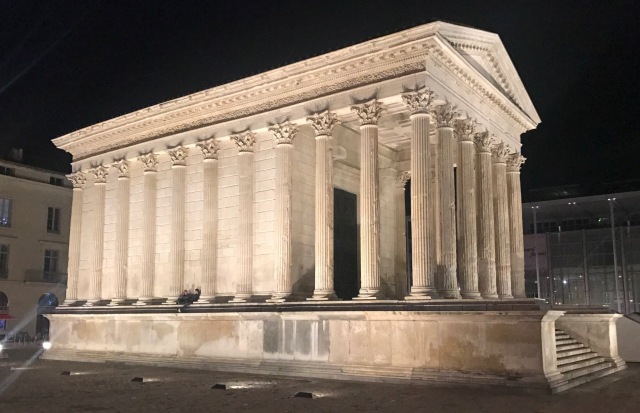
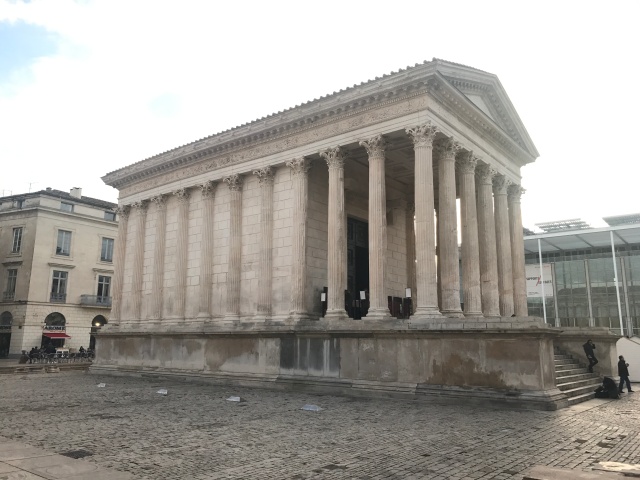
We were, of course, blown away by what we saw.  As many people reading this will know, the Maison Carée (literally, the square house – although it isn’t) in Nimes (Roman    Nemausus) is arguably one of the best, if not the best, preserved Roman Temple facades.   It sits in the original space of the Forum, high on its 2.8m plinth with its white marble glowing in the sunshine.  The impact remains dramatic two millennia after it was built.
IMG_3229

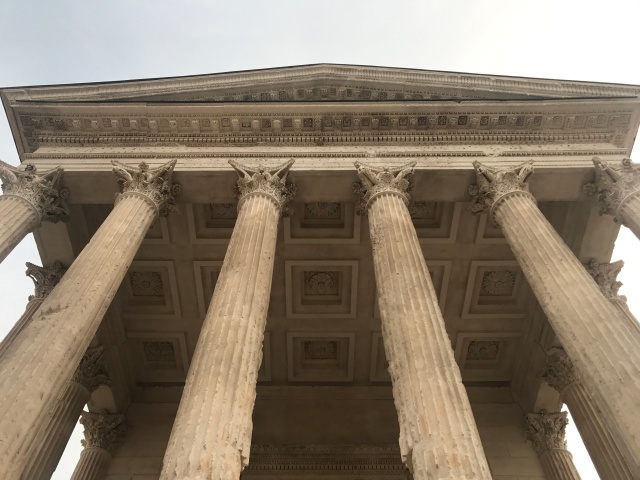
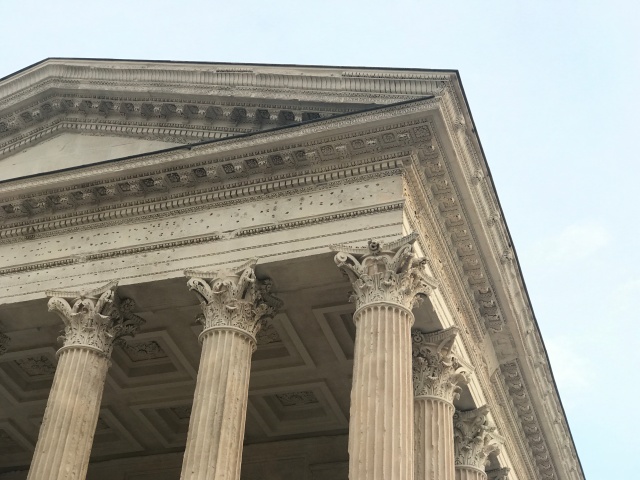
The Temple was dedicated c4-7AD to Gaius Caesar and Lucius Caesar, the grandsons and heirs of Augustus, who died tragically soon after.  If you believe Robert Graves, after Suetonius, both were poisoned by Augustus’ wife Livia to open the way for her son and Augustus’ step-son Tiberius to become Emperor.   The lettering of the dedication (“To Gaius Caesar, son of Augustus, Consul; to Lucius Caesar, son of Augustus, Consul-Designate; to the Princes of Youth”) had been removed from the facade in medieval times, but in 1758 a local scholar reconstructed it from the fixing holes left on the front frieze!

What we see today is the fruit of several reconstructions starting in Napoleonic times with the removal of accreted buildings, through to 1992 when the square around it was cleared. It inspired Thomas Jefferson’s design of the Virginian State Capitol.
IMG_1514

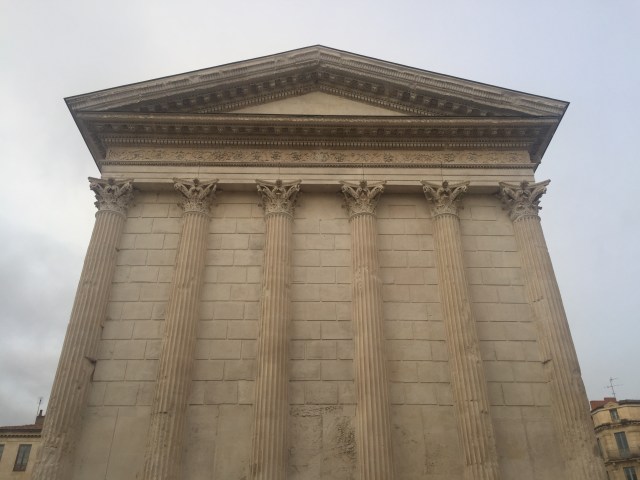
The building is remarkable in that the portico forms a third of the length of the building, and there are 20 columns engaged with the wall.  The frieze is exceptionally fine, decorated with rosettes and acanthus leaves.

There is nothing left inside of the sanctuary and altars that must have been there.  Perhaps more could be done to give a sense of the numinous atmosphere it would once have had.  There is, however, a good explanatory film which takes an unashamedly pro-Roman stance on the benefits to the local tribal leaders of joining Caesar as auxiliary cavalry and aiding him in suppressing their Gallic brothers and defeating Rome’s enemies.  The film then flashes forward to show the wealthy and now thoroughly Romanised citizens of Nemausus worshipping the Emperor.  It’s beautifully done and the re-enactors must have had a great time making it.  There is a gratuitous dig at Arles for being founded by former Roman soldiers rather than by the indigenous Gallo-Romans!  The master self-propagandist Julius Caesar would have been mightily impressed.

You could spend a lot of time describing the Maison Carée, but the key thing is how absolutely striking and atmospheric it is – in the sunlight (which we didn’t have much of at New Year) and especially when floodlit at night.
IMG_3213

IMG_3227

Gallo-Roman Museum Saint-Romain-en-Gal, Vienne

IMG_9509IMG_9493

Overall          *** 3 stars – remarkable mosaics

Display         5  artefacts displayed as works of art, models exceptional

Access           4 large car park with underpass to Museum

Other             Museum almost overwhelms the exhibits!

Vienne was originally the capital (oppidum) of the civitas of the Allobroges, which stretched from the Rhone at Vienne to Lake Geneva.

This is a massive modern museum opened in 1996.  It displays the finds from ancient Vienne in a spare and light modern manner.  We saw it the day after the Museum in Lyon at Fouvière and although the permanent collection here contains some stunning exhibits – the mosaics stand out and are beautifully displayed, it is not quite its equal.

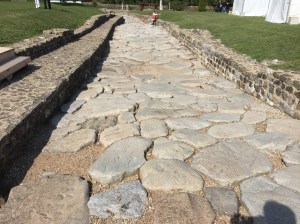
Outside there are the remains of the suburb of Roman Vienne, where the houses of wealthy citizens lined the road next to the palatial baths and exercise ground net to the Rhone.  There is a workshop for the mosaic restorers and a space of temporary exhibitions in a second building, which forms the entrance.IMG_9499

IMG_9477

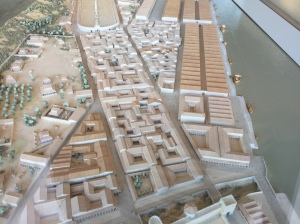
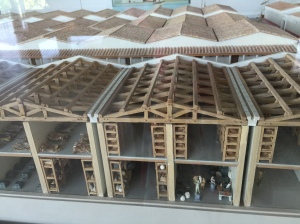
Vienna became a Roman colony in 47 BCE under Caesar and was in the old Transapline Gaul – Provincia.  Herod Archaelaus was exiled here in 6 CE.  In the later Empire it became the place of collection of the annona or tax in kind from the Gauls.  As a result there are remains of massive warehouses lining the Rhone where the taxes were assembled before being transported to Rome.  These are displayed by a series of model reconstructions.

Perhaps as a result of this role, Vienne (Vienna) became the capital of the late Roman Diocese of Vienensis, at last equalling its rival just up the Rhone at Lyon.

Again as an inhabitant of Britannia you are left wondering at the wealth and display of the Gauls compared to our off-shore island!

When we visited there was a Roman festival of re-enactors in progress, one of several events staged each year at the Museum.  French re-enactment groups dressed appropriately lived like free-Gauls and Roman soldiers – sensibly kept well apart here.  Also various groups re-constructed ancient wine and beer making, medicinal herb preparation, Celtic and Gallo-Roman cuisine.  The tasting measures were alas depressingly small, although the re-enactments were impressive!

IMG_9463

Temple of Augustus and Livia, Vienne

IMG_9538

Overall Rating     ****     4 stars – almost complete early temple

Display                  *           1 – not much local information available

Access                    ***       in centre of city, parking difficult

Other                     Wow factor

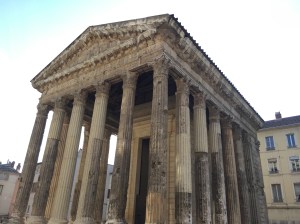
In the centre of Vienne in the Place du Palais you can stumble across the Temple of Augustus and Livia.  This is an almost complete early Imperial Temple, and you will be amazed.  It was erected at the end of the 1st Century BCE and dedicated to Augustus.  In 41 CE Claudius rededicated it also to Augustus’ wife Livia his grandmother.  Claudius was born in nearby Lugdunum.

It owes its survival, like the Maison Carée in Nîmes to being converted to a Church after the Theodosian Decrees.  In the Revolution it was used for the Festival of Reason.  The columns on closer examination are scared by wall fastenings of earlier centuries.  It as restored in the 19th Century when the centuries of church were stripped from the fabric.  No chance of doing such drastic changes these days, so we should be pleased with the courage of those times.

This temple really impresses in its completeness, when you are used to temples surviving as just columns.  It is almost the equal of Nîmes and deserves to be better known.

IMG_9545