

Overall Impact: ***** 5 stars – Less well known than the Arch of Galerius but has the impact of the Pantheon in Rome. A unique survival (and a marvellous surprise to us!)
Access **** 4 stars – Situated a short walk (125m) north of the Arch and, unlike the Arch, in a quiet side street. Recently restored and now open to the public.
Atmosphere *** 3 stars – C5th mosaics only partially remain. Damaged during the Mausoleum’s period as an Ottoman Mosque, they have now been wonderfully restored.
Other ** 2 stars – There is no good guide book on sale at the site – but do check out local book shops for a scholarly exposition which we happened upon. No good post cards available.
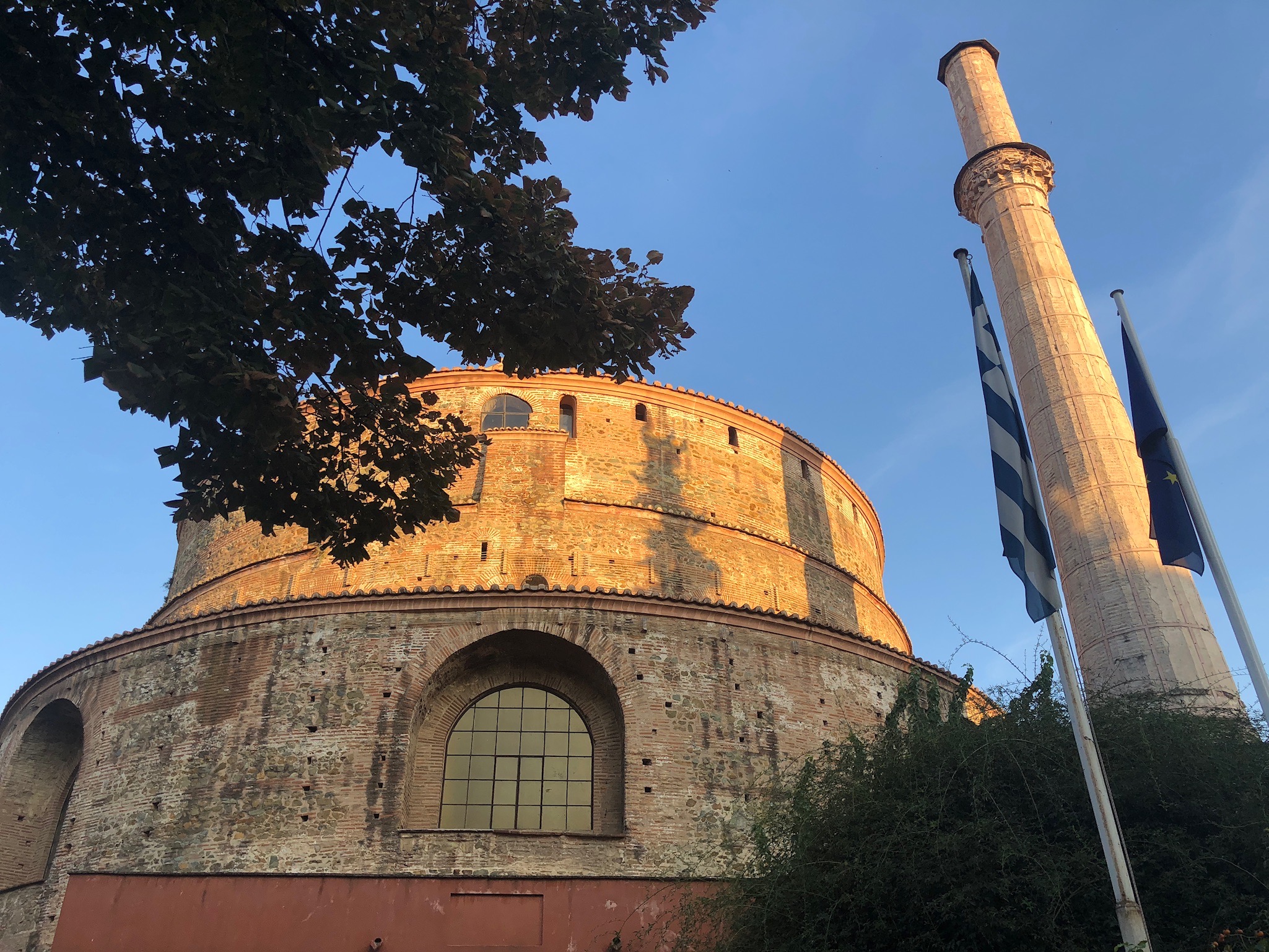
The Rotunda of Galerius is north of his Arch: built in AD306, it is usually thought to have been intended as his Mausoleum. However, when in AD311 Galerius died hideously from a disease usually interpreted as gangrene, he was buried at Felix Romuliana (Gamzigrad in Serbia), his birthplace. Therefore it probably never fulfilled its intended function.
The Rotunda’s dome is 30m high and is one of the largest surviving from the Empire. The walls are extremely thick, explaining how it has survived earthquakes through the centuries.

It was empty until Theodosius I had it converted into a church in the late C4th. It was then decorated with some very fine mosaics apparently depicting prominent members of the Thessalonica community, rather than Imperial portraits.


The church was turned into a mosque by the Ottomans in 1590. It was re-opened after extensive restoration in 2015, as a Museum.
 Roman Sites