Où sont les Wisigoths en Toulouse?

Overall Impact:               – 0 stars – very little to see!

Access                                * 1 star – easy access to Museum, other areas difficult to find

Atmosphere                      * 1 star – you need to use your imagination to visualise Visigoths

Other                                  *** 3 stars – fascinating subject, but seemingly little local interest

Brief Historical Background

The Visigoths under Alaric sacked Rome in 410, seizing portable treasures.  Even Galla Placidia – the sister of Honorius, the Western Augustus – was captured.  On Alaric’s death his brother Athaulf succeeded him as leader and spent the years 410 to 415 operating in the Gallic and Spanish provinces, playing competing factions of Germanic and Roman commanders off against each another.  He captured Toulouse in 413 and married Galla Placidia in 414 as the Western Imperial Government started to come to terms with the Goths as useful allies.   Honorius’ regime used Athaulf to provide Visigothic assistance in regaining nominal Roman control of Hispania from the Vandals, Alans and Suevi.

In 418, Honorius’ regime rewarded his Visigothic allies, now under King  Wallia, by giving them land in Gallia Aquitania along the Garonne Valley with Tolosa (Toulouse) as their capital.  This is thought legally to have been achieved through hospitalitas – the rules for the billeting of soldiers.  At first the Visigoths were not given a large extent of landed estates in Aquitania but they did gain the right to the taxes of the region, so that the Gallic aristocrats, farmers and traders now paid their taxes to the Visigoths instead of to the Western Roman Government.


Settling a barbarian group effectively as a ‘state within a state’ within the boundary of the Empire was a novel and desperate measure, but it was a settlement which the Honorian regime – holed up within the walls of Ravenna, behind protecting marshes – grasped with some relief after Alaric’s sack of Rome in 410 and the chaos of the previous years.

Furthermore the Visigoths, like other barbarian tribes, were Arian Christians having been converted in the mid-Fourth Century when the Arian doctrine of the Trinity was the ‘orthodoxy’ of the Church and Emperor.  Arianism is the belief that Jesus Christ is the Son of God, who was begotten by God the Father at a point in time, and is therefore distinct from God the Father and therefore subordinate to the Father.  The Emperor Constantine at the Council of Nicaea in 325, and Theodosius at the Council of Constantinople in 381, had strengthened the Nicene formula of the co-essential divinity of the Son, applying to Jesus Christ the term “consubstantial”.  The 381 version speaks of the Holy Spirit as worshipped and glorified with the Father and the Son.  Thus Arians became heretics in the sight of the Empire.

The Visigothic Kingdom continued in Spain, but not in Toulouse, until the Muslim invasion of 711. Clovis welded together the Frankish Kingdom in the early Sixth Century, and in 507, with Burgundian assistance, he defeated the Visigothic King Alaric II at the Battle of Vouillé (Campus Vogladensis) near Poitiers and went on to capture Aquitania and sack Toulouse.  By 508 the Visigoths had lost their their grip on Aquitania and only retained the coastal strip called Septimania stretching from Narbonne and Nîmes.

Tolosa was the Visigothic capital for nearly a century – so can we find the remains of their regime?

They are very hard to find. We spent a few days haunting the museums and sites of Toulouse and there are not many traces and very little published information. What remains is generally described as ‘late antique’ rather than Visigothic, and there are few explicit references to the Visigothic period.

This post is about what we found.


IMG_3040
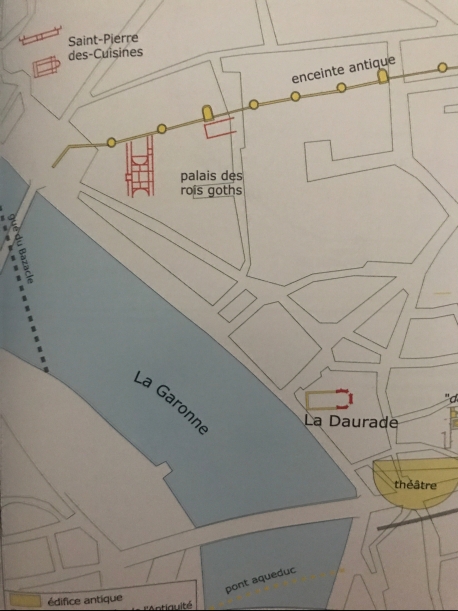
Map courtesy of ‘L’ancienne église Sainte-Marie ;a Daurade à Toulouse’ by Quitterie Cazes, published by Musée Saint-Raymond

Health Warnings

Two ‘health warnings’, though, are needed: first, it is not unreasonable to talk about ‘late antiquity’ since any existing buildings of Tolosa would, as part of the Empire, have been made use of by the new Visigothic rulers of the City after 413.  Furthermore, it is difficult to distinguish between the Orthodox (Nicene) churches and sarcophagi of the Fifth Century from the Arian ones of the Visigoths.

Secondly, because Alaric is thought in 410 to have carried off from Rome Titus’s booty from the Sack of the Jerusalem Temple, including the Menorah (the seven-branched candelabra), and because in the 13th Century Toulouse went on to become the centre of the Cathars and the Albigensian Crusade, one’s investigations can quickly stray into the misty world of pseudo-history and fictional conspiracy theory.  What follows in this blog does not touch on the fate of the Ark of the Covenant, the Priory of Sion – or the novels of Dan Brown!

Sarcophagi in the Musée Saint Raymond
In the museum basement there is a fine collection of late antique sarcophagi from across south-west France. The intriguing question is: are they from the Visigothic period, and are they Orthodox (Nicene) or Arian – and how would you tell?
IMG_0668
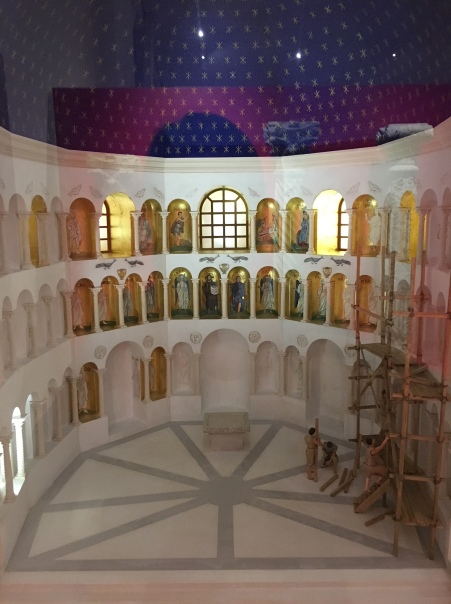
Model of the Apse of the Daurade Church in Arian Visigothic Days – model was in Musée Saint Raymond early 2017

The Daurade Church
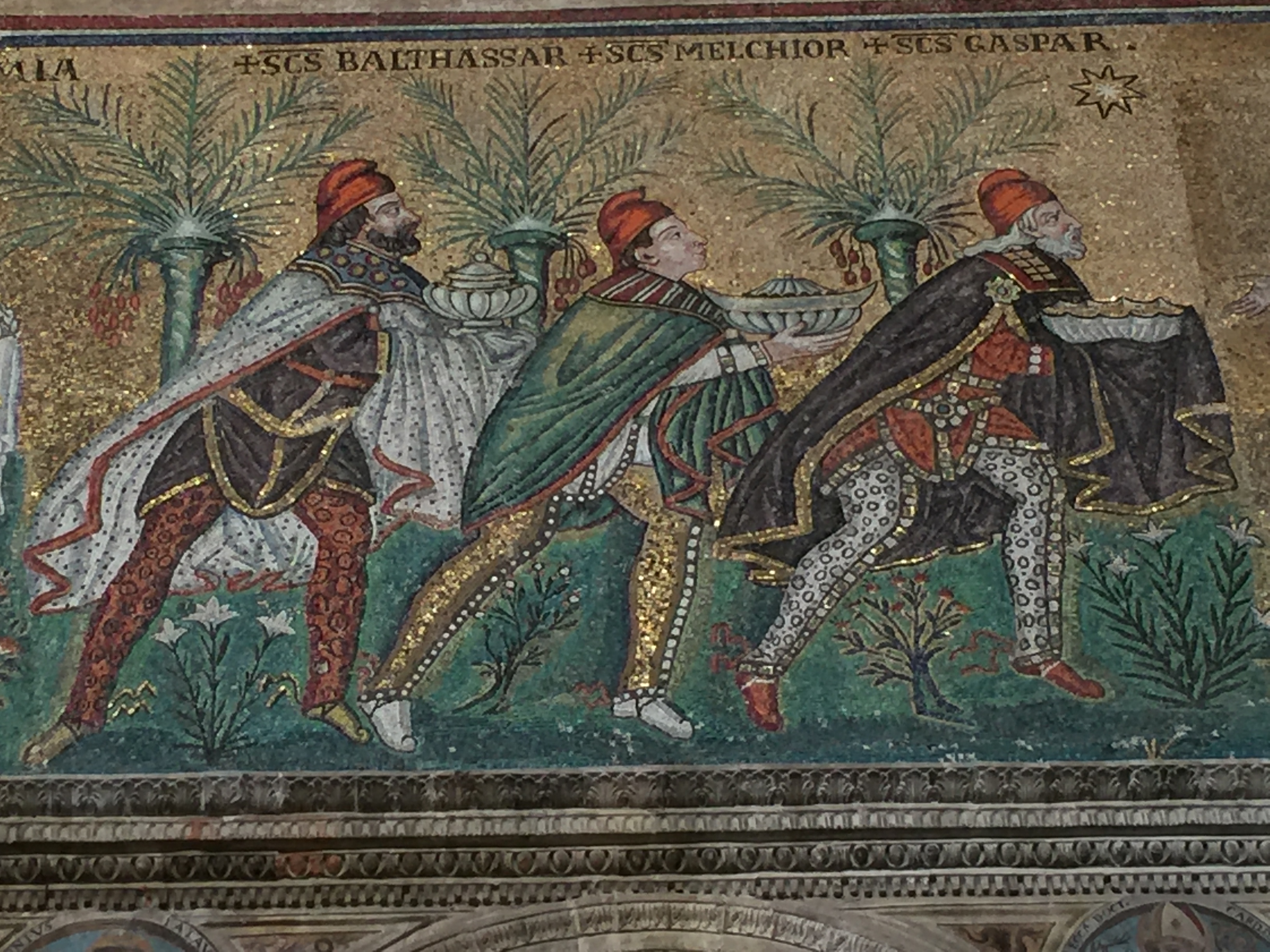
One of the most tragic losses is the Daurade or ‘golden’ Church.  It seems likely that this was the Arian Church, close to the Visigothic Palace.  The church consisted of nave based on the classical Roman Temple of Apollo, a probably Fifth Century apse, and later additions. It was demolished for a grand but conventional French classical church of 1761. Frustratingly, we are left just with drawings of the impressive apse made before its destruction. One can only think, for a parallel, of the mosaics at San Appolinare Nuovo in Ravenna.
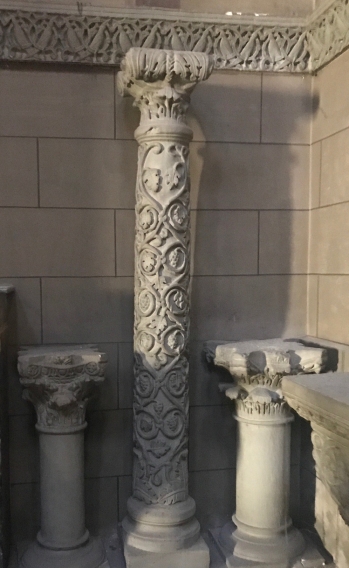
IMG_2886
Surviving early column and capital (or replica?) in a Chapel of the current Daurade Church

The demolition of a classical Temple with late antique mosaics puts one in mind of Charles V’s comment when he learned that the stunning mosque at Córdoba had had a standard C16th church inserted at its core. He reputedly said: “You have built here what you or anyone might have built anywhere else, but you have destroyed what was unique in the world.

img_3039.jpeg
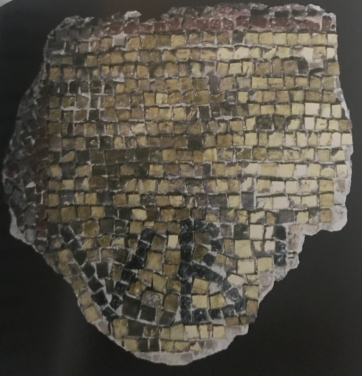
Only remaining piece of Daurade mosaics now in Avignon

All that survives are the late antique columns that were given away after the demolition in the C18th and a small fragment of mosaic with gold tesserae.
IMG_0667
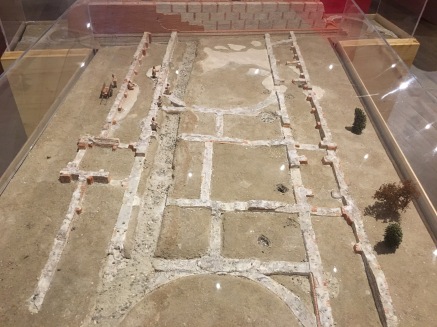
Model of the Remains of the Visigothic Palace revealed in 1989 before their destruction.  Model was in Musée Saint Raymond early 2017.

The Visigothic Palace
This was discovered in 1989 adjoining the Roman city walls on the bank of the River Garonne, near the site of the NW gate of the Roman City.  Although the site was excavated and photographed, there seems to have been no detailed recording made of this unique site and the ruins were not preserved. An undistinguished development of 1990s apartments is no substitute.

Saint Pierre-des-Cuisines

This Church just outside the Roman Walls opposite the Palace and near the Garonne dates from the C5th and was built around a necropolis.  Its core is early and would date to the Visigothic period.

Wall in Jardin des Plantes

There is also a small surviving section of late antique wall in the south of the city in the Jardin des Plantes
IMG_3041
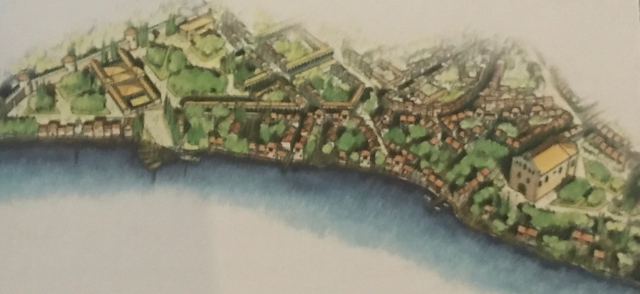
Reconstruction of Wall, Palace and Dourade area of Visigothic Tolosa courtesy of ‘L’ancienne église Sainte-Marie ;a Daurade à Toulouse’ by Quitterie Cazes, published by Musée Saint-Raymond

Toulouse under the Visigoths

Under the Visigoths, Toulouse appears to have prospered more than cities that remained at that time under imperial Roman rule.  Given the dominance of the Garonne Valley down to Bordeaux, and the conquest of Hispania and the Gallic Mediterranean sea-board, Tolosa – unlike many late antique cities – appears to have maintained its population levels.  It was the centre of an expansionist, although barbarian, Arian kingdom, one which was dedicated to preserving the civilisation that had laid the golden eggs.
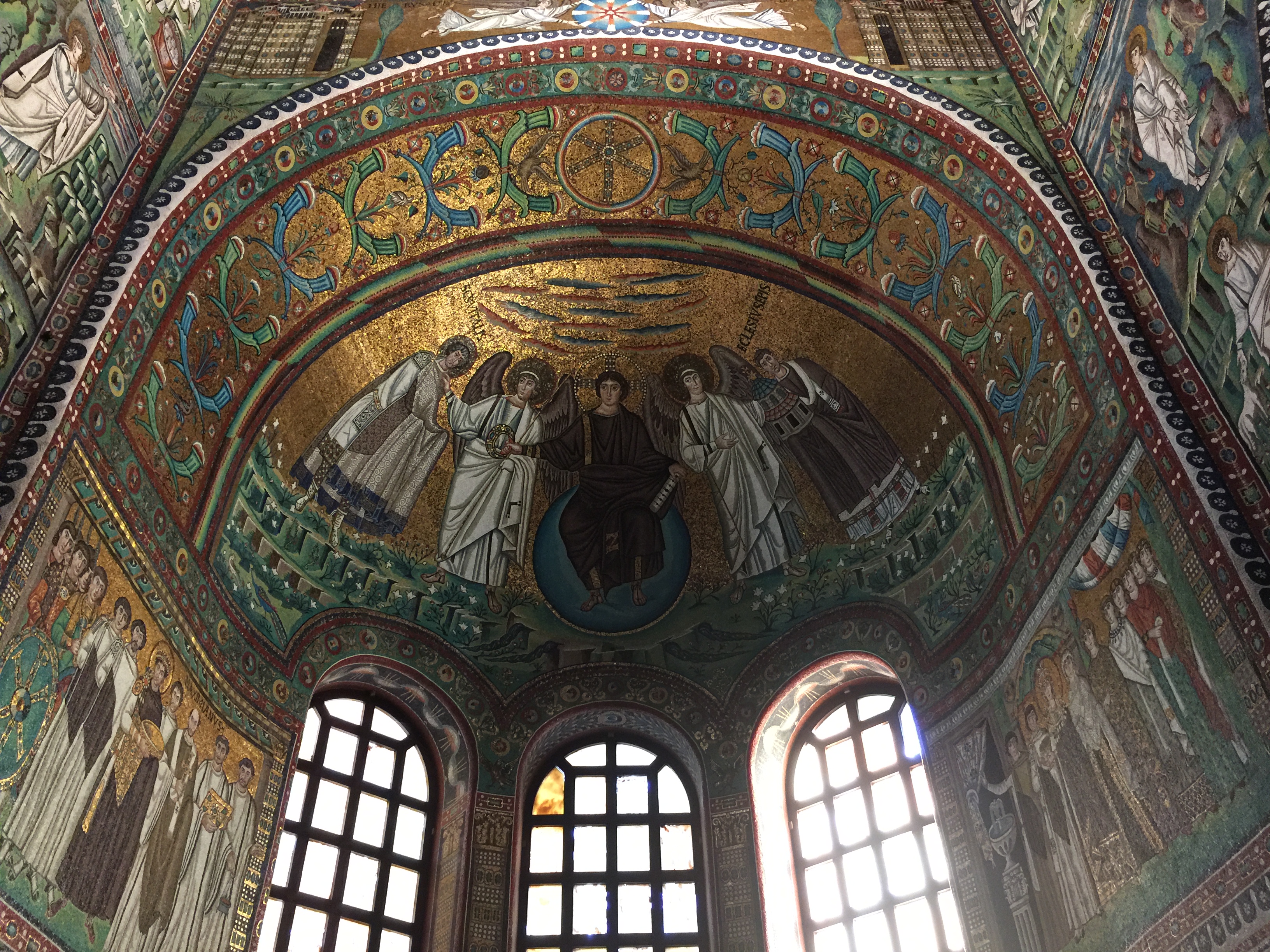
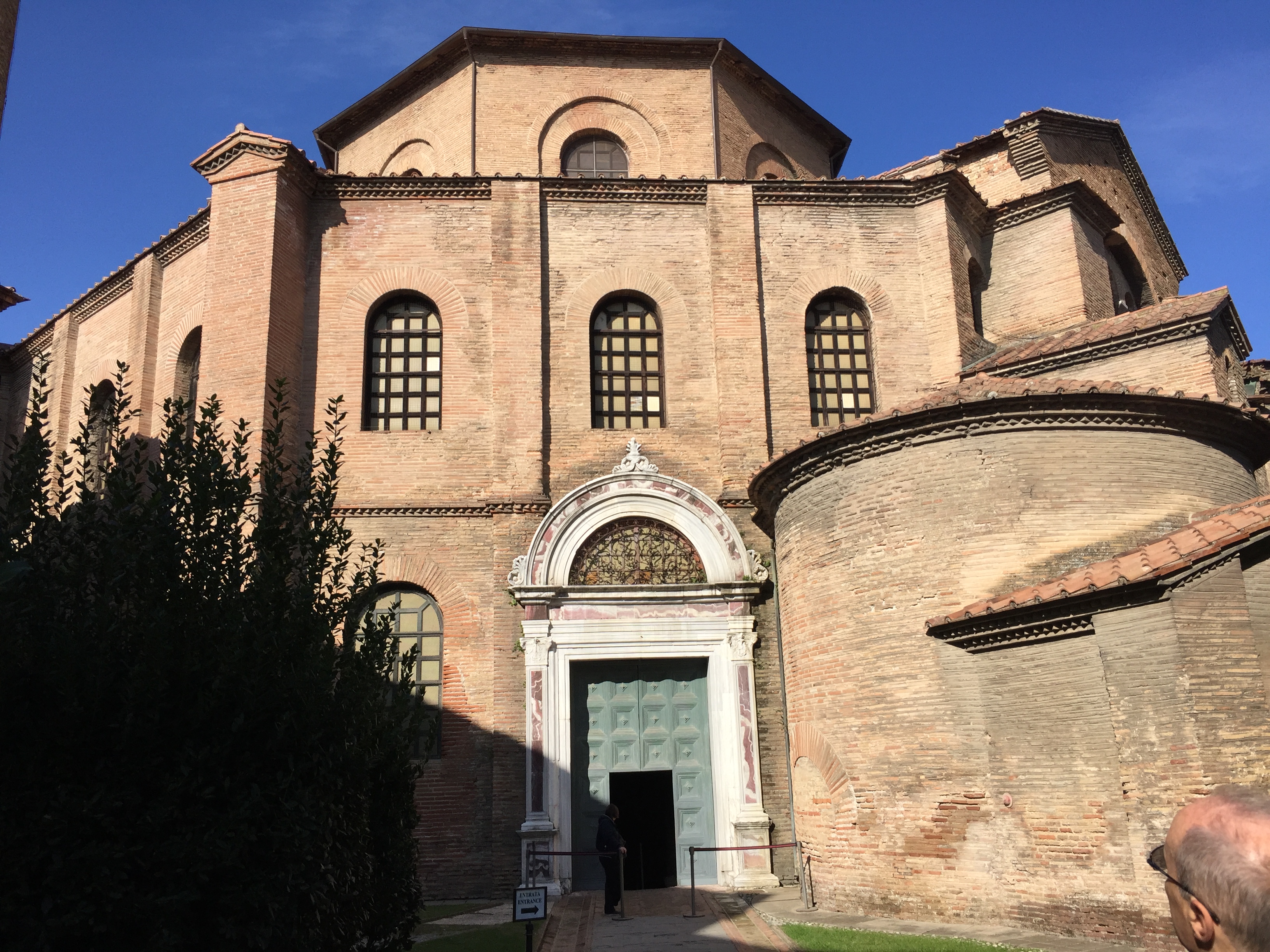
Basilica of San Vitale Ravenna

IMG_0196

Overall          *****  5 stars – original building and superb mosiacs

Display         3 – very good guide books available, little on site

Access           4 – open and accessible on UNESCO trail

Other             Marks the re-imposition of Roman orthodoxy

San Vitale was begun in 526 under Ostrogothic rule, by the Orthodox (Roman) Bishop Ecclesius.  It was finished under Bishop Maximian who was sent out from Constantinople after the reconquest by Belisarius.  It was paid for by Julius Argentarius.  Maximian is definitely depicted in the courtiers behind Justinian in the mosaic in the apse, as Julian may be.

IMG_0173

San Vitale is octagonal in plan, preceded by a narthex, flanked by two towers and appears to be heavily influenced by contemporary architecture in Constantinople, where Ecclesius had long resided.  The apse is as usual semi-circular on the inside and polygonal on the outside.  Above the main body of the Church is a polygonal lantern.  It is supposedly is of the same design as the Imperial Audience Chamber in Constantinople.  There are no parallels of this design in Italy.

On entering S. Vitale on a sunny day you are struck by the varied play of light and dark, with shafts of sun-light slanting down and illuminating the columns, capitals and above all causing the mosaics to shine and sparkle.

The main glory of S. Vitale are the magnificent mosaics, which testify to the brilliance of the artists and craftsmen of 6th Century Ravenna.  It is tempting to describe them but no words can do them justice, nor indeed photos or professional portraits.  You just have to see them!

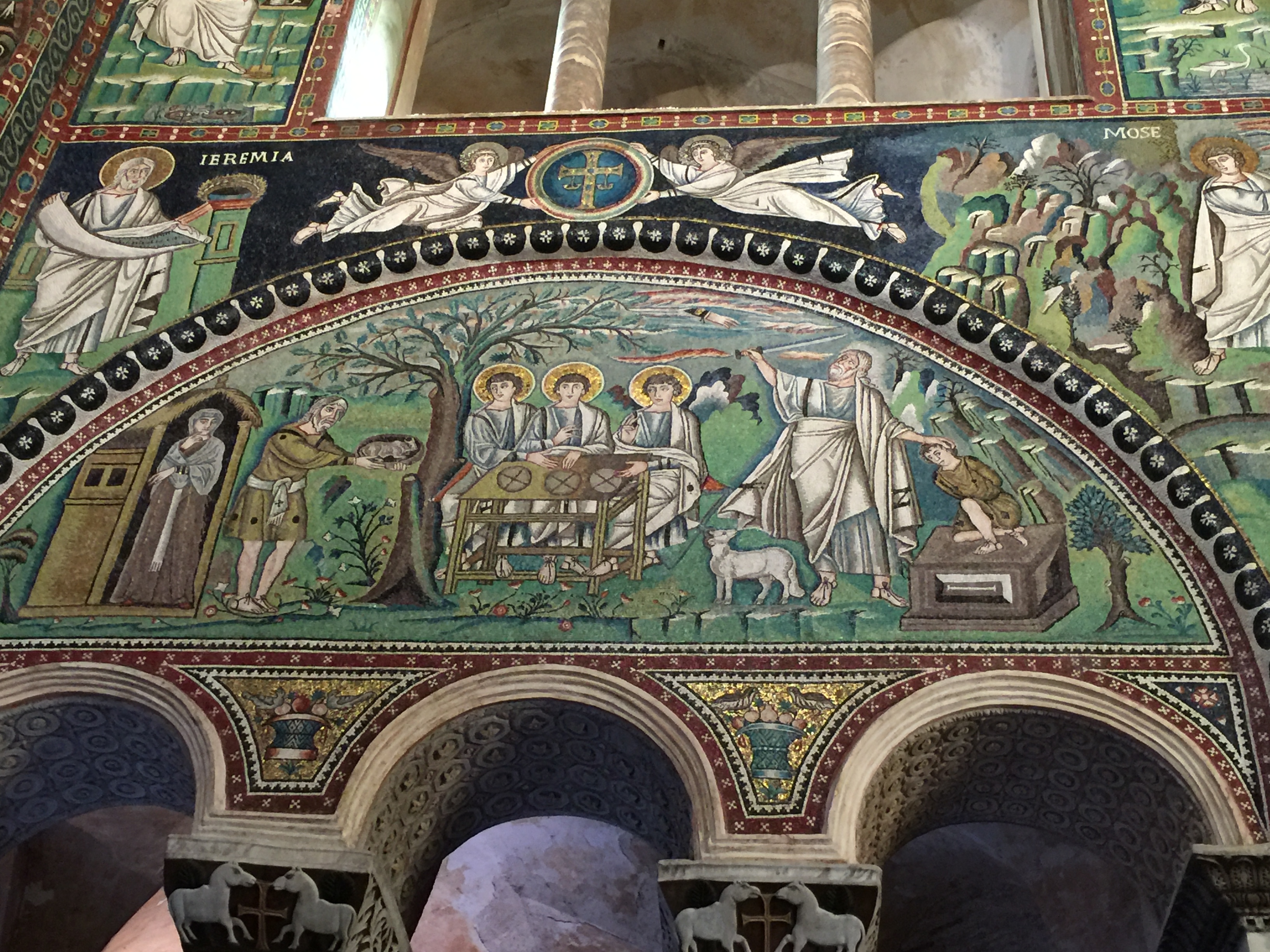
The Presbytery mosaics are all about the Sacrifice of the Eucharist.  Thus the triumphal arch leading into the Presbytery is decorated with 15 busts of Christ, the Apostles and Ss. Gervais and Protassius, said to be the sons of S. Vitale.   In the ceiling at the centre stands the Mystic Lamb supported by four praying angels.  On the side walls next to figures of the evangelists, prophets and Moses are scenes of sacrifice from the Book of Genesis – the Hospitality of Abraham and the Sacrifice of Issac, and the Offered Sacrifces of Abel and Melchizedek.

IMG_0186

In the Apse the figure of Christ sits on a blue globe flanked by two angels.  The right hand angel offers the crown of martyrdom to S. Vitalis and the left hand offers a scroll to Bishop Ecclesius,  the Church founder who carries a model of the Church itself.  Interestingly Christ wears the Imperial purple and the angels traditional Roman dress.

IMG_0319

Perhaps the most famous mosaics, are the panels facing each other on the side walls of the apse.  On the right is the Emperor Justinian in purple with a golden halo, surrounded by court officials, Bishop Maximian is named and speculatively one of the men is Julius Argentarius the patron, and possibly on his right General Belisarius, who re-conquered Ravenna in 540.  Palatine Guards with chi-rho symbol on their shields are also shown.  Opposite is the Empress Theodora with her court ladies.   In typical Byzantine fashion the Emperor and Empress are shown face on looking impassively forward.   Showing the Imperial Family in the same way as saints, prophets and angels expresses the authority of both the Emperor and the Church and inextricably links them.  This is something first seen in the now lost mosaics of St John the Evangelist.

St John the Evangelist, Ravenna

Narthex of St John the Evangelist

Overall          ** 2 stars – remarkable survival

Display         2  limited information for visitors, hard to use QR codes

Access           3 open and accessible but not on UNESCO trail

Other             Hugely significant but heavily restored and bombed!

St John the Evangelist was founded by the Augusta Galla Placidia after 425, when she and her children survived a storm on the passage back from exile in Constantinople to Ravenna, and made a vow to the Evnagelist that if they survived she would build a Church to him.

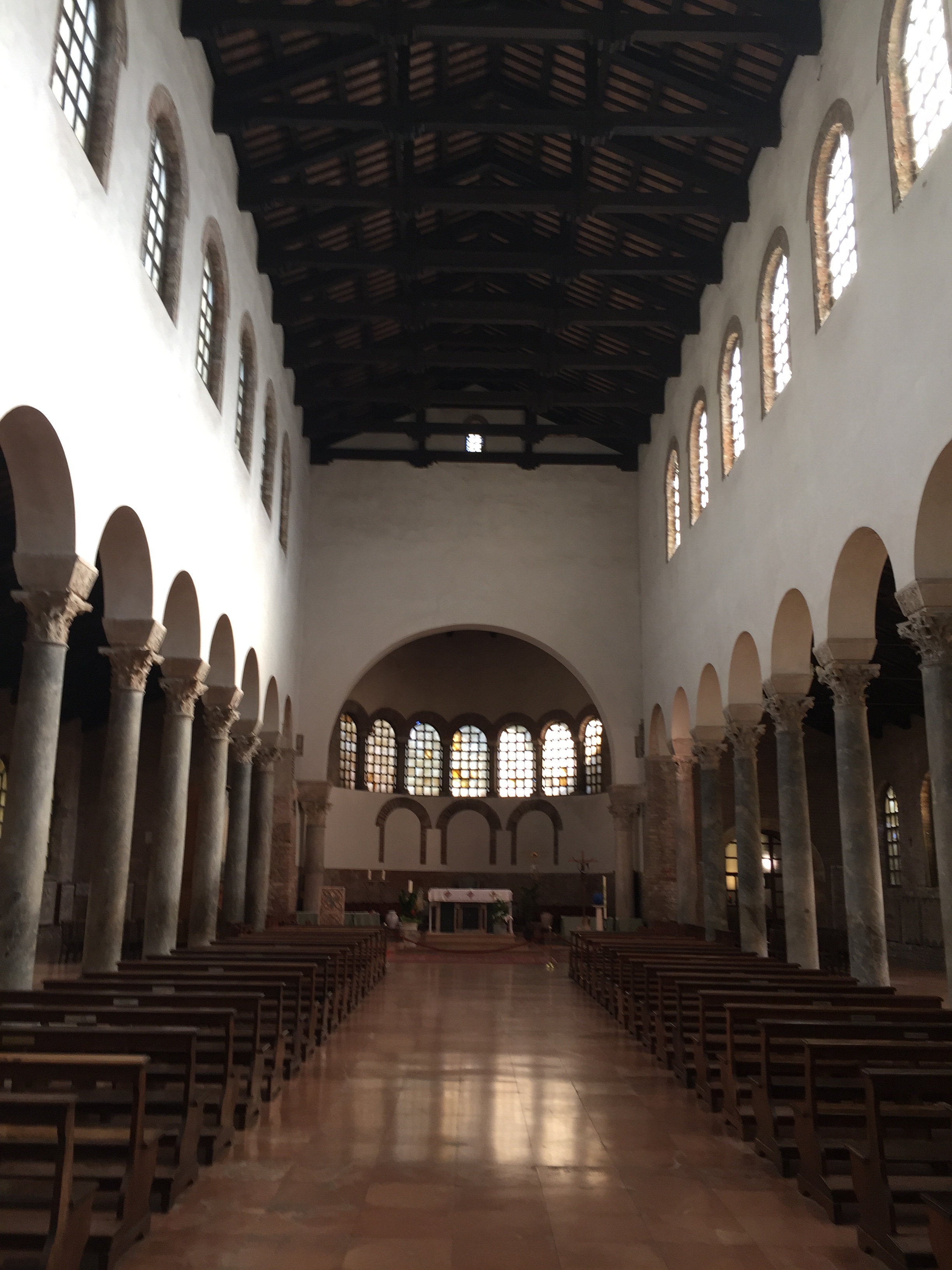
Alas not much survives from the original structure although the columns, capitals and bases, re-used from a 3rd Century are part of Galla’s building.  The magnificent mosaics on the apse were destroyed in 1568, but a detailed description was made before that date.

Nave and Apse sadly devoid of mosaics

The mosaics centred on an enthroned figure of Christ with a passage from Matthew 5.7.  There were also two panels showing the storm at sea, and representations of the Imperial Family.  In medallions above were inages of 10 of Galla Placidia’s relatives going back to Constantine and probably including her deceased son by Athaulf, Theodosius.    Beneath the enthroned Christ was a large scale image of the then Bishop of Ravenna, Peter Chrysologus, with his hands in prayer.  Peter was flanked by images of Theodosius II, Emperor of the Eastern Empire and Eudocia and their children Arcadius and Eudocia, who was married to Valentinian III, Galla’s son.  This was a startling mixture of Christ, the Imperial Family and the Bishop of Ravenna.  A combination that was to be followed in Ravenna mosaics in the future at S. Vitale and S. Apollinare in Classe.

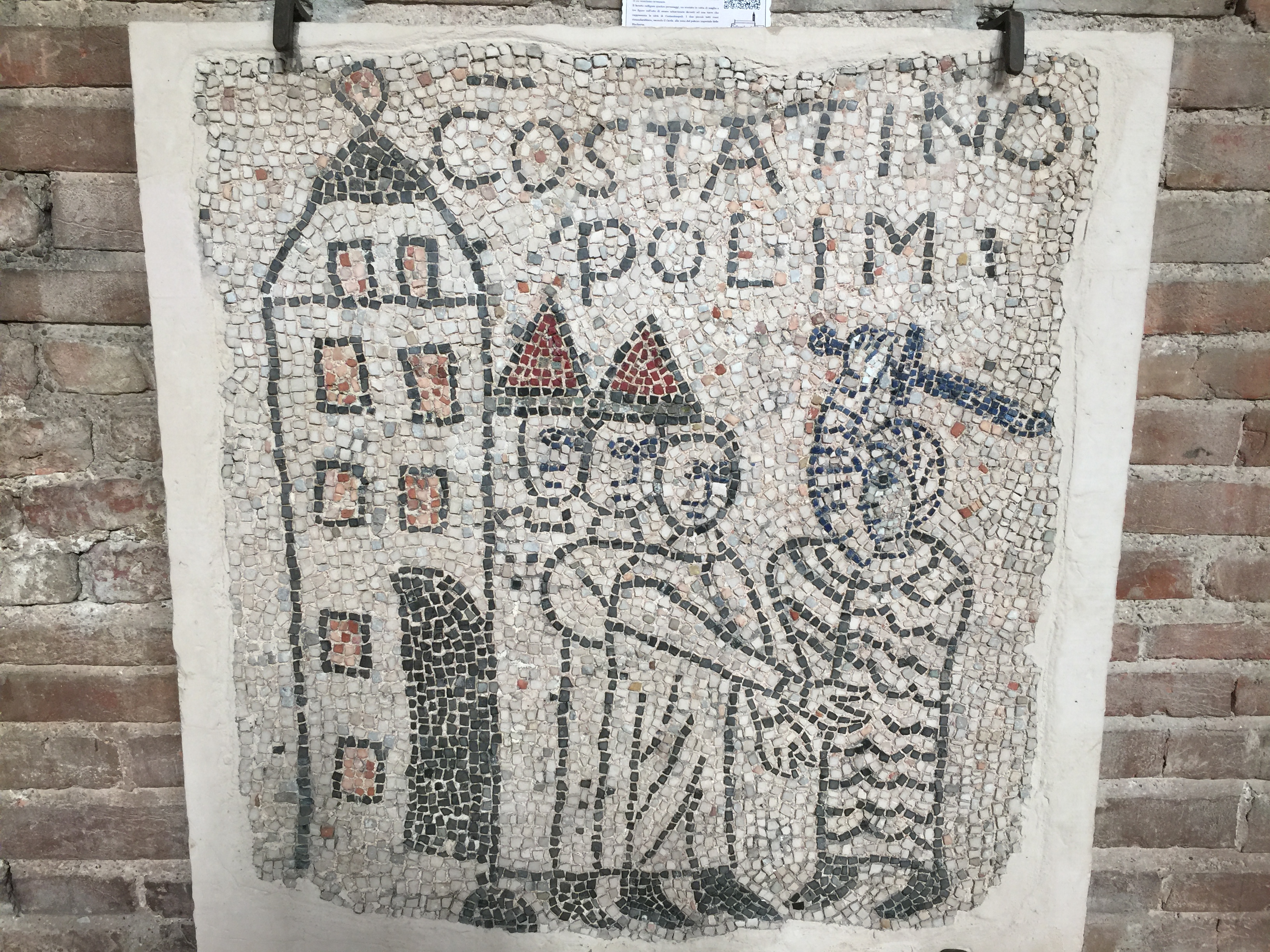
An interesting post-script to St John the Evangelist is that the floor from c1215 was excavated following the serious bomb damage of 1944, and panels line the walls.  Interestingly and possibly uniquely in the West, these celebrate the sack of Constantinople by the 4th Crusade in 1204, the Crusaders having been lead astray by the Doge of Venice.

IMG_0085IMG_0105

Introduction to Late Roman, Ostrogothic and Byzantine Ravenna

IMG_0173

Overall Rating      ******    6 stars – stunning mosaics in sites across the City

Other                       Wow Factor!  The mosaics will blow your socks off!

Ravenna has been called the ‘Late Roman Pompeii’.  The marketing hype does not quite work since unlike Pompeii Ravenna has been continuously inhabited.  However it does contain the largest assembly of surviving Late Roman mosaics in a collection of remarkable buildings of the 5th and 6th Centuries.

The fact that although they are in one place over a period of 150 years and are stylistically similar, they are variously classified as Later Roman (or Late Antiquity), Ostrogothic or Byzantine demonstrates how fast the Mediterranean World was changing.  This is why we are writing this introduction to Ravenna to save repeating the history at each site.

This history is complex.  In the 4th Century Constantine and his dynasty, followed by Valentinian and his dynasty waged largely successful defensive wars against invading German tribes – Franks, Goths, Huns and Vandals.  They also divided the Empire into more easily defended zones, sometimes East and West but often more complicated, which although better defensively, resulted in destructive civil wars between rival Augusti who wanted to rule the whole Roman World.  These wars sapped the fighting strength of the field armies and the economic sustainability of the Empire.  Also German mercenaries and recruits became integrated not just into the armies, but also the high command of the Roman state.

Theodosius I (379-395) restored the East after the calamitous defeat by the Goths at Adrianople in 378.  He conquered the West twice, defeating his rivals at the Battle of Frigidus in 394, using German mercenaries as well as the Eastern Field Army to defeat the West.  He then died in Milan in 395, leaving the East to his eldest son Arcadius and the West to his younger son Honorius.  Guided by his half Vandal generalissimo Stilicho, Honorius ruled from Milan, but when in 402 Alaric and the Visigoths began rampaging round Italy, he retreated to Ravenna.

Ravenna was safe since it was surrounded by marshes and connected by a deep water canal to the long time Roman port and fleet base at a Classis.  It remained the “capital” of Italy until 751.  Ravenna in this period was the most prosperous city in the West, since it was the seat of authority and the principal port between Eastern and Western Empires.   There is evidence for more than 60 churches in use at this time.  Rome in contrast was sacked 6 times, its aqueducts cut and its grain supply from Egypt and North Africa stopped, declined catastrophically.

The magnificent surviving churches of Ravenna and their mosaics are connected with three great personalities of the period: the Augusta (Empress) Galla Placidia, the Ostrogothic King Theodoric and Bishop Maximian of Ravenna.

Galla Placidia was the half sister of Honorius, and after the Visigothic Sack of Rome by Alaric in 410, she was taken by the Goths as a hostage, and married in 414 to Alaric’s successor Athaulf.  On Athaulf’s death she returned to the Empire and joined Honorius in Ravenna.  She married the consul and general Constantius in Ravenna, who briefly deposed Honorius in 421.  After his death Galla Placidia was banished to Constantinople.  After Honorius’ death in 423 she returned to Ravenna in 425, ruling what was left of the Western Empire as Augusta, in her own right and in the name of her son Valentinian III.  She died in Rome in 450, and Valentinian was murdered in 455.

IMG_0072

Galla Placidia was the most important church builder in Ravenna over this period and built St John the Evangelist, in thanks for her safe return from Constantinople by sea in 425.

IMG_0228

She also built a large cross shaped church, to house a relic of the True Cross (Santa Croce).  Attached to the southern end of the narthex (vestibule) of Santa Croce she also built a smaller cross shaped building, which is traditionally seen (certainly from the 9th century) as the Mausoleum of Galla Placidia.

A Late Roman capital city must have a Cathedral and there is evidence that the Basilica Ursiana, was built by Bishop Ursus in the last decade of the 4th Century.  Alas the original cathedral was demolished in 1733!  However the baptistry built by Bishop Neon around 458 survives and is known as the Neonian Baptistry or the Baptistry of the Orthodox for reasons which will soon be apparent.  Also around the end of the 5th Century, Bishop Peter II decorated a chapel with mosaics, now known as the Capella Arcivescovile.

After Valentininan III’s murder, the Western Empire spiralled into extinction with Emperors little more than puppets of their Germanic generalissimos, until in 476 the last Emperor appropriate called Romulus Augustus was deposed by Odavacer the Herul, sending the Imperial insignia to Constantinople and ruling Italy nominally in the name of the Eastern Emperor Zeno.  By this time Spain and South West Gaul were in the hands of the Visigoths, Africa the Vandals and the rest of Gaul the Franks and Burgundians – Britain had long departed the imperial orbit, losing the use of money and central administration.

Zeno encouraged the Ostrogothic leader Theodoric to attack Odavacer and Theodoric took Ravenna in 493, stabbing it is said, his adversary to death in the Ad Laurata Palace in the City.  Theodoric was recognised as King of Italy by the Eastern Emperor Anastasius (491-518).

IMG_0050

Theodoric was a Goth but no barbarian.  He had been brought up in the Imperial Palace in Constantinople as privileged hostage.  He ran Italy with the advice of Romans like the philosopher Boethius and the administrator Cassiodorus.  Theodoric built himself a Palace in Ravenna, and its principal gate was known as the Chalke (bronze) Gate, like the gate of the palace in Constantinople.

Theodoric was a Goth and a Christian.  The Goths were converted in the mid 4th Century by Bishop Ulfilas.  Ulfilas followed the then prevailing orthodoxy of the Emperor Constantius of Arianism.  That is he followed Arius of Alexandria in believing that because Christ had been created by God he could not be fully divine.  This view of the Trinity was over-thrown at the Council of Constantinople in 381 when the doctrine of the Father Son and Holy Ghost Trinity won the day, and Arians became heretics.  So when Theodoric took over Ravenna and Italy the Arians were in charge.  Theodoric built a huge Arian basilica next to his Palace, which is now called S. Apollinare in Nuovo.   On Theodoric’s death in 526 he was buried in a splendid stone Mausoleum.

IMG_0136

He was succeeded by his daughter Queen Amalaswentha, who ruled in the name of her son or husband until 536, when she was succeeded by King Vitiges.  In 535 the Eastern Emperor Justinian launched a campaign to recapture Italy lead by his general Belisarius, who captured Ravenna in 540.  From then until 751, Ravenna was the seat of the Exarch who ruled whatever lands Constantinople held in Italy.

The arrival of Belisarius meant that the heretic Arians had been defeated and in 561 Theodoric’s Palace Church was rededicated and he and his court removed from the mosaics.

IMG_0196IMG_0191

The next great phase of building in Ravenna is associated with Bishop Maximian the orthodox bishop who arrived in 546.  Bishop Maximian dedicated S. Vitale in the City in 547, and S. Apollinare in Classe in 549, at the port some 5kms outside.  However it should be noted that both of these magnificent buildings were begun long before Maximian’s arrival and even before the Eastern Empire’s take-over of Ravenna in 540.  We know that they were both funded by one Julianus Argentarius, a banker.  So although totally Byzantine – the Imperial couple Justinian and Theodora feature on the mosaics, these churches also represent continuity across regime change in Ravenna.

In addition to the magnificent churches and palaces Ravenna  must have had fine buildings to house the administrators and generals of the Roman, Gothic and Byzantine regimes.  Most of these houses and baths have disappeared, but in the so-called House of Stone Carpets, we can see just how magnificent these dwellings would have been.

Ravenna eventually fell to the Lombards and then the Franks, Charlemagne borrowing statues and ideas for his new Holy Roman Empire capital in Aachen.  It is a remarkable survival of Roman Christian culture of different kinds, that disappeared from the West after the 8th and 9th Centuries.