Introducing Caerleon Legionary Fortress

Overall         4**** A lot to see: for Britannia, these are substantial visible remains

Display         3*** Museum brilliant and Cadw great at Baths (amphitheatre & barracks less so)

Access           4**** You can walk around whole site with Caerleon village; easy parking

Atmosphere 4**** Once you have walked around you can start to imagine the Fortress

Other            5***** Caerleon is very rare in Britannia, since the other Legionary Fortresses (Colchester, Gloucester, Exeter, Lincoln, Chester and York) are under modern cities and there is little of the Fortress to see at Wroxeter (and nothing at Inchtuthil)

Caerleon Legionary Fortress of Legio II Augusta consistes of:

  • The Natatio and part of Frigidarium and Apodyterium of the internal Fortress Baths
  • The exposed Ramparts on the South and West sides
  • The Amphitheatre, just outside the South-West Gate
  • The ‘only exposed legionary barrack block in the Empire (?)’
  • The Legion Museum of the National Museum of Wales

Having failed to complete the conquest of the resident Iron Age tribe the Silures in South Wales in the AD50s, in AD75 Legio II Augusta moves from Exeter (Isca Dumnoniorum) to Caerleon (Isca) to complete the conquest. Unsurprisingly, the Romans have to quell determined military resistance.

The first fortress is constructed of timber with turf and earth ramparts. At a date quite soon after (probably around AD80) the whole fortress is rebuilt in stone, and a set of impressive fortress Baths are built in stone from the outset. By now, conditions for the occupiers are improving significantly .

In AD90 the Amphitheatre is begun and the fortress Baths receive their first refurbishment.  Then, in AD122, most of Legio II Augusta moves north to build Hadrian’s Wall, but Caerleon remains operational.

In AD 130 the Baths receive a total reshape, including new changing rooms, and the pool is shortened.

In AD193 under Septimius Severus, despite an apparent rebuild of the Principia (HQ), Isca is abandoned or at least ‘mothballed’.  This presumably reflects Legio II Augusta’s role campaigning in Scotland with the Emperor, with plans for permanent deployment in the North.  (Severus had deployed legions in his new Province of Mesopotamia in AD197.)

In AD211 the plan to abandon Isca is dropped and under Emperor Caracalla major repairs are undertaken  to the Fortress, Amphitheatre and Baths.  Legio II Augusta gains the title Anoniniana – ‘Caracalla’s Own’.

By AD250 major components of the Legion have left as vexillations (detachments) to fight in the Anarchy of the C3rd, leaving large parts of the Fortress unoccupied.

There is some rebuilding of barracks in AD253-258 and around AD274.

Between AD287 and 296 the main buildings of the Fortress are demolished and Legio II Augusta is moved to Richborough, possibly by the military commander – then usurper – Carausius, in order to defend against Channel raiders and, thereafter, against the legitimate Empire.

Caerleon

pf_sf_interpretation
The plan of the Stone Fortress, courtesy of Caerleon Research Committee


Prsyg Field Barracks, Caerleon

IMG_1732

Overall         2 ** interesting site, unique display of a legionary barrack block

Display         1 * one barrack block is original the other three are surface representations

Access           3 *** you can park in adjacent rugby club car park unless a match is on

Atmosphere 1 * the multiplicity of walls are confusing in the ‘real’ barrack block

Other             3 *** However all of this is part of the fabulous displays at Caerleon

In the North West of the Fortress there is a block of four barracks on view.  These constitute two-thirds of the barracks of a single Cohort.  The first line of barracks are the actual stone buildings, and are below ground level.   The other three barracks are much higher at current ground level are are modern.

The original barracks from 75AD were wooden, but the Fortress was rebuilt in stone over the next few years.  There is controversy as to whether only the bottom parts of the barracks were stone with timber top halves, or completely of stone.

The II Augusta was composed of 10 cohorts, each of six centuries composed of 80 legionaries.  The centuries were twinned reflecting the old Republican maniple, and the barrack blocks faced each other.  There were 10 contuburnia each of 8 legionaries in each century.  Each contubernium had two rooms in the barracks, one at the back with bunks and cooking equipment, and a room at the front for storage of weapons, armour and shields.

The excavated remains show 12 pairs of rooms, which allows for some to be used as store-rooms or new recruits.  At the other end of the barrack-block are the Centurion’s quarters, which combine quite lavish accommodation with the offices of the Century.

In summary this is rather a disappointing site, given what we are looking at here.  Unlike the Roman Baths where the site is brought to life through finds, light effects and models, here we are presented with the confusing multi period jig-saw of walls which make it very hard to envisage what life was like for the legionaries who built this and lived here. The best place to feel this is perhaps the admittedly auxiliary reconstructed barracks at the Saalburg.

Roman Legionary Baths Caerleon

IMG_1804
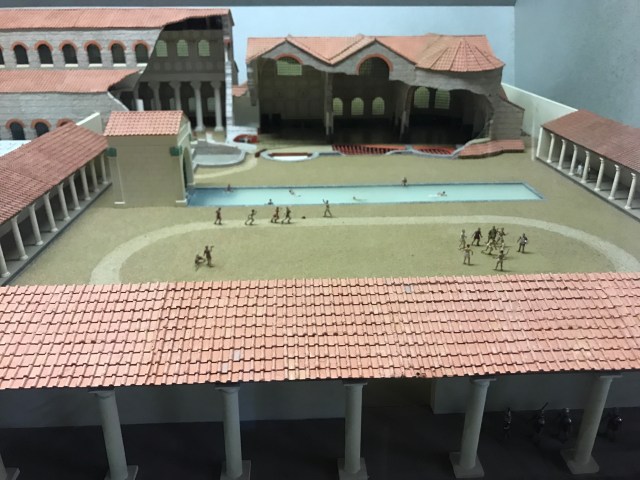
Model of the Complex in the Cadw Cover Building

Overall          4 ****  Exposed remains of part of the huge Legionary Baths

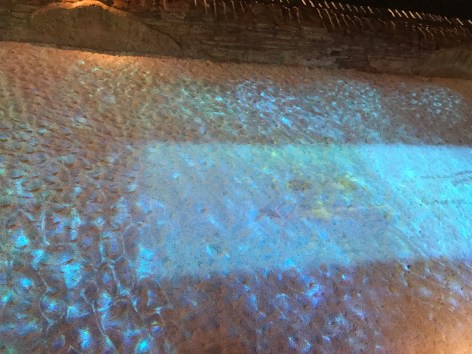
Display         5 *****  Excellent; the light effects recreate the water and bathers

Access           3 ***  Car park outside, shared with the pub!

Atmosphere 4 ****  Magical light effects bring the baths to life

Other            Part of the best assemblage of legionary remains in Britannia, with friendly                         Cadw staff and family activities during the holidays.

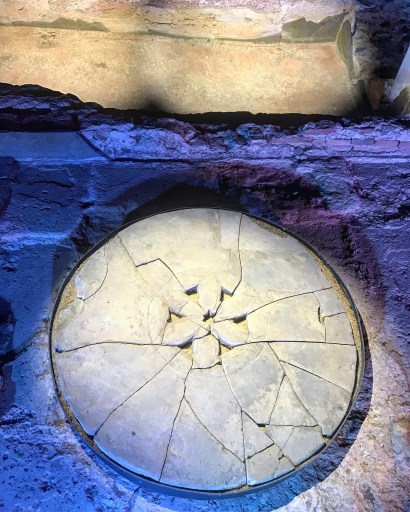
You can only see a small part of the internal Baths of the Fortress, built of stone after AD75 by Legio II Augusta.  We are lucky, however, in that the Swimming Pool (Natatio), part of the Cold Room (Frigidarium) and part of the Changing Room (Apodyterium) are exposed.  The enormous Exercise Hall (Basilica), Warm Room (Tepidarium) and Hot Room (Caldarium) are  not visible, so the vast scale of the entire baths complex can only be imagined.

The displays are clearly – and very reasonably – aimed at the school visits market, with interactive games and dressing up.  There are also several clear explanatory boards, however, with exhibits of finds and – our favourite item – an excellent cut-away model of the whole Baths complex, as originally completed.

IMG_1806

Best of all are the light effects on the plunge pool which make it look as if it is full of water and in use by ghostly Roman bathers.  The pool was originally 41m long, held 365,000 litres of water, and had a larger surface area than the Great Bath at Aquae Sulis (Bath).

One of the most interesting findings to emerge from the excavations of the Baths was proof of their use by women and children, presumably related to the garrison. The collection of carved gemstones (intaglio) from the baths drain is a highlight.

The Baths building was refurbished in 87-95AD, and in c130 the pool was shortened. During Septimius Severus’ campaigns in Scotland the stone slabs of the lining were removed, possibly presaging a planned evacuation, but it was then re-lined and and continued in use until 240, with final abandonment in 290-300!

IMG_1810

What our visit brought home to us was the sheer scale and luxury of this ‘Legionary Recreation Centre’ in the middle of what was still, at the time of construction, a war-zone.  The Baths would have towered over the rest of the Fortress and, with an overall length of 110m, are comparable in size to a medieval Cathedral, the Basilica being comparable to the nave and the cold, warm and hot rooms like the chancel. The contrast between the conditions experienced by the Legionaries in the Fortress and the defeated Silures outside cannot be exaggerated.