Introducing Caerleon Legionary Fortress

Overall         4**** A lot to see: for Britannia, these are substantial visible remains

Display         3*** Museum brilliant and Cadw great at Baths (amphitheatre & barracks less so)

Access           4**** You can walk around whole site with Caerleon village; easy parking

Atmosphere 4**** Once you have walked around you can start to imagine the Fortress

Other            5***** Caerleon is very rare in Britannia, since the other Legionary Fortresses (Colchester, Gloucester, Exeter, Lincoln, Chester and York) are under modern cities and there is little of the Fortress to see at Wroxeter (and nothing at Inchtuthil)

Caerleon Legionary Fortress of Legio II Augusta consistes of:

  • The Natatio and part of Frigidarium and Apodyterium of the internal Fortress Baths
  • The exposed Ramparts on the South and West sides
  • The Amphitheatre, just outside the South-West Gate
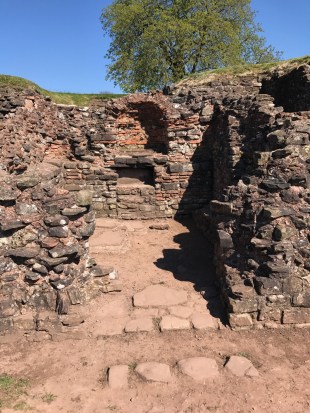
  • The ‘only exposed legionary barrack block in the Empire (?)’
  • The Legion Museum of the National Museum of Wales

Having failed to complete the conquest of the resident Iron Age tribe the Silures in South Wales in the AD50s, in AD75 Legio II Augusta moves from Exeter (Isca Dumnoniorum) to Caerleon (Isca) to complete the conquest. Unsurprisingly, the Romans have to quell determined military resistance.

The first fortress is constructed of timber with turf and earth ramparts. At a date quite soon after (probably around AD80) the whole fortress is rebuilt in stone, and a set of impressive fortress Baths are built in stone from the outset. By now, conditions for the occupiers are improving significantly .

In AD90 the Amphitheatre is begun and the fortress Baths receive their first refurbishment.  Then, in AD122, most of Legio II Augusta moves north to build Hadrian’s Wall, but Caerleon remains operational.

In AD 130 the Baths receive a total reshape, including new changing rooms, and the pool is shortened.

In AD193 under Septimius Severus, despite an apparent rebuild of the Principia (HQ), Isca is abandoned or at least ‘mothballed’.  This presumably reflects Legio II Augusta’s role campaigning in Scotland with the Emperor, with plans for permanent deployment in the North.  (Severus had deployed legions in his new Province of Mesopotamia in AD197.)

In AD211 the plan to abandon Isca is dropped and under Emperor Caracalla major repairs are undertaken  to the Fortress, Amphitheatre and Baths.  Legio II Augusta gains the title Anoniniana – ‘Caracalla’s Own’.

By AD250 major components of the Legion have left as vexillations (detachments) to fight in the Anarchy of the C3rd, leaving large parts of the Fortress unoccupied.

There is some rebuilding of barracks in AD253-258 and around AD274.

Between AD287 and 296 the main buildings of the Fortress are demolished and Legio II Augusta is moved to Richborough, possibly by the military commander – then usurper – Carausius, in order to defend against Channel raiders and, thereafter, against the legitimate Empire.

Caerleon

pf_sf_interpretation
The plan of the Stone Fortress, courtesy of Caerleon Research Committee


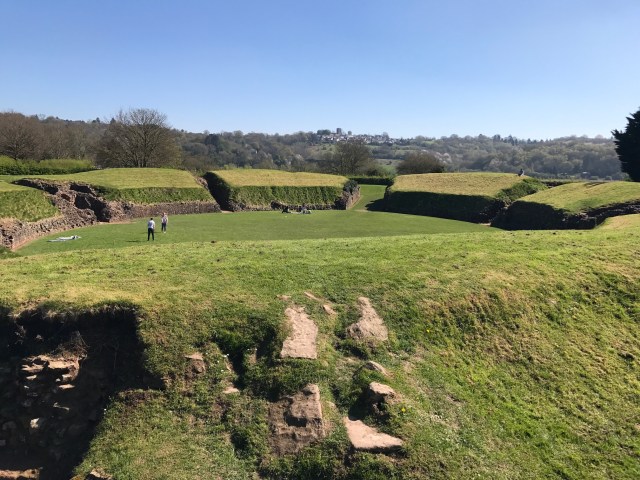
The Legionary Amphitheatre at Caerleon

IMG_1711

Overall         3 *** important site, impressive scale and great setting

Display         2 ** site remains excellently consolidated, little information on site

Access           3 *** you can park in adjacent rugby club car park unless a match is on

Atmosphere 2 ** great impression, but far too pleasant for its original purpose!

Other             3 *** best amphitheatre in Britannia!

This is the only fully visible Legionary Amphitheatre in Britannia, and is another Mortimer Wheeler production, excavated in 1926-7.

It was constructed in cAD90 outside the South-West Gate of the Fortress on the Via Principalis, now called Broadway  It is c80m by c65m in size and elliptical in shape.  Its surviving lower part was made of stone and earth, with an upper part constructed of timber, forming a grandstand with tiers of wooden seating.  It is calculated that it could hold the full 6,000-man complement of Legio II Augusta.

There are two processional entries facing each other on the long axis, and two other entrances with waiting rooms for gladiators, prisoners and beasts, facing each other on the short axis.  The legionary stonemasons included inscribed stones with the name of the centurion of the Century that had built that section, sometimes with the Capricorn badge of II Augusta.  The originals are now in the Legion Museum, but replicas have been put in place and can be spotted.

IMG_1713
Entrance to Arena from Waiting Room
IMG_1717
The Shrine to Nemesis

There is a niche on the East with a shrine to Nemesis, which was identified by a curse tablet found nearby.  This added in 212-22, dated by brick work dating to Caracalla when Leg II Augusta held the title of Antonina.

Together with the vast Baths Complex, the Amphitheatre gives you an insight into the daily world of a Roman Legionary – certainly, in the late 1st and 2nd Centuries, not a humble ‘grunt’ but an accomplished professional military engineer, probably literate, well-paid and forming the sinews that held the Empire together.  A grateful Emperor and Respublica would provide him with all the comforts that could be built – not just bread and circuses, but baths and regular donatives of cash on special occasions.  As Septimius Severus said to his sons on his deathbed, ‘Be harmonious, enrich the soldiers, scorn everybody else’.

Most Roman amphitheatres have a thoroughly miserable and acutely depressing atmosphere; you only have to think of what happened in them.  However, at Caerleon, where the grass is frequented by picnicking families and boys kicking footballs, it is actually quite cheerful.

Unlike the rest of Caerleon, on site the information provided is meagre, so you need Cadw’s well-illustrated guide to the Fortress.

IMG_1719
Copy of Centurial Stone of Century of Claudius Cupitus

Roman Legionary Baths Caerleon

IMG_1804
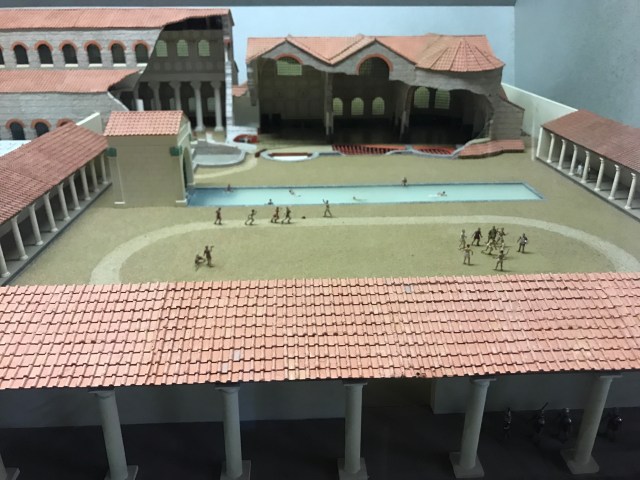
Model of the Complex in the Cadw Cover Building

Overall          4 ****  Exposed remains of part of the huge Legionary Baths

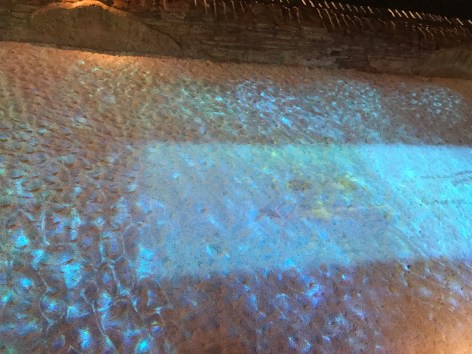
Display         5 *****  Excellent; the light effects recreate the water and bathers

Access           3 ***  Car park outside, shared with the pub!

Atmosphere 4 ****  Magical light effects bring the baths to life

Other            Part of the best assemblage of legionary remains in Britannia, with friendly                         Cadw staff and family activities during the holidays.

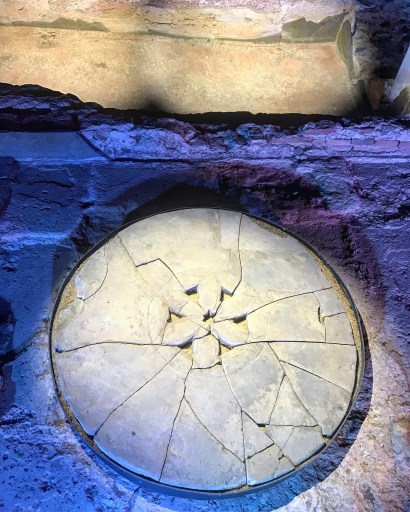
You can only see a small part of the internal Baths of the Fortress, built of stone after AD75 by Legio II Augusta.  We are lucky, however, in that the Swimming Pool (Natatio), part of the Cold Room (Frigidarium) and part of the Changing Room (Apodyterium) are exposed.  The enormous Exercise Hall (Basilica), Warm Room (Tepidarium) and Hot Room (Caldarium) are  not visible, so the vast scale of the entire baths complex can only be imagined.

The displays are clearly – and very reasonably – aimed at the school visits market, with interactive games and dressing up.  There are also several clear explanatory boards, however, with exhibits of finds and – our favourite item – an excellent cut-away model of the whole Baths complex, as originally completed.

IMG_1806

Best of all are the light effects on the plunge pool which make it look as if it is full of water and in use by ghostly Roman bathers.  The pool was originally 41m long, held 365,000 litres of water, and had a larger surface area than the Great Bath at Aquae Sulis (Bath).

One of the most interesting findings to emerge from the excavations of the Baths was proof of their use by women and children, presumably related to the garrison. The collection of carved gemstones (intaglio) from the baths drain is a highlight.

The Baths building was refurbished in 87-95AD, and in c130 the pool was shortened. During Septimius Severus’ campaigns in Scotland the stone slabs of the lining were removed, possibly presaging a planned evacuation, but it was then re-lined and and continued in use until 240, with final abandonment in 290-300!

IMG_1810

What our visit brought home to us was the sheer scale and luxury of this ‘Legionary Recreation Centre’ in the middle of what was still, at the time of construction, a war-zone.  The Baths would have towered over the rest of the Fortress and, with an overall length of 110m, are comparable in size to a medieval Cathedral, the Basilica being comparable to the nave and the cold, warm and hot rooms like the chancel. The contrast between the conditions experienced by the Legionaries in the Fortress and the defeated Silures outside cannot be exaggerated.

Roman Civitas Walls, Exeter

IMG_1503

Overall          1 * the lower courses survive in some sections

Display         2 ** good wall walk published by Council covering all periods

Access           4 **** easy throughout the entire length on streets and parks

Atmosphere 2 ** you can get start to get a feel for the shape of the Isca Dumnoniorum

Isca Dumnoniorum inherited the site and presumably many of the buildings of the former Legionary Fortress of II Augusta, when the legion vacated the site in c75CE.

In Ptolemy’s Geographia of the 2nd Century Isca – which means ‘water’ in Celtic – is one of the four ‘cities’ of the Dumnonii, and is also the termination of one of the routes of the Antonine Itinerary.

IMG_1528

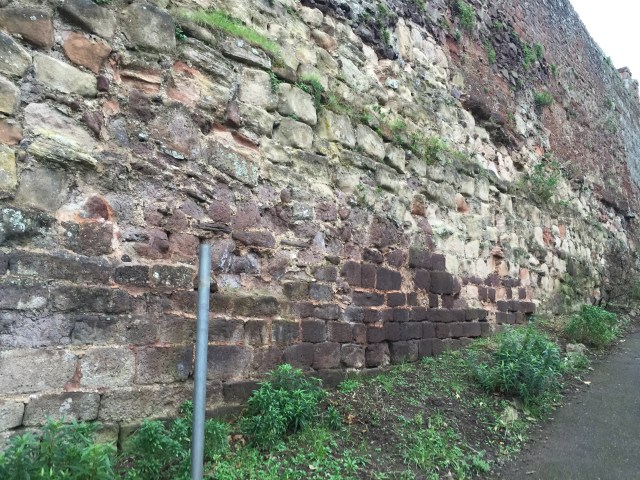
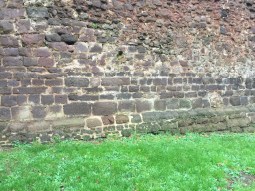
The Civitas capital of the Dumnonii was twice as large than the preceding Legionary Fortess of 17ha and was enclosed by a ditch and rampart enclosing 37ha (92 acres).   In the late 2nd Century a stone wall was constructed.  The circuit of stone defensive walls is on the Roman foundations but has successively been rebuilt and raised by Saxons, Normans, Plantagenets and in the Civil War. The layers of wall can be clearly seen in the Northenhay section above.  The Roman layers are the squared grey volcanic ‘trap’ at the bottom.  The Alfredian section is the white stone above.  Further examples from the same sector are below.

IMG_1525IMG_1521


Not much of Isca has been discovered in excavations and there is even less to see.  There was a civilian bath house and there is evidence of copper and bronze working. A possible stock-yard has also been identified.

Many coins have been discovered from the early 4th Century but hardly any later than 380, suggesting that at least its role as a regional market centre ended several decades before the end of central Roman rule.   

London’s Amphitheatre

Overall          2 **   Only foundations and drains survive

Display         5 *****  Brilliant trompe l’oeil display, v.g. guide book

Access           5 *****  Free and accessible in underneath Guildhall Art Gallery

Atmosphere 3 ***   You can get a real feeling for what it looked like

Other             4 **** A key discovery for Londonium as provincial capital

The amphitheatre of Londinium, the capital of the Province of Britannia, was discovered relatively recently in 1988, and opened amidst much gladiatorial hoopla in 2002.  The entrance is from the basement of the new Guildhall Art Museum into an underground gallery beneath the plaza in front of the Guildhall.

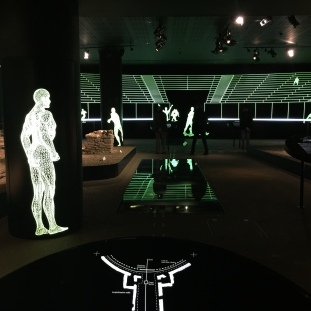
The east gate and adjoining walls are on display, with a stunning backdrop of fluorescent green to represent the seating tiers and human figures suggested by geometrical surfaces – very modern but it works well!

IMG_1137

The first amphitheatre was constructed in AD 74 and built of wood.  It was about the size of Wembley Stadium and seated nearly 7,000 spectators, it is calculated.  Around AD 120 and the visit of that Imperial Improver Hadrian, the amphitheatre was expanded with ragstone walls 2.5m high around the arena and additional seating up to accommodate, it is suggested, some 10,500 spectators.  That’s two Royal Albert Halls!

The walls on the arena were covered in pink plaster and costly imported marbles have been found, no doubt for the VIP boxes.  A large quantity of Samian ware was also found, some of it official souvenirs with gladiators fighting, and other fine dining ware.  Apparently, those putting on the games could dine with the gladiators – a grisly Roman twist on the corporate box at Wembley!

IMG_1154

Magnificent jointed woodwork of drains and entrances has survived in the wet conditions, shedding light on Roman woodworking techniques.  Many coins, hair pins and even a gold necklace were found, so clearly women were in the audiences.

The amphitheatre fell into disuse in the second half of the fourth century.

We can but speculate on the scenes it saw of gladiator fights and exotic animal ‘hunts’, of executions and martyrdoms.

There is an excellent guidebook in the bookshop which sets out the context of the amphitheatre within Roman London, Roman Britain and other amphitheatres in the Empire.

This site is a tough one to rate since there is actually not that much preserved, although what there is is interesting, especially the wooden drain.  The display is excellent.

IMG_1142