The Legionary Amphitheatre at Caerleon

IMG_1711

Overall         3 *** important site, impressive scale and great setting

Display         2 ** site remains excellently consolidated, little information on site

Access           3 *** you can park in adjacent rugby club car park unless a match is on

Atmosphere 2 ** great impression, but far too pleasant for its original purpose!

Other             3 *** best amphitheatre in Britannia!

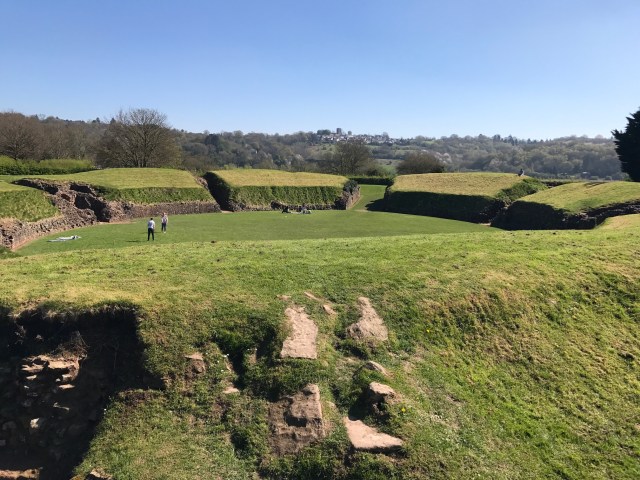
This is the only fully visible Legionary Amphitheatre in Britannia, and is another Mortimer Wheeler production, excavated in 1926-7.

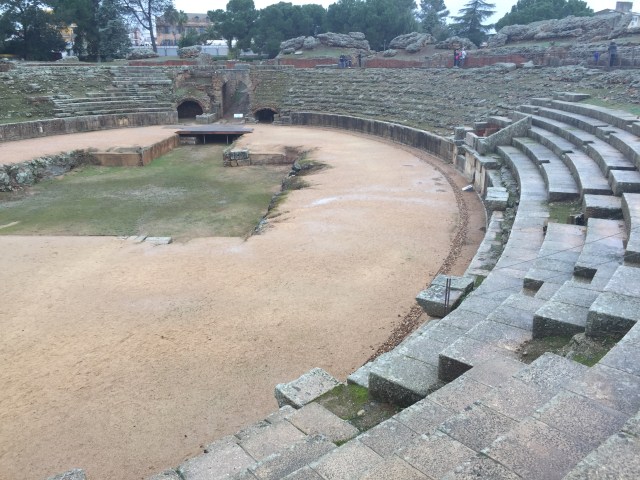
It was constructed in cAD90 outside the South-West Gate of the Fortress on the Via Principalis, now called Broadway  It is c80m by c65m in size and elliptical in shape.  Its surviving lower part was made of stone and earth, with an upper part constructed of timber, forming a grandstand with tiers of wooden seating.  It is calculated that it could hold the full 6,000-man complement of Legio II Augusta.

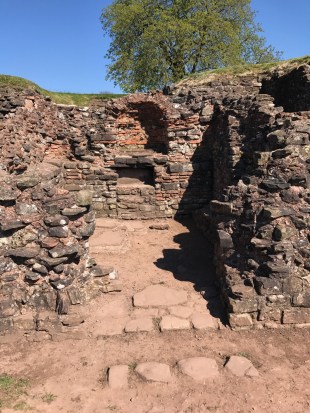
There are two processional entries facing each other on the long axis, and two other entrances with waiting rooms for gladiators, prisoners and beasts, facing each other on the short axis.  The legionary stonemasons included inscribed stones with the name of the centurion of the Century that had built that section, sometimes with the Capricorn badge of II Augusta.  The originals are now in the Legion Museum, but replicas have been put in place and can be spotted.

IMG_1713
Entrance to Arena from Waiting Room
IMG_1717
The Shrine to Nemesis

There is a niche on the East with a shrine to Nemesis, which was identified by a curse tablet found nearby.  This added in 212-22, dated by brick work dating to Caracalla when Leg II Augusta held the title of Antonina.

Together with the vast Baths Complex, the Amphitheatre gives you an insight into the daily world of a Roman Legionary – certainly, in the late 1st and 2nd Centuries, not a humble ‘grunt’ but an accomplished professional military engineer, probably literate, well-paid and forming the sinews that held the Empire together.  A grateful Emperor and Respublica would provide him with all the comforts that could be built – not just bread and circuses, but baths and regular donatives of cash on special occasions.  As Septimius Severus said to his sons on his deathbed, ‘Be harmonious, enrich the soldiers, scorn everybody else’.

Most Roman amphitheatres have a thoroughly miserable and acutely depressing atmosphere; you only have to think of what happened in them.  However, at Caerleon, where the grass is frequented by picnicking families and boys kicking footballs, it is actually quite cheerful.

Unlike the rest of Caerleon, on site the information provided is meagre, so you need Cadw’s well-illustrated guide to the Fortress.

IMG_1719
Copy of Centurial Stone of Century of Claudius Cupitus

Introduction to Merida, Emerita Augusta

IMG_2288-1

Overall          6 ****** a must-see Roman Colonia with ‘one of everything’

Display         5 ***** informative bilingual display boards all around the City

Access           3 *** in a well laid-out archaeological park – parking is difficult

Atmosphere 6 ****** remarkable assemblage of Roman remains

Other             4 **** Merida has Spain’s Roman Museum (closed on Mondays of course!)

The Roman Colonia of Emerita Augusta was founded in 25 BCE by P. Carisius, legate of Augustus, for veteran soldiers (emeriti) from the bloody wars against the Cantabri in the north of the Iberian Peninsular.  The soldiers originally came from Legio V Alaudae and Legio X Gemina, and later from VI Victrix and VII Gemina.

Emerita guarded the principal crossing of the River Guardiana (Fl. Ana in Latin) and became the capital of the Roman Province of Lusitania.  The territorium of the Colonia stretched out as far as 100kms from the City.

The original settlement was probably a rectangle like a military camp, possibly with the surviving Arch of Trajan marking one of its gates.  Later, in the 3rd Century, a much larger city wall was built enclosing the amphitheatre and theatre in the north-east, to protect the City against the rampaging Franks and Alamanni who had by then broken into the Empire.

IMG_2374

Emerita contains a remarkable assemblage of Roman remains including a bridge of 57 arches over the Guardiana which carried the Roman road from Asturica Augusta in the north to Italica in the south. (See our separate post about the bridge.)

IMG_2347-1

IMG_2361

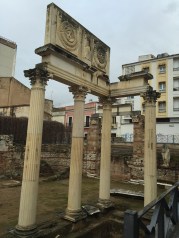
There are remains of the Forum and porticos, a Temple to Rome (wrongly called the Temple of Diana) adjacent to the Forum, and the remains of the Temple of Mars under the Church of Santa Eulalia in the west.

IMG_2315

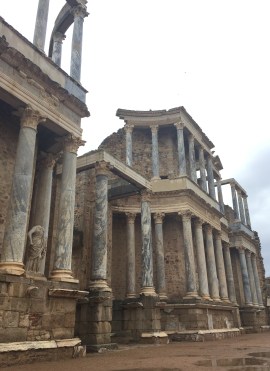
The most remarkable remains are the “entertainment quarter” in the north-east, containing arguably the best-preserved Theatre in the Roman World for refined entertainment, a large Amphitheatre for gladiatorial games, and a Circus for chariot racing.

Excavations at the Alcazabar (later Arab citadel) have revealed Roman streets and insulae inside a Roman wall, and remains of the Roman dyke that protected the river quality, an ancient forerunner of Bazalgette’s ‘interceptor sewer’ in London.

Emerita had a large population whose water consumption required advanced hydraulic systems fed by two large reservoirs, both of which are still in working order.  The Proserpina Reservoir could hold 8 million cubic metres of water.  Two aqueducts fed the town.

There is also a stunning Roman Archaeological Museum with the finds from Emerita, in a modern building made out of replica Roman brick. Sadly the museum was closed on our Monday visit to Merida (although we did see it years ago), so we will need to review it on a future occasion.

So why the very high score of 6 stars?  The Bridge, Amphitheatre and especially the Theatre are wonderfully preserved, they are well presented and there are enough other key Roman buildings preserved (temples, porticos and aquaducts) that it gives you a real feeling for what a major Roman Colonia was like.

Amphitheatre at Merida

IMG_2237

Overall          5 ***** well preserved large amphitheatre

Display         4 **** informative bilingual display boards

Access           3 *** well laid out archaeological park – parking difficult

Atmosphere 4 **** has the melancholy air of most Roman amphitheatres

Other             4 **** next door to Spain’s magificent Roman Museum

We don’t particularly like Amphitheatres, for the simple reason of what happened there and the brutal and bloody aspect of Roman ‘civilisation’ it forces you to confront.  (The feeling of ‘preserved misery’ in the passages under the Amphitheatre at El Djem in Tunisia was palpable for us.) However, you cannot escape them: no provincial capital worth the name could afford not to have its Amphitheatre and the one at Merida is magnificent.

It formed of a large ellipse some 126m by 103m.  Crowd control was  as usual excellent, with 16 entrances, each of which accessed a stairway connecting the 32 vomitoria (entrance/exits) that opened onto the cavea (seating) for as many as 15,000 spectators.  There was a grandstand for local VIPs.  Clearly, as with Directors’ Boxes at the Emirates or the Etihad Stadiums, being visible in the best seats mattered in the  City’s social pecking order.

Inscriptions give the probable date of construction as 8 BCE, when Emerita Augusta was still only 16 years old and was expanding fast.  The emeriti – retired legionaries after whom the City is named – would no doubt have wanted their fill of games both to show their status and civilisation, and also for entertainment as in their ‘good old days under the eagles’.

Construction, like the Theatre next door, is of concrete and ashlars.  There is a fossa bestiaria (large pit) in the arena floor which was used for release of wild animals and other unpleasant surprises for the gladiators and victims of the games.

The Amphitheatre, as with all sites in Merida, has informative bilingual displays.  The more blood-thirsty in your party can learn that there were many different types of gladiator for the Roman ‘games enthusiast’ in addition to the retarii (net men) and the murmillones (full armour specialists).

The Amphitheatre is only part of a large well-displayed archaeological park in the north-east of the old city of Merida, complete with a world class Roman Museum devoted to Roman Spain.  There are some pretty good tapas bars and a brew pub opposite.  A ticket gives entrance to this zone and four other Roman sites.

London’s Amphitheatre

Overall          2 **   Only foundations and drains survive

Display         5 *****  Brilliant trompe l’oeil display, v.g. guide book

Access           5 *****  Free and accessible in underneath Guildhall Art Gallery

Atmosphere 3 ***   You can get a real feeling for what it looked like

Other             4 **** A key discovery for Londonium as provincial capital

The amphitheatre of Londinium, the capital of the Province of Britannia, was discovered relatively recently in 1988, and opened amidst much gladiatorial hoopla in 2002.  The entrance is from the basement of the new Guildhall Art Museum into an underground gallery beneath the plaza in front of the Guildhall.

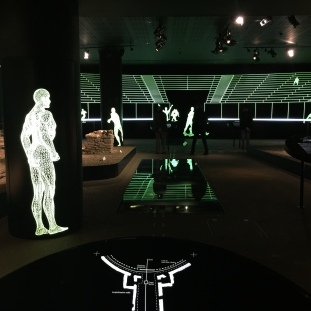
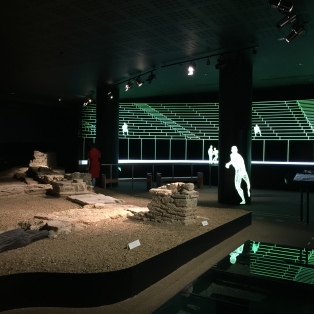
The east gate and adjoining walls are on display, with a stunning backdrop of fluorescent green to represent the seating tiers and human figures suggested by geometrical surfaces – very modern but it works well!

IMG_1137

The first amphitheatre was constructed in AD 74 and built of wood.  It was about the size of Wembley Stadium and seated nearly 7,000 spectators, it is calculated.  Around AD 120 and the visit of that Imperial Improver Hadrian, the amphitheatre was expanded with ragstone walls 2.5m high around the arena and additional seating up to accommodate, it is suggested, some 10,500 spectators.  That’s two Royal Albert Halls!

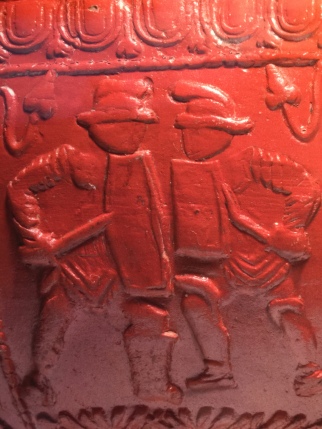
The walls on the arena were covered in pink plaster and costly imported marbles have been found, no doubt for the VIP boxes.  A large quantity of Samian ware was also found, some of it official souvenirs with gladiators fighting, and other fine dining ware.  Apparently, those putting on the games could dine with the gladiators – a grisly Roman twist on the corporate box at Wembley!

IMG_1154

Magnificent jointed woodwork of drains and entrances has survived in the wet conditions, shedding light on Roman woodworking techniques.  Many coins, hair pins and even a gold necklace were found, so clearly women were in the audiences.

The amphitheatre fell into disuse in the second half of the fourth century.

We can but speculate on the scenes it saw of gladiator fights and exotic animal ‘hunts’, of executions and martyrdoms.

There is an excellent guidebook in the bookshop which sets out the context of the amphitheatre within Roman London, Roman Britain and other amphitheatres in the Empire.

This site is a tough one to rate since there is actually not that much preserved, although what there is is interesting, especially the wooden drain.  The display is excellent.

IMG_1142