Prsyg Field Barracks, Caerleon

IMG_1732

Overall         2 ** interesting site, unique display of a legionary barrack block

Display         1 * one barrack block is original the other three are surface representations

Access           3 *** you can park in adjacent rugby club car park unless a match is on

Atmosphere 1 * the multiplicity of walls are confusing in the ‘real’ barrack block

Other             3 *** However all of this is part of the fabulous displays at Caerleon

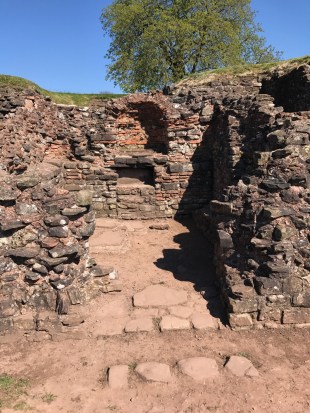
In the North West of the Fortress there is a block of four barracks on view.  These constitute two-thirds of the barracks of a single Cohort.  The first line of barracks are the actual stone buildings, and are below ground level.   The other three barracks are much higher at current ground level are are modern.

The original barracks from 75AD were wooden, but the Fortress was rebuilt in stone over the next few years.  There is controversy as to whether only the bottom parts of the barracks were stone with timber top halves, or completely of stone.

The II Augusta was composed of 10 cohorts, each of six centuries composed of 80 legionaries.  The centuries were twinned reflecting the old Republican maniple, and the barrack blocks faced each other.  There were 10 contuburnia each of 8 legionaries in each century.  Each contubernium had two rooms in the barracks, one at the back with bunks and cooking equipment, and a room at the front for storage of weapons, armour and shields.

The excavated remains show 12 pairs of rooms, which allows for some to be used as store-rooms or new recruits.  At the other end of the barrack-block are the Centurion’s quarters, which combine quite lavish accommodation with the offices of the Century.

In summary this is rather a disappointing site, given what we are looking at here.  Unlike the Roman Baths where the site is brought to life through finds, light effects and models, here we are presented with the confusing multi period jig-saw of walls which make it very hard to envisage what life was like for the legionaries who built this and lived here. The best place to feel this is perhaps the admittedly auxiliary reconstructed barracks at the Saalburg.
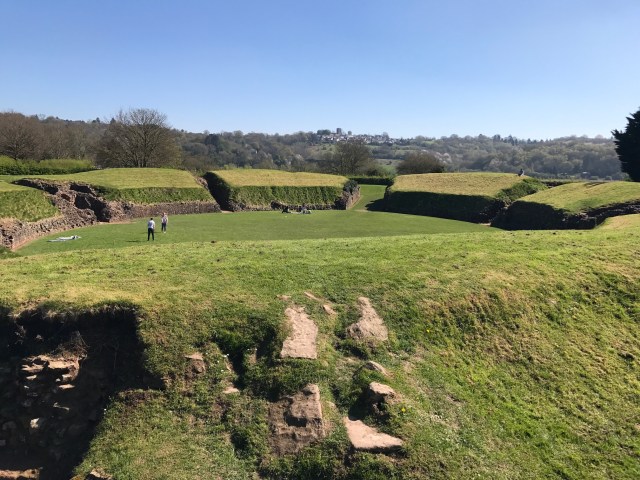
The Legionary Amphitheatre at Caerleon

IMG_1711

Overall         3 *** important site, impressive scale and great setting

Display         2 ** site remains excellently consolidated, little information on site

Access           3 *** you can park in adjacent rugby club car park unless a match is on

Atmosphere 2 ** great impression, but far too pleasant for its original purpose!

Other             3 *** best amphitheatre in Britannia!

This is the only fully visible Legionary Amphitheatre in Britannia, and is another Mortimer Wheeler production, excavated in 1926-7.

It was constructed in cAD90 outside the South-West Gate of the Fortress on the Via Principalis, now called Broadway  It is c80m by c65m in size and elliptical in shape.  Its surviving lower part was made of stone and earth, with an upper part constructed of timber, forming a grandstand with tiers of wooden seating.  It is calculated that it could hold the full 6,000-man complement of Legio II Augusta.

There are two processional entries facing each other on the long axis, and two other entrances with waiting rooms for gladiators, prisoners and beasts, facing each other on the short axis.  The legionary stonemasons included inscribed stones with the name of the centurion of the Century that had built that section, sometimes with the Capricorn badge of II Augusta.  The originals are now in the Legion Museum, but replicas have been put in place and can be spotted.

IMG_1713
Entrance to Arena from Waiting Room
IMG_1717
The Shrine to Nemesis

There is a niche on the East with a shrine to Nemesis, which was identified by a curse tablet found nearby.  This added in 212-22, dated by brick work dating to Caracalla when Leg II Augusta held the title of Antonina.

Together with the vast Baths Complex, the Amphitheatre gives you an insight into the daily world of a Roman Legionary – certainly, in the late 1st and 2nd Centuries, not a humble ‘grunt’ but an accomplished professional military engineer, probably literate, well-paid and forming the sinews that held the Empire together.  A grateful Emperor and Respublica would provide him with all the comforts that could be built – not just bread and circuses, but baths and regular donatives of cash on special occasions.  As Septimius Severus said to his sons on his deathbed, ‘Be harmonious, enrich the soldiers, scorn everybody else’.

Most Roman amphitheatres have a thoroughly miserable and acutely depressing atmosphere; you only have to think of what happened in them.  However, at Caerleon, where the grass is frequented by picnicking families and boys kicking footballs, it is actually quite cheerful.

Unlike the rest of Caerleon, on site the information provided is meagre, so you need Cadw’s well-illustrated guide to the Fortress.

IMG_1719
Copy of Centurial Stone of Century of Claudius Cupitus

Roman Legionary Baths Caerleon

IMG_1804
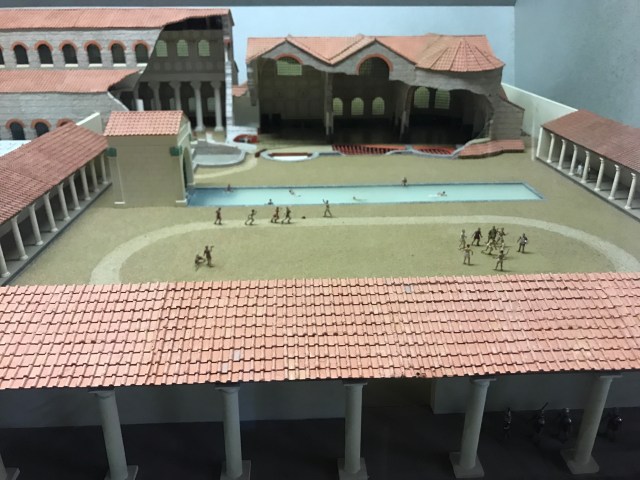
Model of the Complex in the Cadw Cover Building

Overall          4 ****  Exposed remains of part of the huge Legionary Baths

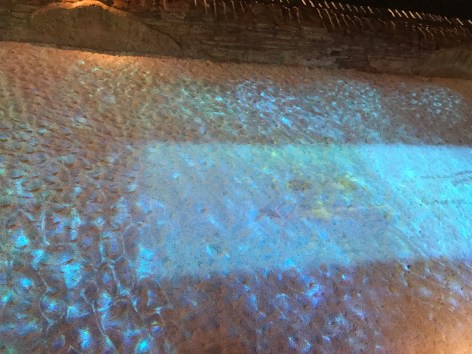
Display         5 *****  Excellent; the light effects recreate the water and bathers

Access           3 ***  Car park outside, shared with the pub!

Atmosphere 4 ****  Magical light effects bring the baths to life

Other            Part of the best assemblage of legionary remains in Britannia, with friendly                         Cadw staff and family activities during the holidays.

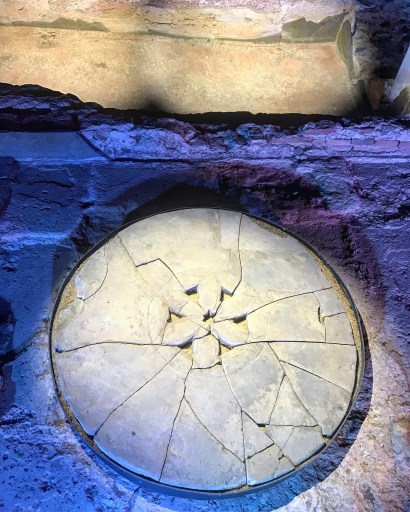
You can only see a small part of the internal Baths of the Fortress, built of stone after AD75 by Legio II Augusta.  We are lucky, however, in that the Swimming Pool (Natatio), part of the Cold Room (Frigidarium) and part of the Changing Room (Apodyterium) are exposed.  The enormous Exercise Hall (Basilica), Warm Room (Tepidarium) and Hot Room (Caldarium) are  not visible, so the vast scale of the entire baths complex can only be imagined.

The displays are clearly – and very reasonably – aimed at the school visits market, with interactive games and dressing up.  There are also several clear explanatory boards, however, with exhibits of finds and – our favourite item – an excellent cut-away model of the whole Baths complex, as originally completed.

IMG_1806

Best of all are the light effects on the plunge pool which make it look as if it is full of water and in use by ghostly Roman bathers.  The pool was originally 41m long, held 365,000 litres of water, and had a larger surface area than the Great Bath at Aquae Sulis (Bath).

One of the most interesting findings to emerge from the excavations of the Baths was proof of their use by women and children, presumably related to the garrison. The collection of carved gemstones (intaglio) from the baths drain is a highlight.

The Baths building was refurbished in 87-95AD, and in c130 the pool was shortened. During Septimius Severus’ campaigns in Scotland the stone slabs of the lining were removed, possibly presaging a planned evacuation, but it was then re-lined and and continued in use until 240, with final abandonment in 290-300!

IMG_1810

What our visit brought home to us was the sheer scale and luxury of this ‘Legionary Recreation Centre’ in the middle of what was still, at the time of construction, a war-zone.  The Baths would have towered over the rest of the Fortress and, with an overall length of 110m, are comparable in size to a medieval Cathedral, the Basilica being comparable to the nave and the cold, warm and hot rooms like the chancel. The contrast between the conditions experienced by the Legionaries in the Fortress and the defeated Silures outside cannot be exaggerated.

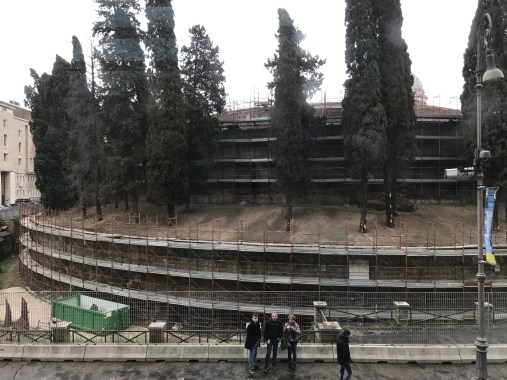
Mausoleum of Augustus

img_0655

Overall          2 ** it’s in terrible state – but gets the ranking because of what it is!

Display         0 nothing, what a shocker

Access           1 * you can’t go in but can get a view from the fascist square around it

Atmosphere 1 * gloomy neglect

Other             5 ***** Just think who it was for – one of the major figures of World History and it’s next door to the re-located but, magnificent Ara Pacis in it’s modern Museum.

The Mausoleum of Augustus was built by Augustus in 28BCE on the Campus Martius, close to the Tiber north of Rome.

Intriguingly it was one of the first – not the last – projects initiated by Augustus in Rome, just after assuming unchallenged power over the ‘Republic’, after his Victory at Actium in 31 BCE.  He lasted until 14AD.  Does this suggest an element of pessimism in his character or just careful planning?

Just imagine if Octavian as he then was had died in Egypt of disease in 30BCE, it seems highly likely that the Roman Republic would have continued to tear itself apart with Civil Wars and the apparent inevitability and stability of the Roman Empire created by Augustus and Agrippa might never have happened.  Thus the 5 stars in the ‘other’ category.  Just think what if…..

It was circular in plan and consists of concentric rings of brick.  It was planted with cypresses and probably capped with with a status of Augustus.  There were burial spaces in vaults inside and granite obelisks flanked the arched entry.

We know that Marcellus, Agrippa, Drusus, Octavia Minor, Gaius Caesar, Lucius Caesar were interred there before Augustus.  After him the ashes of Livia (his wife), Germanicus, Agrippina, Nero and Drusus sons of Germanicus, Caligula, Tiberius, Claudius, Britannicus and Nerva were interred there.

There is a story that in Alaric’s Sack of Rome in 410, that the ashes of the imperial family were scattered on the ground as the Goths made off with the urns.  However there appears to be no corroboration for this.  The Mausoleum was used as castle in the middle ages, became successively a bull ring and a theatre, until cleared by Mussolini with the newly reconstructed Ara Pacis alongside.  After the War it was allowed to fall into shame-fall neglect, although at last renovations seem to be underway, financed by a Telco.

At present the site is closed during reconstruction works.

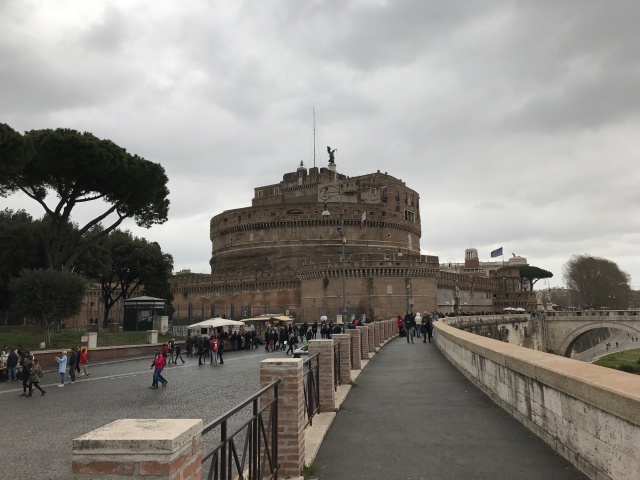
Hadrian’s Mausoleum, Rome

IMG_0574

Overall          4 **** bashed about but still huge and hugely impressive

Display         2 ** some bilingual display boards but bookshop shut!

Access           3 *** lots of stairs, crowds even in March

Atmosphere 2 ** there is not much of Hadrian’s work left above the circular ramp

Other             4 **** approached over Pons Aelius, surviving from 137 and it’s in Rome!

I have never been a fan of Hadrian and the more I read of him, the more I see him as the Emperor who put the Roman Imperial Project into reverse.  So Hadrian’s Wall is a Monument to the Roman Army’s failure to complete the Conquest of Britannia and a vast labour creation and energy displacement scheme for legionaries.  At least he didn’t give up Dacia as he gave up Mesopotamia.  I could go on…..

Augustus’ Mausoleum was full up by this time, and Hadrian never one for self effacement embarked on building his new larger edifice in 130, approached directly by a new Tiber Bridge the Pons Aelius (see another in Newcastle).   He probably knew that the Roman Senate who hated Hadrian for his Greek sophistry, beard and behaviours, would not support this after his death.

It is unclear exactly what the final Mausoleum looked like; reconstructions suggest a vast circular structure, topped by a hill with cypresses and perhaps a quadriga with the deified Hadrian ascending to the heavens on the top.

The Mausoleum has been knocked about since it was completed by Hadrian’s last minute adopted successor Antoninus Pius (pius because he completed it) in 139 just after the bearded one’s death.  It was incorporated in the Aurelian Walls in 271 as a redoubt, but that did not save it and Rome from being sacked by Alaric and his Visigoths in 410.  The ashes of Hadrian and succeeding Augusti are assumed to have been scattered at that time.  The statues around the top of the Mausoleum were used to drop on the heads of Ostrogothic besiegers in 537.

It acquired the title of Castel San Angelo after an appearance of the Archangel Michael to end the plague of 590.  Converted to military uses it became a Renaissance Fortress for the Popes – complete with an elevated escape corridor (the Passeto di Borgo) from the Vatican Palace used by Clement VII to escape Charles V’s mutinous soldiers in the Sack of 1527.

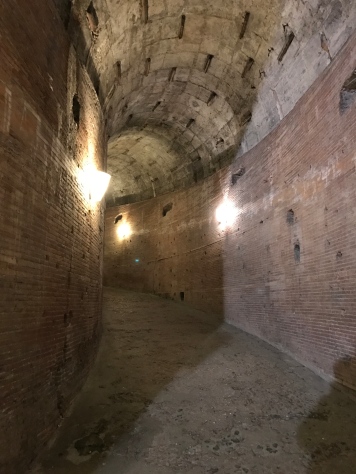
IMG_0586

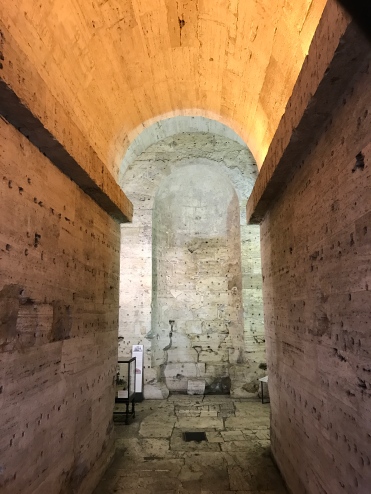
As a Roman site it is strangely dissatisfying – the lower levels with the entrance niche where a gigantic statue of Hadrian probably stood, and the curving and rising corridor through the masonry are evocative, even with the swarms of visitors.   The so-called Chamber of the Urns having been turned into a Renaissance draw-bridge is not.  From then on the Mausoleum becomes the Pope’s Palace Fortress.

IMG_0584

Theatre at Merida

IMG_2315

Overall          5 ***** beautifully preserved large theatre with scaena

Display         4 **** informative bilingual display boards

Access           3 *** well laid-out archaeological park – parking difficult

Atmosphere 5 ***** almost unique impression of what a Roman Theatre looked like

Other             4 **** next door to Spain’s magnificent Roman Museum and other sites

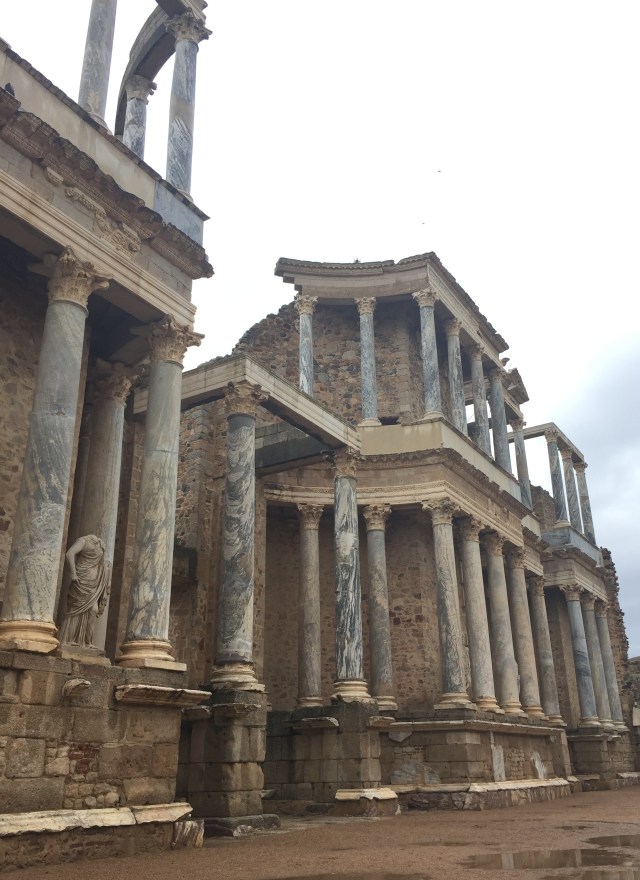
The Theatre at Emerita Augusta is without doubt the ‘star attraction’ of the city and is arguably the best preserved Theatre in the Roman Empire.

It is constructed of concrete and granite ashlars. Most of the cavea (seating) tiers are set back into the hillside, as is normal, and it has 13 entrances.  Its maximum diameter is 87m and it could seat 6,000 people.

The orchestra is a semi-circle paved with white and blue marble in front of the stage.  Around it are 3 tiers of seats separated from the rest by a marble parapet.  Three doors allow for the entrance of actors onto the stage.

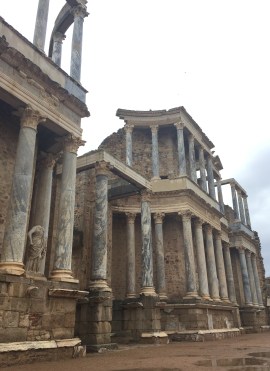
What really makes the Theatre at Emerita outstanding is the survival of the beautiful scaena (back scene), most of which is still in place including the statues and the columns of the tiered colonnades.  The statues are of Ceres, Pluto and Proserpina, with others interpreted as imperial portraits.

It is built according to the rules of Vitruvius and is, as a result, similar to other surviving theatres at Orange in Southern France and Dougga in Tunisia.

Inscriptions show that the Theatre was begun by the remarkable Marcus Agrippa, Augustus’s right-hand man, in 16 BCE when he was campaigning in Iberia. It was modified over the centuries of use: the current scaena was erected under Trajan, and under Constantine (330-40CE) new decorative elements were added.

IMG_2319

What was performed in a Roman Theatre?  There were comedies and tragedies, most being re-workings of  Greek subjects.  The Roman comedies that have survived are the work of Plautus and Terentius, who took Greek subjects, removed the role of the chorus and introduced musical accompaniment.   Action is set on a street with complications following from overhearing what the stock characters are saying to each other. When you watch Shakespeare’s ‘Two Gentlemen of Verona’, you get a pretty good impression of the kind of plays the citizens of Emerita would have enjoyed here. The most prominent tragedian was the Stoic philosopher Seneca, who also adapted Greek originals for a Latin audience.

For a Colonia, building a Theatre was a very visible statement of its Romanitas or ‘Roman-ness’, as well as a way for the urban elite to show off in the front rows. Theatres were maintained in major settlements throughout the Roman World – clearly, gladiators and games had their place in popular culture, but so did comedies and tragedies!

Introduction to Merida, Emerita Augusta

IMG_2288-1

Overall          6 ****** a must-see Roman Colonia with ‘one of everything’

Display         5 ***** informative bilingual display boards all around the City

Access           3 *** in a well laid-out archaeological park – parking is difficult

Atmosphere 6 ****** remarkable assemblage of Roman remains

Other             4 **** Merida has Spain’s Roman Museum (closed on Mondays of course!)

The Roman Colonia of Emerita Augusta was founded in 25 BCE by P. Carisius, legate of Augustus, for veteran soldiers (emeriti) from the bloody wars against the Cantabri in the north of the Iberian Peninsular.  The soldiers originally came from Legio V Alaudae and Legio X Gemina, and later from VI Victrix and VII Gemina.

Emerita guarded the principal crossing of the River Guardiana (Fl. Ana in Latin) and became the capital of the Roman Province of Lusitania.  The territorium of the Colonia stretched out as far as 100kms from the City.

The original settlement was probably a rectangle like a military camp, possibly with the surviving Arch of Trajan marking one of its gates.  Later, in the 3rd Century, a much larger city wall was built enclosing the amphitheatre and theatre in the north-east, to protect the City against the rampaging Franks and Alamanni who had by then broken into the Empire.

IMG_2374

Emerita contains a remarkable assemblage of Roman remains including a bridge of 57 arches over the Guardiana which carried the Roman road from Asturica Augusta in the north to Italica in the south. (See our separate post about the bridge.)

IMG_2347-1

IMG_2361

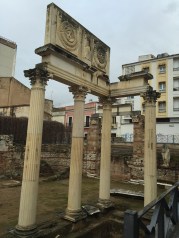
There are remains of the Forum and porticos, a Temple to Rome (wrongly called the Temple of Diana) adjacent to the Forum, and the remains of the Temple of Mars under the Church of Santa Eulalia in the west.

IMG_2315

The most remarkable remains are the “entertainment quarter” in the north-east, containing arguably the best-preserved Theatre in the Roman World for refined entertainment, a large Amphitheatre for gladiatorial games, and a Circus for chariot racing.

Excavations at the Alcazabar (later Arab citadel) have revealed Roman streets and insulae inside a Roman wall, and remains of the Roman dyke that protected the river quality, an ancient forerunner of Bazalgette’s ‘interceptor sewer’ in London.

Emerita had a large population whose water consumption required advanced hydraulic systems fed by two large reservoirs, both of which are still in working order.  The Proserpina Reservoir could hold 8 million cubic metres of water.  Two aqueducts fed the town.

There is also a stunning Roman Archaeological Museum with the finds from Emerita, in a modern building made out of replica Roman brick. Sadly the museum was closed on our Monday visit to Merida (although we did see it years ago), so we will need to review it on a future occasion.

So why the very high score of 6 stars?  The Bridge, Amphitheatre and especially the Theatre are wonderfully preserved, they are well presented and there are enough other key Roman buildings preserved (temples, porticos and aquaducts) that it gives you a real feeling for what a major Roman Colonia was like.

Amphitheatre at Merida

IMG_2237

Overall          5 ***** well preserved large amphitheatre

Display         4 **** informative bilingual display boards

Access           3 *** well laid out archaeological park – parking difficult

Atmosphere 4 **** has the melancholy air of most Roman amphitheatres

Other             4 **** next door to Spain’s magificent Roman Museum

We don’t particularly like Amphitheatres, for the simple reason of what happened there and the brutal and bloody aspect of Roman ‘civilisation’ it forces you to confront.  (The feeling of ‘preserved misery’ in the passages under the Amphitheatre at El Djem in Tunisia was palpable for us.) However, you cannot escape them: no provincial capital worth the name could afford not to have its Amphitheatre and the one at Merida is magnificent.

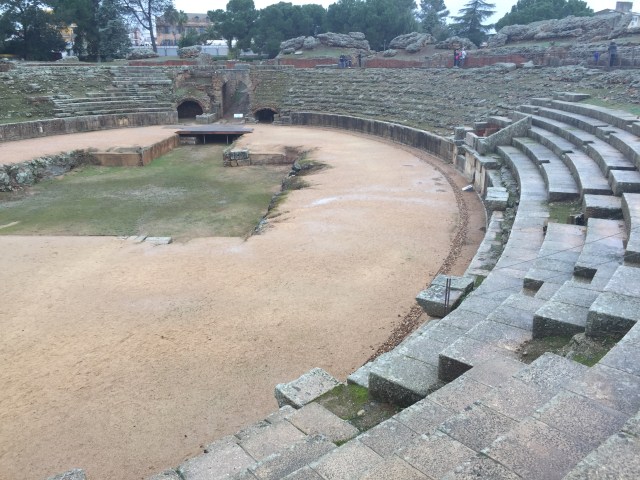
It formed of a large ellipse some 126m by 103m.  Crowd control was  as usual excellent, with 16 entrances, each of which accessed a stairway connecting the 32 vomitoria (entrance/exits) that opened onto the cavea (seating) for as many as 15,000 spectators.  There was a grandstand for local VIPs.  Clearly, as with Directors’ Boxes at the Emirates or the Etihad Stadiums, being visible in the best seats mattered in the  City’s social pecking order.

Inscriptions give the probable date of construction as 8 BCE, when Emerita Augusta was still only 16 years old and was expanding fast.  The emeriti – retired legionaries after whom the City is named – would no doubt have wanted their fill of games both to show their status and civilisation, and also for entertainment as in their ‘good old days under the eagles’.

Construction, like the Theatre next door, is of concrete and ashlars.  There is a fossa bestiaria (large pit) in the arena floor which was used for release of wild animals and other unpleasant surprises for the gladiators and victims of the games.

The Amphitheatre, as with all sites in Merida, has informative bilingual displays.  The more blood-thirsty in your party can learn that there were many different types of gladiator for the Roman ‘games enthusiast’ in addition to the retarii (net men) and the murmillones (full armour specialists).

The Amphitheatre is only part of a large well-displayed archaeological park in the north-east of the old city of Merida, complete with a world class Roman Museum devoted to Roman Spain.  There are some pretty good tapas bars and a brew pub opposite.  A ticket gives entrance to this zone and four other Roman sites.

Roman Bridge over the River Guardiana Merida

IMG_2390

Overall          4 **** remarkable survival through wars and floods

Display         5 ***** bilingual information with diagrams, some on Alcazaba above

Access           5 ***** a pedestrian bridge open at all times, parking on road nearby

Atmosphere 3 *** the view form the Moorish Alcazaba is superb

Other            4 **** a tribute to Roman engineering and construction

The Roman Road from Asturica to Italica crossed the River Guardiana (Latin Ana plus later Arabic Wadi = Wadi-ana).

In the river there is a central island that serves to break the force of the water in spate.  The original Roman bridges connected the City with the island and the island with the southern bank.  In the 17th Century the two bridges were connected with arches in the middle as well.

Today the bridge now has 57 arches of various periods and spans 792m making it the longest surviving bridge from Antiquity.  The best preserved Roman section is the one from the City to the island, identified by curved breakwaters up-stream.  Within the arches are spillways to reduce the resistance to flood-waters and no doubt a key reason this magnificent bridge is still here.  A remarkable survival!

Roman Legionary Fortress of II Augusta Exeter

IMG_1497

Overall          no stars  Very little to see – need to use your imagination

Display         1 *  Occasional tours of the sites are provided by tourist info

Access           1 *  Easy to walk round the streets but need to use your imagination

Atmosphere no stars  Hard to imagine what the fortress looked like

Other             no stars   If only the Lottery Bid to display the fine baths had come off!

In c55 CE the Roman invasion force established a Legionary Fortress for the Legio II Augusta.  It is usually thought that this legion had been active in conquering the South West Peninsula and the tribes of the Durotriges and Dumnonii, initially under the command of the future Emperor Vespasian.

The II Augusta presence in Exeter is confirmed by a dolphin antefix from the baths, dated to about 60CE, made from the same mould as an antefix from Caerleon.

IMG_1484

The fortress was 17ha (42 acres) in extent and the excavations that have taken place show it to have been a classic first Century playing card design with barracks, granaries and workshops built in timber.

The only stone building was a magnificent bath house, supplied by an aquaduct through the Porta Decumana.  The hot room (caldarium) and the warm room (tempidarium) have been excavated, and there was an exercise yard (palaestra) where a cockfighting pit has been found.  Alas the remains outside the West Door of the magnificent medieval Cathedral were covered over and a recent lottery bid to re-excavate and display them failed.

II Augusta remained at Isca Dumnoniarum for approximately 20 years, presumably pacifiying the Dumnonii, before departing for the Silurian front in South Wales, settling finally into another Isca (Caerleon).

IMG_1486IMG_1499


The above finds of a legionary dagger (pugio) and more carved antefixes from the bath roof are in the Exeter Museum RAMM.

The Legionary Fortress was connected to coastal shipping supply by subsidiary fort at Topsham on the River Exe Estuary.   There was a supply depot at St Loyes between Topsham and the Legionary Fortress.

In about 75CE, the Fortress appears to have been handed over to the civilian Civitas (self governing tribe) of the Dumnonii, in an apparently brilliantly successful example of turning hostile Celtic tribes into Romano-Britons – or at least transforming the tribal leadership.   A policy Tacitus set out clearly in his hagiographical biography of Britannia Governor Julius Agricola (77-85CE).  
In order, by a taste of pleasures, to reclaim the natives from that rude and unsettled state which prompted them to war, and reconcile them to quiet and tranquillity, he [Agricola] incited them, by private instigations and public encouragements, to erect temples, courts of justice, and dwelling-houses…..He was also attentive to provide a liberal education for the sons of their chieftains, preferring the natural genius of the Britons to the attainments of the Gauls; and his attempts were attended with such success, that they who lately disdained to make use of the Roman language, were now ambitious of becoming eloquent….At length they gradually deviated into a taste for those luxuries which stimulate to vice; porticos, and baths, and the elegancies of the table; and this, from their inexperience, they termed politeness, whilst, in reality, it constituted a part of their slavery.
Tacitus, Agricola 21
The stone built legionary baths were presumably too luxurious for the civilian Civitas and were demolished.