
Overall 4 **** Exposed remains of part of the huge Legionary Baths
Display 5 ***** Excellent; the light effects recreate the water and bathers
Access 3 *** Car park outside, shared with the pub!
Atmosphere 4 **** Magical light effects bring the baths to life
Other Part of the best assemblage of legionary remains in Britannia, with friendly Cadw staff and family activities during the holidays.
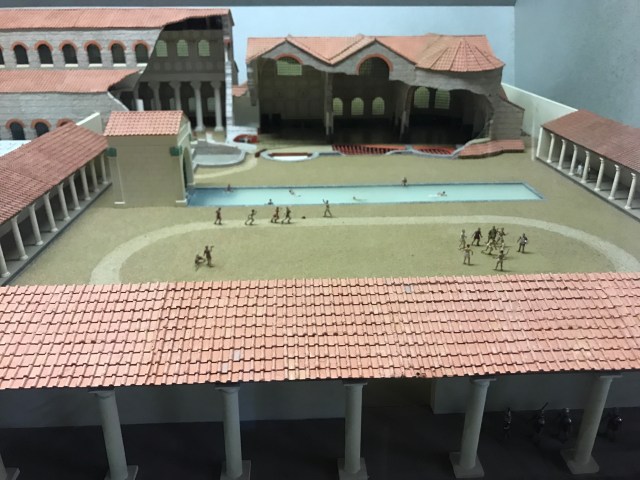
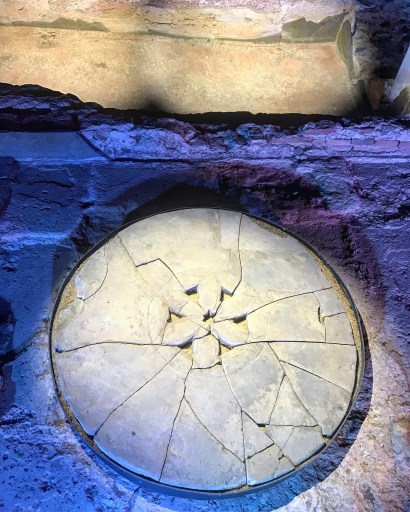
You can only see a small part of the internal Baths of the Fortress, built of stone after AD75 by Legio II Augusta. We are lucky, however, in that the Swimming Pool (Natatio), part of the Cold Room (Frigidarium) and part of the Changing Room (Apodyterium) are exposed. The enormous Exercise Hall (Basilica), Warm Room (Tepidarium) and Hot Room (Caldarium) are not visible, so the vast scale of the entire baths complex can only be imagined.
The displays are clearly – and very reasonably – aimed at the school visits market, with interactive games and dressing up. There are also several clear explanatory boards, however, with exhibits of finds and – our favourite item – an excellent cut-away model of the whole Baths complex, as originally completed.
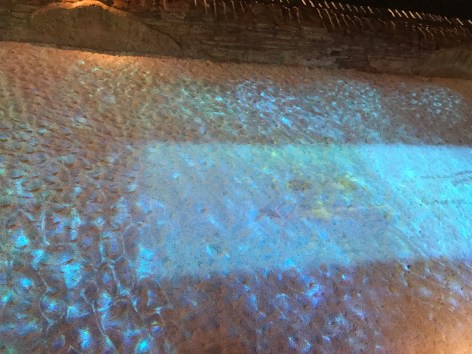
Best of all are the light effects on the plunge pool which make it look as if it is full of water and in use by ghostly Roman bathers. The pool was originally 41m long, held 365,000 litres of water, and had a larger surface area than the Great Bath at Aquae Sulis (Bath).
One of the most interesting findings to emerge from the excavations of the Baths was proof of their use by women and children, presumably related to the garrison. The collection of carved gemstones (intaglio) from the baths drain is a highlight.
The Baths building was refurbished in 87-95AD, and in c130 the pool was shortened. During Septimius Severus’ campaigns in Scotland the stone slabs of the lining were removed, possibly presaging a planned evacuation, but it was then re-lined and and continued in use until 240, with final abandonment in 290-300!
What our visit brought home to us was the sheer scale and luxury of this ‘Legionary Recreation Centre’ in the middle of what was still, at the time of construction, a war-zone. The Baths would have towered over the rest of the Fortress and, with an overall length of 110m, are comparable in size to a medieval Cathedral, the Basilica being comparable to the nave and the cold, warm and hot rooms like the chancel. The contrast between the conditions experienced by the Legionaries in the Fortress and the defeated Silures outside cannot be exaggerated.
 Roman Sites