
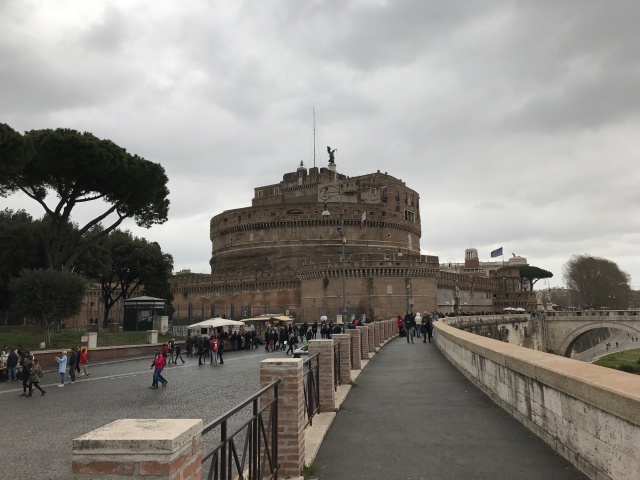
Overall 4 **** bashed about but still huge and hugely impressive
Display 2 ** some bilingual display boards but bookshop shut!
Access 3 *** lots of stairs, crowds even in March
Atmosphere 2 ** there is not much of Hadrian’s work left above the circular ramp
Other 4 **** approached over Pons Aelius, surviving from 137 and it’s in Rome!
I have never been a fan of Hadrian and the more I read of him, the more I see him as the Emperor who put the Roman Imperial Project into reverse. So Hadrian’s Wall is a Monument to the Roman Army’s failure to complete the Conquest of Britannia and a vast labour creation and energy displacement scheme for legionaries. At least he didn’t give up Dacia as he gave up Mesopotamia. I could go on…..
Augustus’ Mausoleum was full up by this time, and Hadrian never one for self effacement embarked on building his new larger edifice in 130, approached directly by a new Tiber Bridge the Pons Aelius (see another in Newcastle). He probably knew that the Roman Senate who hated Hadrian for his Greek sophistry, beard and behaviours, would not support this after his death.
It is unclear exactly what the final Mausoleum looked like; reconstructions suggest a vast circular structure, topped by a hill with cypresses and perhaps a quadriga with the deified Hadrian ascending to the heavens on the top.
The Mausoleum has been knocked about since it was completed by Hadrian’s last minute adopted successor Antoninus Pius (pius because he completed it) in 139 just after the bearded one’s death. It was incorporated in the Aurelian Walls in 271 as a redoubt, but that did not save it and Rome from being sacked by Alaric and his Visigoths in 410. The ashes of Hadrian and succeeding Augusti are assumed to have been scattered at that time. The statues around the top of the Mausoleum were used to drop on the heads of Ostrogothic besiegers in 537.
It acquired the title of Castel San Angelo after an appearance of the Archangel Michael to end the plague of 590. Converted to military uses it became a Renaissance Fortress for the Popes – complete with an elevated escape corridor (the Passeto di Borgo) from the Vatican Palace used by Clement VII to escape Charles V’s mutinous soldiers in the Sack of 1527.
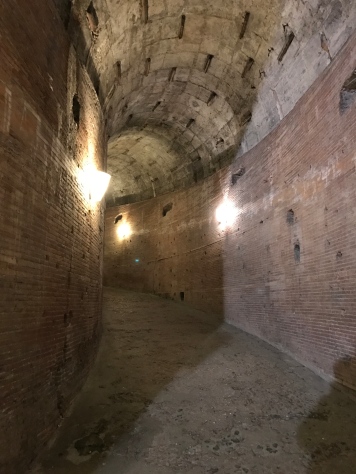
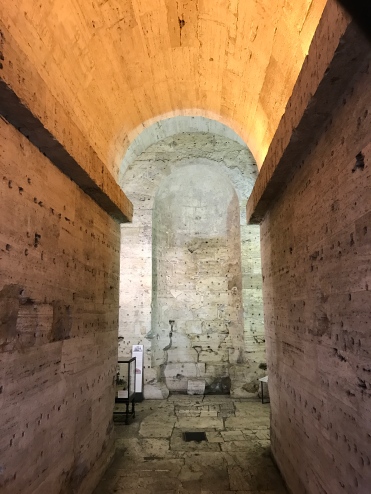
As a Roman site it is strangely dissatisfying – the lower levels with the entrance niche where a gigantic statue of Hadrian probably stood, and the curving and rising corridor through the masonry are evocative, even with the swarms of visitors. The so-called Chamber of the Urns having been turned into a Renaissance draw-bridge is not. From then on the Mausoleum becomes the Pope’s Palace Fortress.
 Roman Sites