
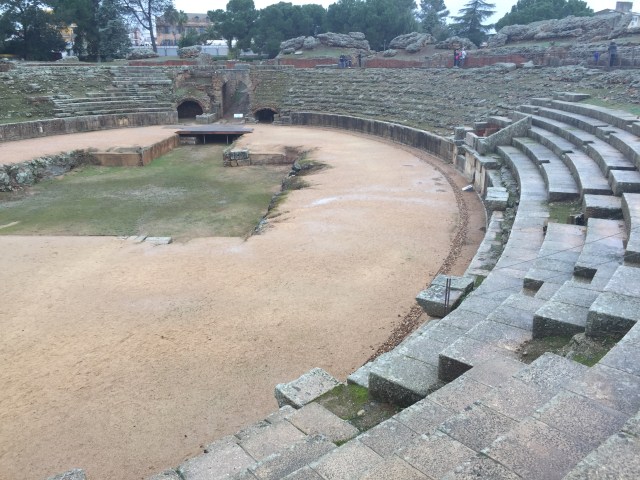
Overall 5 ***** well preserved large amphitheatre
Display 4 **** informative bilingual display boards
Access 3 *** well laid out archaeological park – parking difficult
Atmosphere 4 **** has the melancholy air of most Roman amphitheatres
Other 4 **** next door to Spain’s magificent Roman Museum
We don’t particularly like Amphitheatres, for the simple reason of what happened there and the brutal and bloody aspect of Roman ‘civilisation’ it forces you to confront. (The feeling of ‘preserved misery’ in the passages under the Amphitheatre at El Djem in Tunisia was palpable for us.) However, you cannot escape them: no provincial capital worth the name could afford not to have its Amphitheatre and the one at Merida is magnificent.
It formed of a large ellipse some 126m by 103m. Crowd control was as usual excellent, with 16 entrances, each of which accessed a stairway connecting the 32 vomitoria (entrance/exits) that opened onto the cavea (seating) for as many as 15,000 spectators. There was a grandstand for local VIPs. Clearly, as with Directors’ Boxes at the Emirates or the Etihad Stadiums, being visible in the best seats mattered in the City’s social pecking order.
Inscriptions give the probable date of construction as 8 BCE, when Emerita Augusta was still only 16 years old and was expanding fast. The emeriti – retired legionaries after whom the City is named – would no doubt have wanted their fill of games both to show their status and civilisation, and also for entertainment as in their ‘good old days under the eagles’.
Construction, like the Theatre next door, is of concrete and ashlars. There is a fossa bestiaria (large pit) in the arena floor which was used for release of wild animals and other unpleasant surprises for the gladiators and victims of the games.
The Amphitheatre, as with all sites in Merida, has informative bilingual displays. The more blood-thirsty in your party can learn that there were many different types of gladiator for the Roman ‘games enthusiast’ in addition to the retarii (net men) and the murmillones (full armour specialists).
The Amphitheatre is only part of a large well-displayed archaeological park in the north-east of the old city of Merida, complete with a world class Roman Museum devoted to Roman Spain. There are some pretty good tapas bars and a brew pub opposite. A ticket gives entrance to this zone and four other Roman sites.
 Roman Sites