

Overall 1 * the lower courses survive in some sections
Display 2 ** good wall walk published by Council covering all periods
Access 4 **** easy throughout the entire length on streets and parks
Atmosphere 2 ** you can get start to get a feel for the shape of the Isca Dumnoniorum
Isca Dumnoniorum inherited the site and presumably many of the buildings of the former Legionary Fortress of II Augusta, when the legion vacated the site in c75CE.
In Ptolemy’s Geographia of the 2nd Century Isca – which means ‘water’ in Celtic – is one of the four ‘cities’ of the Dumnonii, and is also the termination of one of the routes of the Antonine Itinerary.
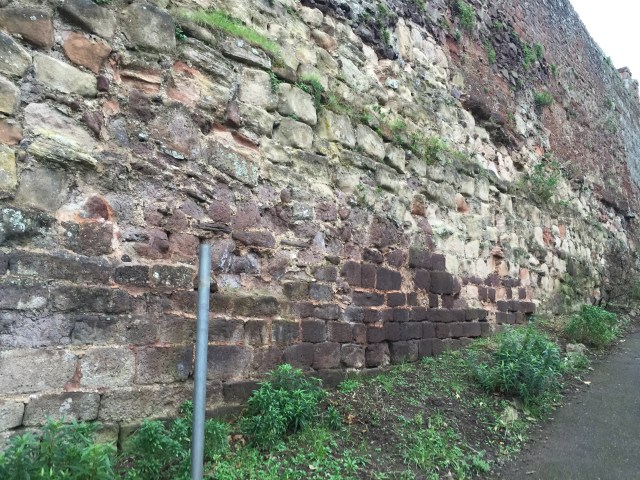
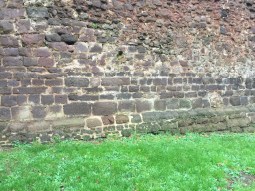
The Civitas capital of the Dumnonii was twice as large than the preceding Legionary Fortess of 17ha and was enclosed by a ditch and rampart enclosing 37ha (92 acres). In the late 2nd Century a stone wall was constructed. The circuit of stone defensive walls is on the Roman foundations but has successively been rebuilt and raised by Saxons, Normans, Plantagenets and in the Civil War. The layers of wall can be clearly seen in the Northenhay section above. The Roman layers are the squared grey volcanic ‘trap’ at the bottom. The Alfredian section is the white stone above. Further examples from the same sector are below.

Not much of Isca has been discovered in excavations and there is even less to see. There was a civilian bath house and there is evidence of copper and bronze working. A possible stock-yard has also been identified.
Many coins have been discovered from the early 4th Century but hardly any later than 380, suggesting that at least its role as a regional market centre ended several decades before the end of central Roman rule.
 Roman Sites