
Overall ***** 5 stars – original building and superb mosiacs
Display 3 – very good guide books available, little on site
Access 4 – open and accessible on UNESCO trail
Other Marks the re-imposition of Roman orthodoxy
San Vitale was begun in 526 under Ostrogothic rule, by the Orthodox (Roman) Bishop Ecclesius. It was finished under Bishop Maximian who was sent out from Constantinople after the reconquest by Belisarius. It was paid for by Julius Argentarius. Maximian is definitely depicted in the courtiers behind Justinian in the mosaic in the apse, as Julian may be.
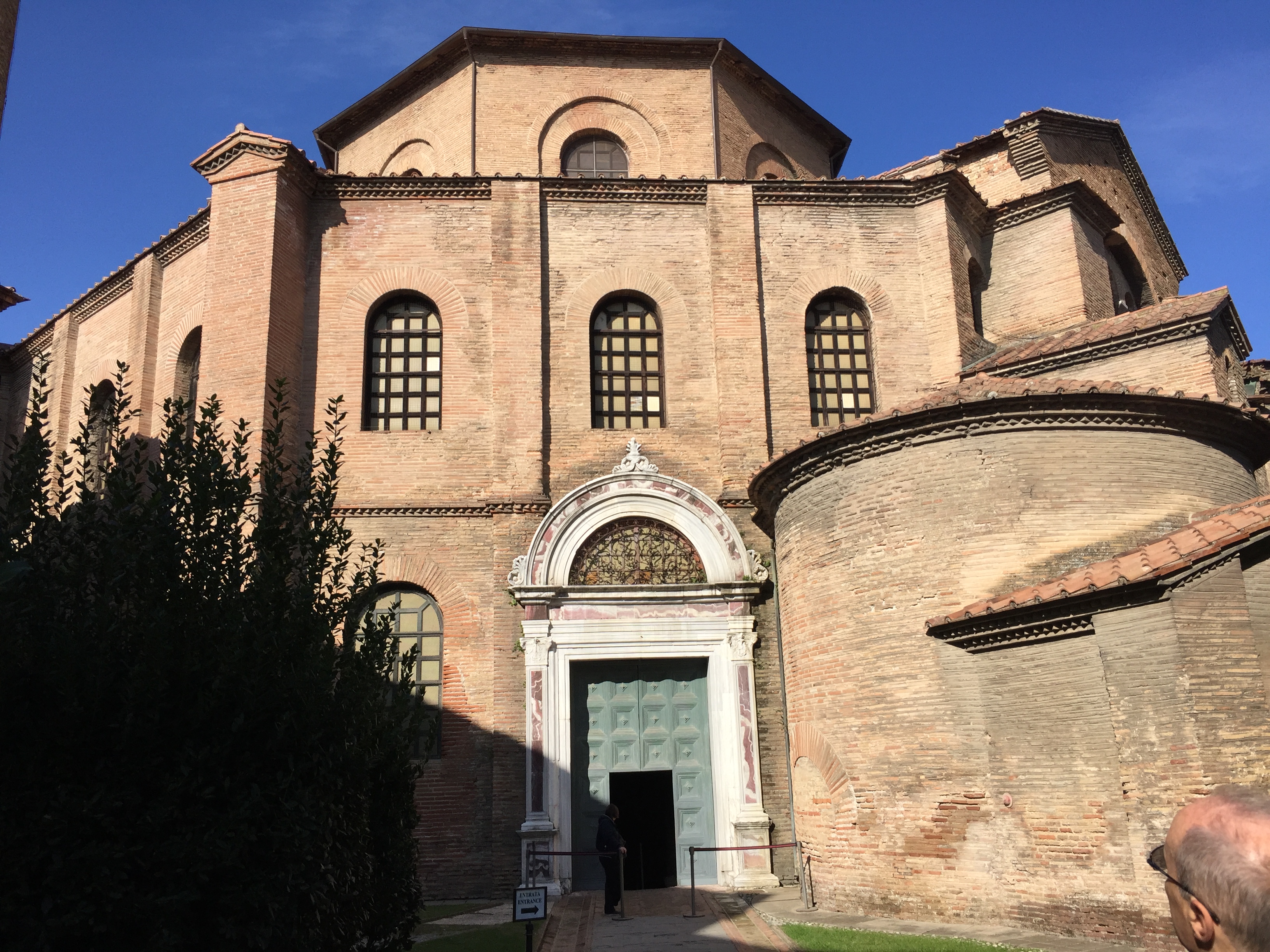
San Vitale is octagonal in plan, preceded by a narthex, flanked by two towers and appears to be heavily influenced by contemporary architecture in Constantinople, where Ecclesius had long resided. The apse is as usual semi-circular on the inside and polygonal on the outside. Above the main body of the Church is a polygonal lantern. It is supposedly is of the same design as the Imperial Audience Chamber in Constantinople. There are no parallels of this design in Italy.
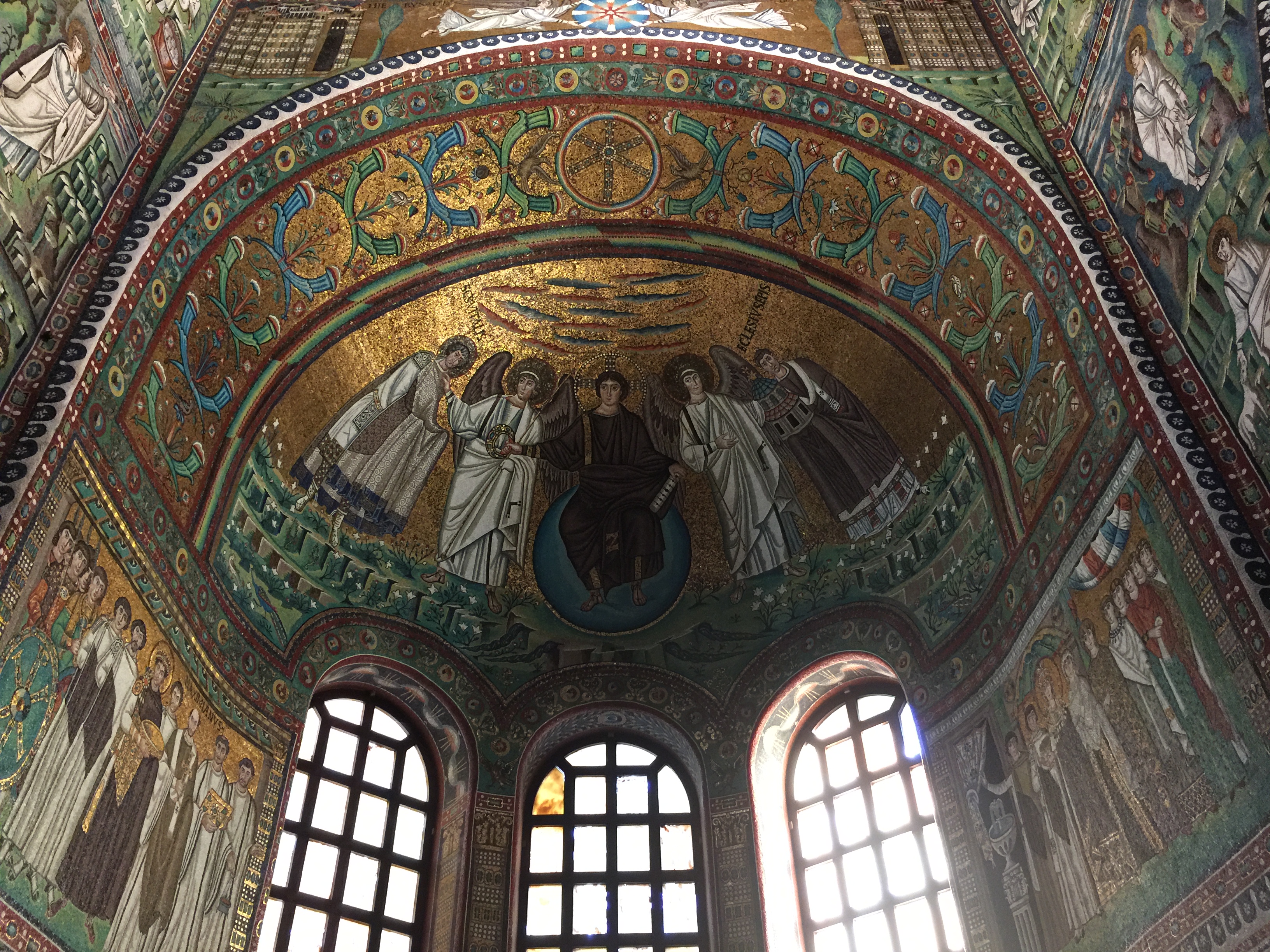
On entering S. Vitale on a sunny day you are struck by the varied play of light and dark, with shafts of sun-light slanting down and illuminating the columns, capitals and above all causing the mosaics to shine and sparkle.
The main glory of S. Vitale are the magnificent mosaics, which testify to the brilliance of the artists and craftsmen of 6th Century Ravenna. It is tempting to describe them but no words can do them justice, nor indeed photos or professional portraits. You just have to see them!
The Presbytery mosaics are all about the Sacrifice of the Eucharist. Thus the triumphal arch leading into the Presbytery is decorated with 15 busts of Christ, the Apostles and Ss. Gervais and Protassius, said to be the sons of S. Vitale. In the ceiling at the centre stands the Mystic Lamb supported by four praying angels. On the side walls next to figures of the evangelists, prophets and Moses are scenes of sacrifice from the Book of Genesis – the Hospitality of Abraham and the Sacrifice of Issac, and the Offered Sacrifces of Abel and Melchizedek.

In the Apse the figure of Christ sits on a blue globe flanked by two angels. The right hand angel offers the crown of martyrdom to S. Vitalis and the left hand offers a scroll to Bishop Ecclesius, the Church founder who carries a model of the Church itself. Interestingly Christ wears the Imperial purple and the angels traditional Roman dress.

Perhaps the most famous mosaics, are the panels facing each other on the side walls of the apse. On the right is the Emperor Justinian in purple with a golden halo, surrounded by court officials, Bishop Maximian is named and speculatively one of the men is Julius Argentarius the patron, and possibly on his right General Belisarius, who re-conquered Ravenna in 540. Palatine Guards with chi-rho symbol on their shields are also shown. Opposite is the Empress Theodora with her court ladies. In typical Byzantine fashion the Emperor and Empress are shown face on looking impassively forward. Showing the Imperial Family in the same way as saints, prophets and angels expresses the authority of both the Emperor and the Church and inextricably links them. This is something first seen in the now lost mosaics of St John the Evangelist.
 Roman Sites